CVE-2026-20182: Unauthenticated Cisco SD-WAN Control-Plane Compromise via vHub Authentication Bypass
Vulnerability Assessment and Penetration Testing (VAPT)
Executive Summary
CVE-2026-20182 is a critical authentication bypass vulnerability affecting Cisco Catalyst SD-WAN controllers. The vulnerability exists within the vdaemon service and is caused by missing verification logic inside vbond_proc_challenge_ack(), where peers identifying themselves as a vHub (device_type = 2) bypass certificate validation and trust verification before being marked as authenticated. Because CHALLENGE_ACK messages are intentionally processed before authentication is completed, the vulnerable code path is remotely reachable without valid credentials or trusted certificates.
A remote attacker can exploit the flaw by establishing a DTLS session using any certificate and sending a crafted CHALLENGE_ACK message claiming to be a vHub device, causing the controller to incorrectly set peer->authenticated = true. This allows unauthenticated systems to be accepted as trusted SD-WAN infrastructure components without cryptographic verification or device identity validation.
Understanding Cisco Catalyst SD-WAN
Cisco Catalyst SD-WAN is Cisco’s software-defined wide area networking (SD-WAN) platform that allows organizations to centrally manage connectivity between branch offices, data centers, cloud environments, and remote users.
Unlike traditional WAN architectures that rely heavily on manual router configuration and expensive MPLS circuits, Catalyst SD-WAN uses centralized software controllers to automate routing, security, and traffic management across the enterprise network.
The platform consists of several core components:
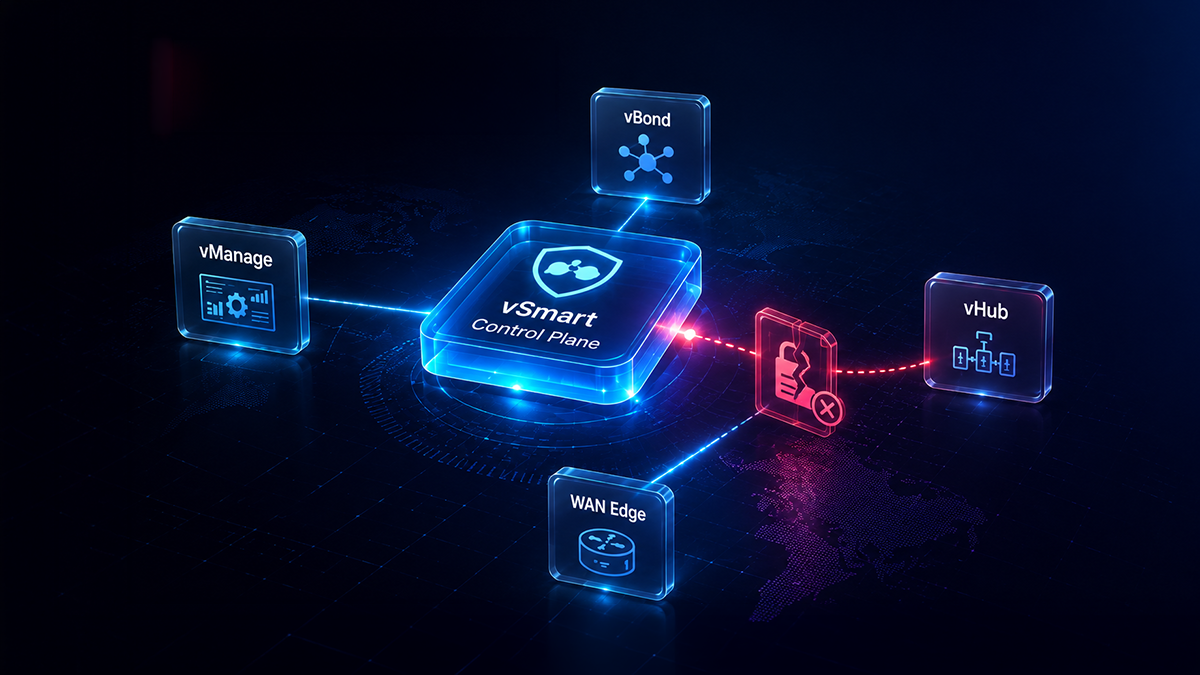
- vManage — Centralized management dashboard used to configure and monitor the SD-WAN fabric.
- vSmart — The control-plane controller responsible for routing intelligence and policy distribution.
- vBond — The orchestration service that authenticates and connects SD-WAN devices to the network.
- WAN Edge Routers — Physical or virtual routers deployed at branch locations and cloud environments.
Catalyst SD-WAN dynamically selects the best network path for applications based on real-time metrics such as latency, jitter, packet loss, and link quality. This enables enterprises to optimize performance for services like VoIP, Microsoft Teams, Zoom, and cloud applications.
Because the SD-WAN controllers manage routing policies, segmentation, trust relationships, and device onboarding, they effectively act as the “brain” of the enterprise network. As a result, vulnerabilities affecting these controllers — such as CVE-2026-20182 — are considered highly critical since successful exploitation could allow attackers to gain extensive control over enterprise-wide network operations.
The vdaemon Service
The Cisco SD-WAN authentication bypass vulnerability resides in the vdaemon service, a core component responsible for secure communication within the SD-WAN control plane. The service communicates using DTLS (Datagram Transport Layer Security) over UDP port 12346, which is used for controller-to-controller and device orchestration traffic.
Security researchers Jonah Burgess and Stephen Fewer from Rapid7 discovered CVE-2026-20182 and confirmed that the issue is not a bypass of a previously patched vulnerability. Instead, it is a completely separate flaw located in a similar area of the vdaemon networking stack.
SD-WAN DTLS Authentication Flow
The vulnerability exists within the SD-WAN DTLS authentication process used by vSmart and related controllers.
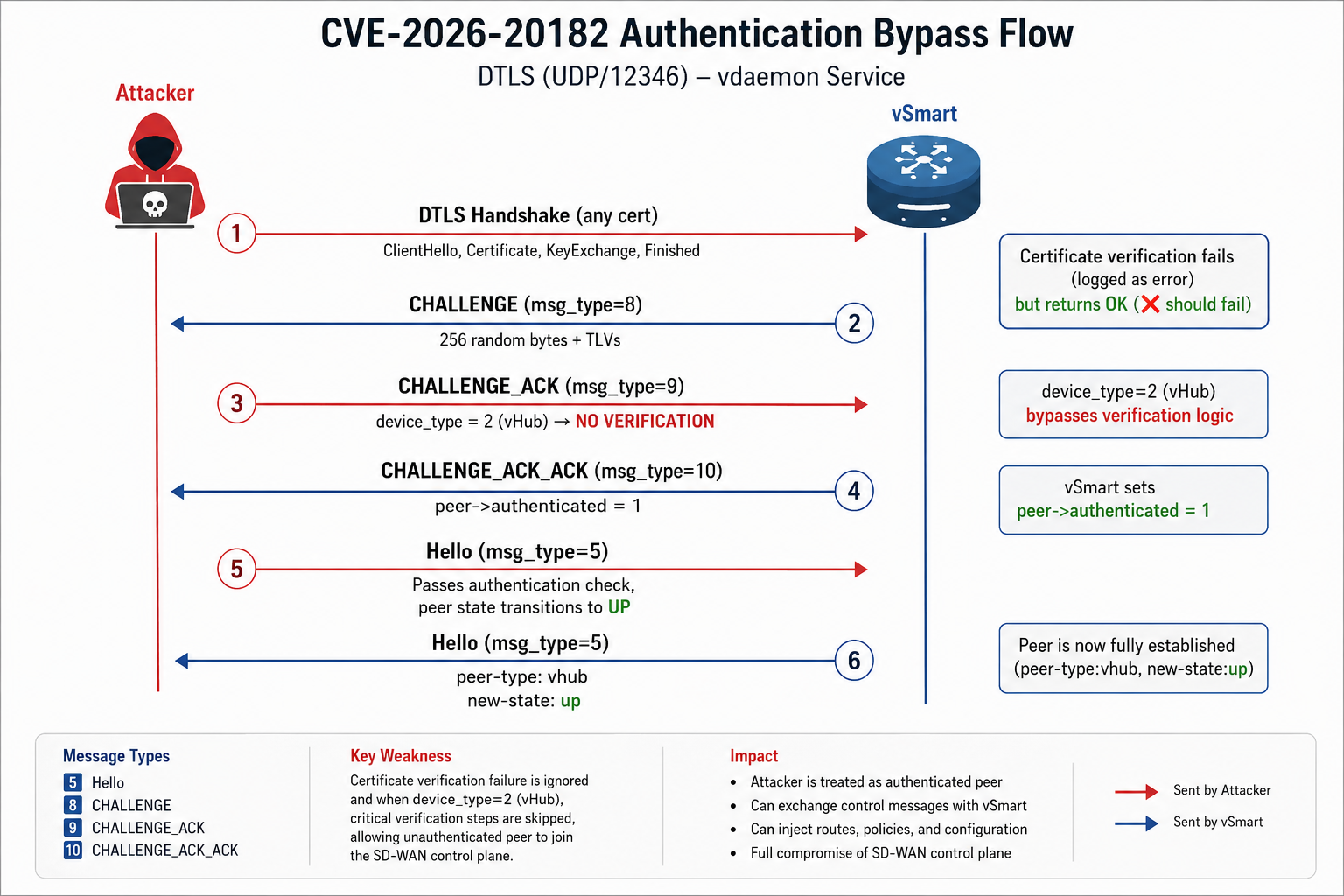
The authentication Steps
1. DTLS Handshake Initiation
The attacker initiates a DTLS connection to the Cisco vSmart controller on UDP/12346 using an arbitrary or invalid certificate.
2.CHALLENGE Response from vSmart
Even though certificate validation fails internally, the vdaemon service incorrectly continues the authentication process and sends a CHALLENGE message (msg_type=8) containing random challenge data.
3. Crafted CHALLENGE_ACK Response
The attacker replies with a CHALLENGE_ACK (msg_type=9) while setting:
device_type = 2which identifies the peer as a vHub device. This triggers a logic path that skips critical verification checks.
4. Authentication State Set
The controller sends CHALLENGE_ACK_ACK (msg_type=10) and internally marks the malicious peer as authenticated:
peer->authenticated = 1;5. Authenticated Hello Exchange
The attacker sends a Hello message (msg_type=5). Since the peer is now considered authenticated, the controller accepts the connection and transitions the peer state to:
new-state: up6. Rogue Peer Successfully Joins the SD-WAN Fabric
The attacker is now treated as a legitimate SD-WAN control-plane peer and can potentially exchange routing, orchestration, and policy messages with the vSmart controller.
What is CVE-2026-20182?
CVE-2026-20182 is a critical Cisco SD-WAN authentication bypass vulnerability with a CVSS score of 10.0. The flaw affects Cisco Catalyst SD-WAN Controller and exists within the vdaemon service responsible for SD-WAN control-plane authentication.
The vulnerability allows a remote unauthenticated attacker to bypass certificate and trust validation mechanisms during the DTLS authentication process and become a trusted SD-WAN control-plane peer.
Successful exploitation may allow attackers to obtain high-privileged access to affected SD-WAN controllers, exchange authenticated orchestration messages, manipulate network behavior, and maintain persistent access to the SD-WAN infrastructure.
Affected Products
CVE-2026-20182 affects both:
- Cisco Catalyst SD-WAN Controller
- Cisco Catalyst SD-WAN Manager
The vulnerability is present regardless of device configuration because the issue exists within the core vdaemon authentication logic used by the SD-WAN control plane.
According to Cisco, the vulnerability affects all major SD-WAN deployment models, including:
| Deployment Type | Affected |
| On-Prem Deployment | Yes |
| Cisco SD-WAN Cloud-Pro | Yes |
| Cisco SD-WAN Cloud (Cisco Managed) | Yes |
| Cisco SD-WAN for Government (FedRAMP) | Yes |
Because the vulnerability impacts the authentication mechanism itself rather than a specific optional feature or configuration, any exposed vulnerable SD-WAN controller may be susceptible to unauthenticated remote exploitation.
Root Cause Analysis
After the DTLS handshake completes — which incorrectly accepts arbitrary or untrusted client certificates — the Cisco vdaemon service sends a CHALLENGE message containing 256 random bytes along with several TLV structures, including Certificate Authority (CA) RSA public key components used during peer validation.
The client is then required to respond with a CHALLENGE_ACK message. The vulnerability exists during the processing of this packet inside the function:
vbond_proc_challenge_ack()This function performs device-type-specific certificate verification logic. However, when the connecting peer identifies itself as a vHub device (device_type = 2), the expected certificate validation path is skipped entirely, allowing unauthenticated peers to become trusted SD-WAN control-plane participants.
vdaemon Message Header Structure
The vdaemon protocol uses a fixed 12-byte message header format:
| Byte Offset | Byte Size | Field | Notes |
| 0 | 1 | msg_type | Low nibble = message type, high nibble = protocol version |
| 1 | 1 | device_info | High nibble = device_type, low nibble = flags |
| 2 | 1 | flags | Standard value: 0xA0 |
| 3 | 1 | padding | Always 0x00 |
| 4 - 7 | 4 | domain_id | Big-endian uint32 |
| 8 - 11 | 4 | site_id | Big-endian uint32 |
The critical field involved in exploitation is:
device_infoSpecifically, the upper nibble of this byte controls the peer device_type.
Supported Device Types
The vdaemon protocol defines multiple device roles encoded within the upper nibble of the device_info field:
| Value | Device Type | Role |
| 1 | vEdge | Data-plane router |
| 2 | vHub | Hub router |
| 3 | vSmart | Control-plane controller |
| 4 | vBond | Orchestrator / trust anchor |
| 5 | vManage | Management plane |
| 6 | ZTP | Zero-touch provisioning |
During exploitation, attackers specifically set:
device_type = 2This causes the vulnerable code path associated with vHub peers to bypass critical certificate verification checks.
As a result, the malicious peer successfully completes the challenge-response sequence and becomes authenticated within the SD-WAN control plane despite presenting an invalid certificate.
Below is a walkthrough of the decompiled code from vbond_proc_challenge_ack(), the function responsible for processing incoming CHALLENGE_ACK messages after the DTLS handshake completes.
Once the DTLS session is established, the function extracts the peer certificate serial number using OpenSSL routines such as:
X509_get_serialNumber()
ASN1_INTEGER_to_BN()
BN_bn2hex()
After extracting the certificate serial, the function enters a series of device-type-specific verification paths. The issue is that every major SD-WAN device type undergoes some form of certificate or identity validation except for vHub (device_type == 2), which completely bypasses all verification logic and is ultimately marked as authenticated.
if ( *(_DWORD *)(a3 + 8) == 3
|| *(_DWORD )(a3 + 8) == 5 ) // [1] {
v24 = is_serial_duplicate(
          v22,
          *(_DWORD *)(a3 + 8),
          ...
      );
if ( v24 )
{
    if ( (unsigned __int8)
         vbond_peer_dup_check(
             a1,
             a2,
             v24,
         ) ) // [2]
    {
        v19 = 36;

        goto LABEL_179; // Reject duplicate peer
    }
}
}
if ( *(_DWORD *)(a3 + 8) == 3 && *(_DWORD *)(a1 + 8) == 3
|| *(_DWORD *)(a3 + 8) == 5 && *(_DWORD *)(a1 + 8) == 3
|| *(_DWORD *)(a3 + 8) == 5 && *(_DWORD *)(a1 + 8) == 5
|| *(_DWORD *)(a3 + 8) == 5 && *(_DWORD *)(a1 + 8) == 4
|| *(_DWORD *)(a3 + 8) == 3 && *(_DWORD *)(a1 + 8) == 4 ) // [3] { v19 = vdaemon_dtls_verify_peer_cert(a2);
if ( v19 )
    v18 = 0;

vdaemon_send_challenge_ack_ack(
    a1,
    *(_QWORD *)(a2 + 1232),
    a2,
    v18
);

if ( v18 != 1 )
    goto LABEL_179;

vbond_send_ssh_keys_to_vmanage_peer(a1, a2);

} if ( *(_DWORD *)(a3 + 8) == 1 // [4]
&& ( dword_2A1A28 == 4
 || dword_2A1A28 == 3
|| dword_2A1A28 == 5 ) ) {
if ( vdaemon_verify_peer_bidcert(a2, ...) )
    goto LABEL_179;
}
return 0LL;
LABEL_179: return v19;
Code Explanation
This code is part of:
vdaemon!vbond_proc_challenge_ack()This processes CHALLENGE_ACK messages during SD-WAN authentication.
1. vSmart / vManage Verification
if ( device_type == 3 || device_type == 5 )This block only runs for:
- 3 = vSmart
- 5 = vManage
The function then checks whether the peer certificate serial already exists:
is_serial_duplicate()If another peer is already using the same certificate:
vbond_peer_dup_check()rejects the connection and jumps to:
LABEL_179This is the failure path.
2. Full Certificate Validation
vdaemon_dtls_verify_peer_cert(a2);This performs:
- certificate chain validation
- trusted CA verification
- SD-WAN trust checks
It only applies to specific controller relationships such as:
- vSmart ↔ vSmart
- vManage ↔ vSmart
- vManage ↔ vBond
If validation fails:
goto LABEL_179;This rejects the peer.
3. vEdge Hardware Validation
if ( device_type == 1 )vEdge devices go through:
vdaemon_verify_peer_bidcert()This validates:
- TPM/hardware certificates
- board IDs
- OTP identity
- challenge signatures
Failure again rejects the connection.
The Vulnerability
There is no verification block for:
device_type == 2This corresponds to:
vHubAs a result, vHub peers bypass:
- certificate validation
- duplicate checks
- hardware verification
The function simply skips all validation logic and continues execution.
The following table summarizes the authentication and verification logic applied to each SD-WAN device type during processing of the CHALLENGE_ACK message inside vbond_proc_challenge_ack():
| Device Type | Value | Verification Performed | Result |
| vEdge | 1 | Hardware/virtual edge certificate validation, TPM verification, challenge-response signature validation, board-ID checks, OTP validation | Verified before authentication |
| vHub | 2 | No verification performed | Falls through directly to peer->authenticated = 1 |
| vSmart | 3 | Certificate chain validation, serial lookup, duplicate-peer checks, DTLS peer certificate verification | Verified before authentication |
| vBond | 4 | Trust-anchor handling performed through separate logic paths | Verified elsewhere |
| vManage | 5 | Certificate chain validation, serial lookup, duplicate-peer checks, DTLS peer certificate verification | Verified before authentication |
The critical issue is the complete absence of a verification path for vHub (device_type == 2). Unlike every other major SD-WAN device role, vHub peers never undergo:
- certificate chain validation
- duplicate serial checks
- hardware identity verification
- trust-anchor enforcement
As a result, a peer identifying itself as a vHub bypasses every authentication check and eventually reaches:
peer->authenticated = 1;This unconditional authentication assignment is the root cause of the authentication bypass vulnerability in CVE-2026-20182.
Therefore, a remote unauthenticated attacker can bypass authentication by establishing a DTLS session to the vSmart controller using any self-signed or attacker-controlled certificate and then claiming to be a vHub (device_type = 2) inside the CHALLENGE_ACK message. No valid credentials, Cisco-issued certificates, or prior knowledge of the SD-WAN deployment are required.
To fully understand the exploitability of this issue, we must confirm that a CHALLENGE_ACK packet can actually reach the vulnerable:
vbond_proc_challenge_ack()handler before authentication has completed.
The answer lies in the pre-dispatch authentication gate implemented inside:
vdaemon!vbond_proc_msg()
if ( *(_BYTE *)(v100 + 70) != 1
 && *(_DWORD *)(a3 + 4) != 5
 && *(_DWORD *)(a3 + 4) != 8
 && *(_DWORD *)(a3 + 4) != 9
 && *(_DWORD *)(a3 + 4)
 && *(_DWORD *)(a3 + 4) != 10
 && *(_DWORD *)(a3 + 4) != 7
 && *(_DWORD *)(a3 + 4) != 11 )
{
    return 20;
}
This condition is effectively a pre-authentication allow list. A message is rejected only when:
- the peer is not authenticated, and
- the incoming message type is not explicitly allowed during the authentication phase
Critically, the following message types are permitted before authentication:
- CHALLENGE
- CHALLENGE_ACK
- NEW_CHALLENGE_ACK
- CHALLENGE_ACK_ACK
- Data
- TEAR_DOWN
Most importantly:
CHALLENGE_ACK = Message Type 9This message type is explicitly included in the allow list.
This means an unauthenticated attacker can directly send a CHALLENGE_ACK packet and reach the vulnerable:
vbond_proc_challenge_ack()without first establishing trust. This behavior is intentional because the authentication handshake itself must occur before the peer is considered authenticated.
Once the attacker abuses the missing vHub validation path and triggers:
peer->authenticated = true;The final step is transitioning the peer into the active control-plane state by sending a HELLO message (Message Type 5).
The HELLO handler performs a secondary authentication check:
if ( *(_BYTE *)(v100 + 70) != 1 )
{
    return 0LL;
}
This
verifies that:
peer->authenticated == truebefore allowing normal processing.
Because the exploit already set the authentication flag through the vHub bypass, the HELLO message now succeeds and the peer transitions into the UP state — effectively becoming a fully trusted SD-WAN control-plane peer.
Post-Authentication SSH Key Injection
After successfully exploiting the authentication bypass and transitioning the rogue peer into the UP state, the attacker gains access to authenticated SD-WAN control-plane message handlers. One particularly dangerous post-authentication primitive is persistent SSH key injection through:
MSG_VMANAGE_TO_PEER (Message Type 14)handled by:
vdaemon!vbond_proc_vmanage_to_peer()The decompiled code reveals that the handler directly appends attacker-controlled SSH public keys into the vmanage-admin account’s authorized_keys file:
// vdaemon!vbond_proc_vmanage_to_peer()

stream = fopen(
    "/home/vmanage-admin/.ssh/authorized_keys",
    "a+"
); // [1]
if ( stream )
{
    if ( (unsigned __int8)
         read_key_data(
             (const char *)(a3 + 32),
             stream
         ) != 1
         && *(_BYTE *)(a3 + 32) )
    {
        if ( dword_241120 > 6 )
        {
            syslog(
                191,
                "%s[%d]: %%%s-%d: sshkey not present, writing to file",
                "vbond_proc_vmanage_to_peer",
                2368LL,
                aVdaemonDbgMisc,
                7LL
            );
        }

        fputs(
            (const char *)(a3 + 32),
            stream
        ); // [2]
    }

    fclose(stream);
}
The file is opened using:
"a+"which places the file in append mode. This means attacker-controlled SSH keys are added alongside existing authorized keys rather than replacing them, allowing persistence without disrupting legitimate administrative access.
At [2], the attacker-controlled buffer is written directly into:
/home/vmanage-admin/.ssh/authorized_keysusing:
fputs()There is no sanitization, filtering, or validation beyond a basic duplicate check.
The injected key data is delivered inside a fixed 769-byte message structure:
| Offset | Size | Field |
| 0–767 | 768 bytes | Key buffer ("\n" + ssh_pubkey + "\n" + "\x00" + padding) |
| 768 | 1 byte | TLV count (0) |
The leading newline ensures the SSH key appends correctly even if the existing authorized_keys file does not terminate with a newline. The embedded null byte terminates the string for fputs(), while the remaining bytes are zero-padded to fill the fixed-size buffer.
Critically, this functionality is available to any authenticated SD-WAN peer regardless of device type. After exploiting the vHub authentication bypass, an attacker can abuse this message handler to inject arbitrary SSH public keys into the privileged:
vmanage-adminaccount on the target vSmart controller.
Because vmanage-admin is an internal high-privilege service account used for automated communication between:
- vManage
- vSmart
- vBond
This primitive transforms the authentication bypass from a transient control-plane compromise into persistent, credential-independent privileged access to the SD-WAN infrastructure.
Post-Exploitation Capabilities
Successful exploitation of the Cisco SD-WAN authentication bypass vulnerability allows an attacker to become a trusted SD-WAN control-plane peer and gain access to highly privileged internal functionality within the Cisco Catalyst SD-WAN environment.
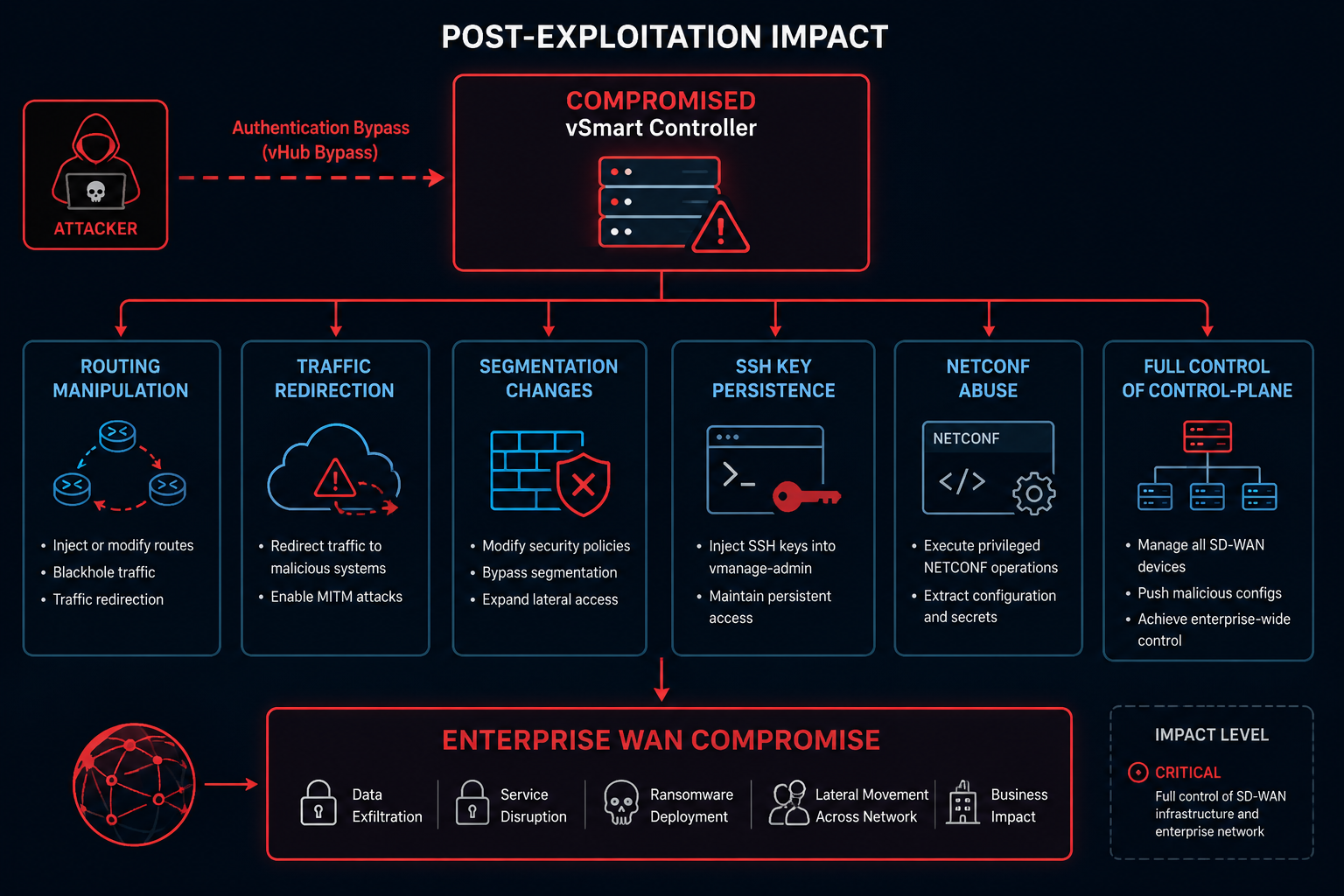
On the left side, the attacker initiates the compromise by abusing the vHub authentication bypass vulnerability. Through the crafted CHALLENGE_ACK message, the attacker bypasses SD-WAN trust validation and gains authenticated access to the vSmart controller.
At the center of the diagram, the compromised vSmart controller represents the primary control-plane target. Once authenticated as a trusted peer, the attacker gains privileged access to SD-WAN orchestration functionality and enterprise WAN management operations.
The compromise then expands into multiple post-exploitation capabilities across the SD-WAN infrastructure:
- Routing Manipulation — Attackers can modify route advertisements, alter path selection, and manipulate SD-WAN traffic flows.
- Traffic Redirection — Enterprise traffic may be redirected, intercepted, or rerouted through attacker-controlled infrastructure.
- Segmentation Changes — Security segmentation and policy boundaries can be modified or bypassed.
- SSH Key Persistence — Attackers can inject SSH public keys into the vmanage-admin account to maintain long-term privileged access.
- NETCONF Abuse — The attacker may interact with the NETCONF management interface to execute configuration changes and orchestration operations.
- Full Control-Plane Compromise — Because vSmart orchestrates routing and trust relationships across the SD-WAN fabric, compromise of the controller may impact the entire enterprise WAN environment.
The bottom section of the diagram highlights the broader enterprise impact, including:
- data exposure
- service disruption
- lateral movement
- malicious configuration deployment
- enterprise-wide WAN compromise
Overall, the diagram demonstrates how CVE-2026-20182 can escalate from a single authentication bypass into a full compromise of the Cisco SD-WAN control plane and associated enterprise infrastructure.
Metasploit Exploit Module
A new Metasploit auxiliary module has been developed for CVE-2026-20182, a critical authentication bypass vulnerability affecting Cisco Catalyst SD-WAN Controller.
Module Capabilities
The Metasploit module automates the full authentication bypass and post-authentication access workflow, including:
- Performing a DTLS handshake using a self-signed certificate
- Sending a crafted CHALLENGE_ACK packet as a vHub
- Bypassing SD-WAN authentication
- Transitioning the rogue peer into the UP state
- Injecting attacker-controlled SSH public keys into:
/home/vmanage-admin/.ssh/authorized_keys - Establishing persistent privileged access to the SD-WAN controller
- Providing access to the NETCONF management service on: TCP/830
Verification
The module was successfully tested against:
Cisco Catalyst SD-WAN Controller 20.12.6.1
Both vulnerability detection and exploitation completed successfully.
Vulnerability Check
msf auxiliary(admin/networking/cisco_sdwan_vhub_auth_bypass) > check
[+] 10.10.10.10:12346 - The target is vulnerable.
Authentication bypass succeeded - vHub CHALLENGE_ACK accepted without verification
Exploitation
msf auxiliary(admin/networking/cisco_sdwan_vhub_auth_bypass) > run

[*] Running module against 192.168.80.11
[*] Phase 1: DTLS handshake with self-signed certificate
[*] DTLS handshake succeeded (self-signed cert accepted)

[*] Phase 2: Waiting for CHALLENGE from server
[*] CHALLENGE received (580 bytes)

[*] Phase 3: Sending CHALLENGE_ACK as vHub
[*] Phase 4: Waiting for server response

[*] Phase 5: Sending Hello as authenticated peer
[+] Hello response received - authenticated as vHub peer

[*] Phase 6: Injecting SSH public key into vmanage-admin authorized_keys
[*] Generating RSA 2048-bit SSH keypair

[+] Authentication bypass and SSH key injection completed
Persistent NETCONF Access
After exploitation, the attacker can authenticate to the NETCONF management service using the injected SSH key:
ssh -i attacker_key.pem vmanage-admin@TARGET_IP -p 830Successful access returns a valid NETCONF session:
<?xml version="1.0" encoding="UTF-8"?>
<hello xmlns="urn:ietf:params:xml:ns:netconf:base:1.0">
  <capabilities>
    ...
  </capabilities>
  <session-id>16</session-id>
</hello>
This confirms successful authenticated access to the SD-WAN management plane through the injected vmanage-admin SSH credentials.
The exploit demonstrates that CVE-2026-20182 is not merely an authentication bypass, but a full control-plane compromise vulnerability capable of providing persistent privileged access to enterprise SD-WAN infrastructure.
Security Impact
Authentication Bypass
Remote attackers can bypass SD-WAN authentication without valid credentials or trusted Cisco-issued certificates.Unauthorized Control-Plane Access
Attackers can join the SD-WAN control plane as a trusted peer by abusing the vHub authentication path.Network Traffic Manipulation
Malicious actors may modify routing behavior, redirect traffic, or manipulate WAN orchestration policies across the SD-WAN fabric.Interception of Communications
Compromised controllers could allow attackers to monitor, intercept, or reroute sensitive enterprise traffic between branches, cloud environments, and data centers.Persistent SSH Access
Attackers can inject arbitrary SSH public keys into the privileged vmanage-admin account, enabling long-term credential-independent access.Large-Scale Service Disruption
Unauthorized configuration changes or orchestration abuse may cause network instability, segmentation failures, or enterprise-wide outages.Full SD-WAN Fabric Compromise
Because vSmart controllers orchestrate routing, trust relationships, and device onboarding, successful exploitation may result in compromise of the entire enterprise SD-WAN infrastructure.
Remediation
Cisco has released software updates that address CVE-2026-20182 across affected Cisco Catalyst SD-WAN deployments. According to Cisco, there are currently no available workarounds or configuration-based mitigations that fully prevent exploitation of this vulnerability. Because the issue exists in the SD-WAN authentication logic itself, upgrading to a fixed software release is the only effective remediation.
Organizations operating exposed:
- vSmart
- vBond
- vManage
controllers should prioritize emergency patching due to the vulnerability’s:
- remote reachability
- unauthenticated attack surface
- control-plane impact
- active exploitation status
The following table summarizes the first fixed software releases provided by Cisco.
Fixed Software Releases
| Cisco Catalyst SD-WAN Release | First Fixed Release |
| Earlier than 20.9 | Migrate to a supported fixed release |
| 20.9 | 20.9.9.1 |
| 20.10 | 20.12.7.1 |
| 20.11* | 20.12.7.1 |
| 20.12 | 20.12.5.4 / 20.12.6.2 / 20.12.7.1 |
| 20.13* | 20.15.5.2 |
| 20.14* | 20.15.5.2 |
| 20.15 | 20.15.4.4 / 20.15.5.2 |
| 20.16* | 20.18.2.2 |
| 20.18 | 20.18.2.2 |
| 26.1.1 | 26.1.1.1 |
Releases marked with * should be migrated to a newer supported train as recommended by Cisco.
Recommended Incident Response Actions
Because successful exploitation results in authenticated SD-WAN control-plane access, defenders should assume that vulnerable internet-exposed systems may already be compromised.
1. Upgrade Immediately
Patch all externally reachable:
- vSmart
- vBond
- vManage
controllers to fixed releases as soon as operationally possible.
2. Review DTLS and Authentication Logs
Inspect SD-WAN logs for:
- unexpected DTLS connections
- unknown peer identifiers
- suspicious CHALLENGE_ACK activity
- abnormal peer state transitions
Particular attention should be paid to peers unexpectedly transitioning to:
state = UP
without legitimate onboarding activity.
3. Audit Authorized SSH Keys
Because attackers can inject SSH keys post-authentication, administrators should inspect:
/home/vmanage-admin/.ssh/authorized_keysfor:
- unknown public keys
- recently appended entries
- suspicious automation artifacts
Unauthorized keys may indicate successful compromise and persistence.
4. Investigate Control-Plane Peers
Review:
- active SD-WAN peers
- peer serial numbers
- controller relationships
- unexpected vHub peers
for anomalies that may indicate rogue control-plane enrollment.
5. Rotate Credentials and Trust Material
If compromise is suspected:
- rotate SSH keys
- regenerate certificates
- rotate API credentials
- re-establish SD-WAN trust relationships
particularly for:
- vmanage-admin
- internal automation accounts
- controller-to-controller trust chains
6. Preserve Forensic Evidence
Before patching compromised systems, organizations should collect:
- controller logs
- DTLS session data
- memory captures
- SD-WAN configuration snapshots
- SSH authorized_keys history
This supports incident response and root-cause analysis.
Conclusion
CVE-2026-20182 is a high-impact authentication bypass vulnerability affecting Cisco Catalyst SD-WAN. By identifying as a vHub during the CHALLENGE_ACK phase, an unauthenticated attacker can bypass certificate validation and become a trusted SD-WAN control-plane peer. Once authenticated, attackers may exchange privileged orchestration messages, manipulate SD-WAN behavior, and gain persistent access through SSH key injection into internal service accounts. Because Cisco SD-WAN controllers manage routing, segmentation, and trust relationships across enterprise WAN environments, successful exploitation may result in full compromise of the SD-WAN control plane. Organizations operating exposed Cisco SD-WAN deployments should immediately upgrade affected systems and treat vulnerable internet-exposed controllers as potentially compromised until proven otherwise.