When AI Becomes the Attacker: Understanding Autonomous Offensive Security Agents
Vulnerability Assessment and Penetration Testing (VAPT)
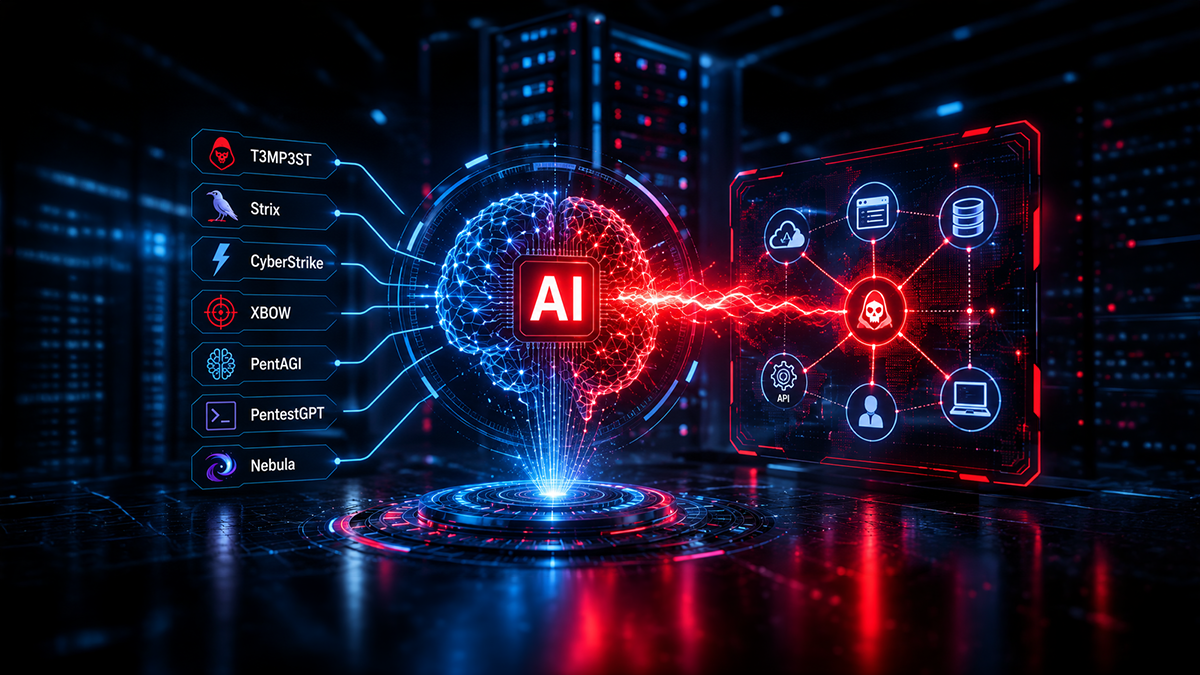
Resecurity analyzed how autonomous offensive security agents such as T3MP3ST, Strix, CyberStrike, XBOW, PentAGI, PentestGPT, and Nebula lower the barriers to vulnerability identification and exploitation. The analysis also explores why AI is being repurposed for real attacks and what defenders should do in response. From a broader perspective, cybercriminals and foreign adversaries are expected to leverage AI to maximize the impact of cyberattacks, while also optimizing and scaling malicious activity —creating a race between AI-driven attackers and defenders.
Executive Summary
Artificial intelligence is rapidly transforming offensive security from isolated automation into autonomous, multi-agent systems capable of mapping attack surfaces, identifying vulnerabilities, validating exploits, and producing technical reports with minimal human intervention. Originally developed for authorized penetration testing and vulnerability research, platforms such as T3MP3ST, Strix, CyberStrike, XBOW, PentAGI, PentestGPT, PentesterFlow, Nebula, Ethiack, and specialized security LLMs like CyberStrike-OffSec-35B, alongside commercial solutions including NodeZero, Pentera, RidgeBot, and Hadrian, are redefining how security assessments are performed while also introducing new dual-use risks.
This article examines the capabilities, architectures, and abuse potential of modern AI offensive security platforms, highlighting how autonomous agents are reshaping both legitimate penetration testing and real-world cyber threats. Through case studies including FortiBleed, JadePuffer, and GTG-2002, it demonstrates that AI-assisted cyber operations are no longer theoretical. While AI dramatically improves the speed, scale, and efficiency of offensive security, human expertise remains essential for creative exploitation, business logic analysis, and strategic decision-making. As autonomous AI continues to evolve, organizations should adopt a hybrid security model that combines AI-powered assessment with human oversight, continuous exposure validation, and strong defensive controls to prepare for increasingly automated cyber threats.
What Can Modern AI Offensive Agents Do?
Modern AI offensive agents can operate across multiple layers of enterprise infrastructure, enabling comprehensive security assessments through autonomous planning and tool orchestration. Common capabilities include:
- Web application testing — Analyze application logic, authentication flows, and common web vulnerabilities.
- API security assessment — Evaluate REST, GraphQL, and gRPC APIs for authentication, authorization, and input validation issues.
- Cloud security analysis — Review cloud configurations, IAM permissions, storage services, and exposed resources.
- Enterprise network assessment — Map internal networks, Active Directory environments, and privilege relationships.
- Container and Kubernetes security — Assess clusters, workloads, RBAC policies, and container configurations.
- Source code and dependency analysis — Identify security flaws, exposed secrets, and vulnerable software components.
- CI/CD and software supply chain review — Evaluate build pipelines, deployment workflows, and artifact security.
- Identity and access management validation — Assess authentication mechanisms, session management, and access controls.
- Browser automation — Execute authenticated workflows and analyze complex web application behavior.
- Security tool orchestration — Coordinate established tools such as Nmap, Nuclei, Burp Suite, SQLMap, and Semgrep through autonomous workflows.
- Continuous reasoning and adaptation — Maintain context across long-running engagements, adjust strategies, and generate evidence-based reports.
How AI Offensive Agents Work
Unlike traditional security automation, which executes predefined scripts, AI offensive agents operate as autonomous decision-making systems. They combine large language models, persistent memory, and specialized security tools to continuously plan, execute, evaluate, and adapt their actions throughout an assessment. Rather than following a fixed sequence of commands, they dynamically adjust their strategy based on the results of previous actions, allowing them to perform complex, multi-stage security assessments with minimal human intervention.
The typical workflow consists of the following stages:
- Goal Definition – The operator provides a high-level objective, such as assessing a web application or validating an organization's attack surface.
- Planning – The AI decomposes the objective into smaller tasks and determines the most efficient assessment strategy.
- Tool Selection – Based on the current objective, the agent selects the appropriate security tools, APIs, browsers, or terminal commands required for each task.
- Execution – The selected tools are invoked to collect information, validate findings, and gather evidence from the target environment.
- Observation – The agent analyzes the results of each action, extracting useful information while identifying failures, new attack paths, or additional opportunities for investigation.
- Memory and Context Management – All observations are stored in a shared memory layer, allowing subsequent tasks to build upon previous discoveries without losing context.
- Adaptive Reasoning – If an action fails or new information becomes available, the agent automatically revises its plan, selects alternative approaches, and continues the assessment.
- Reporting – Once the assessment is complete, the agent correlates the collected evidence into structured technical findings, risk ratings, and remediation recommendations.
Modern AI offensive platforms continuously repeat this Plan → Execute → Observe → Reason → Adapt cycle until the assessment objectives are achieved or predefined limits are reached. This feedback-driven architecture enables AI agents to perform long-running security assessments, coordinate multiple specialized tools, and maintain contextual awareness across every stage of an engagement.
The New Offensive AI Landscape
The offensive AI tooling stack has evolved from simple LLM chatbots that suggest payloads into autonomous attack cells: multi-agent swarms with specialist roles, shared memory, tool adapters, and the ability to operate for hours or days without human intervention.
The common architecture includes:
- A planning/coordination agent that breaks a high-level goal (e.g., “compromise this web app”) into sub-tasks.
- Specialist agents for reconnaissance, scanning, exploitation, lateral movement, exfiltration, and reporting.
- Tool adapters that invoke real security tools (nmap, nuclei, sqlmap, ffuf, semgrep, etc.) and parse their output.
- A memory/state layer (blackboard, vector store, or shared log) so agents do not lose context between steps.
- A feedback loop that lets the swarm retry, adapt, and self-heal when a step fails.
This is the same pattern used by modern defensive AI systems — but pointed outward at targets instead of inward at telemetry.
Why Are AI Agents Better Than Traditional Automation?
Traditional security automation has long been used to execute repetitive tasks such as port scanning, vulnerability enumeration, log analysis, and report generation. These workflows rely on predefined scripts and deterministic logic: each action is executed in a fixed sequence, regardless of whether the previous step succeeded or uncovered new opportunities.
Autonomous AI agents fundamentally change this model. Rather than following a static workflow, they continuously reason about their objectives, evaluate the outcome of every action, and adapt their strategy based on newly acquired information. This enables AI agents to perform complex, multi-stage security assessments with significantly less human intervention.
Several architectural differences distinguish autonomous agents from conventional automation:
| Traditional Automation | Autonomous AI Agents |
| Executes predefined scripts and workflows | Plans actions dynamically based on high-level objectives |
| Follows a fixed sequence of tasks | Continuously replans as new information becomes available |
| Stops or fails when unexpected conditions occur | Recovers from failures by selecting alternative approaches |
| Requires humans to choose tools and attack paths | Selects appropriate tools and techniques autonomously |
| Maintains little or no contextual memory | Preserves long-term context throughout the engagement |
| Individual tools operate independently | Coordinates multiple specialized agents through shared memory |
| Requires manual correlation of findings | Automatically correlates evidence across attack stages |
| Generates static reports after execution | Produces evidence-based reports continuously during the assessment |
Deep Dive: Leading AI Red-Team Tools
1. T3MP3ST — The 8-Agent Offensive Swarm
Repository: elder-plinius/T3MP3ST
License: GNU AGPL-3.0
Primary language: TypeScript
Architecture: ReAct-loop meta-harness around existing AI coding agents (Claude Code, OpenAI Codex, Hermes, local/Ollama)
T3MP3ST is perhaps the most ambitious open-source example of an autonomous offensive-security platform. Instead of shipping its own model, it orchestrates agent-driven missions through a recon → exploit → report kill chain and exposes itself as an MCP server so existing coding agents can call its security tools as native functions.
Eight-operator kill chain
| Agent | Primary Responsibility | MITRE ATT&CK Phase |
| Recon | Asset discovery and OSINT collection | Reconnaissance |
| Scanner | Service discovery and vulnerability identification | Discovery |
| Exploiter | Initial access and exploit validation | Initial Access |
| Infiltrator | Privilege escalation and lateral movement | Lateral Movement, Privilege Escalation |
| Exfiltrator | Credential harvesting and data collection | Collection, Exfiltration |
| Ghost | Persistence, cleanup, and defense evasion | Persistence, Defense Evasion |
| Coordinator | Mission planning and workflow orchestration | Command and Control |
| Analyst | Evidence correlation and report generation |
Unlike sequential automation pipelines, these agents continuously exchange information through a shared planning layer, allowing the framework to refine attack paths, recover from failed actions, and maintain context throughout long-running engagements.
Integrated Tooling and Safety Controls
T3MP3ST organizes its offensive tooling into three permission tiers based on operational risk.
| Tier | Description | Examples | Risk |
| Tier 1 | Default-enabled reconnaissance and validation tools | Nmap, FFUF, cURL, DNS enumeration, XSS and SQL injection scanners | Medium |
| Tier 2 | Optional advanced offensive tooling | Nuclei, SQLMap, Semgrep, Gitleaks, Trivy, Slither, Hashcat, Radare2 | Medium–High |
| Tier 3 | Explicit approval required | Metasploit, Hydra, BloodHound | High |
This tiered approach is designed to prevent high-impact actions from executing automatically while still enabling comprehensive security assessments. However, because most offensive functionality is available within the first two tiers, the framework remains highly capable even without privileged tooling.
The approval gate is important: without it, the agent could “find a working exploit and just fire it.” Even with the gate, the 48 opt-in adapters already map an unauthorized blast radius.
Benchmark claims
- XBEN: 90.1% pass@1 on XBOW’s 104-challenge black-box web suite.
- Cybench: 23/40 = 58% hint-free solves.
- CVE-Zero: Initially reported 8/10 real post-training-cutoff 2026 CVEs to exact file/line/CWE; later README clarifies 4/10 strict exact matches / 10/10 found. The suite is designed to be memorization-proof by using CVEs published after the model’s training cutoff.
Key design notes
- Keyless operation: uses the AI coding agent already installed on the machine, so no separate API billing.
- Scope containment: egress gate refuses off-scope public hosts (SCOPE DENIED) once a mission target is set.
- Reproducibility: npm run verify-claims recomputes headline metrics from committed JSON artifacts.
- War Room UI: web-based mission control at http://127.0.0.1:3333/ui/.
Misuse potential
The explicit recon → exfiltrate architecture is ideal for adversaries. A threat actor can point the swarm at a target list, walk away, and return to harvested credentials and shells. Scope containment helps authorized testers; an attacker can remove or ignore the gate. The “keyless” model also means the attacker does not need their own API account — they can hijack a victim’s existing Claude Code or Codex subscription.
2. Strix — The Open-Source “Find and Fix” Pentest Agent
Repository: usestrix/strix
License: Apache 2.0
Stars: ~38,800 GitHub stars (mid-2026)
Strix markets itself as “autonomous AI hackers that find and fix your app’s vulnerabilities.” It offers a developer-first CLI with CI/CD integration and runs tests inside isolated Docker containers.
Core Components
Strix combines several integrated technologies to automate web application assessments.
- HTTP interception proxy for capturing and manipulating application traffic.
- Browser automation to execute complex user interactions and authenticated workflows.
- Terminal execution for invoking external security tools and scripts.
- Python runtime sandbox for executing validation logic and custom analysis safely.
- Specialized offensive security agents responsible for reconnaissance, exploitation, reporting, and remediation.
- Containerized execution to isolate testing activities from the host environment.
Agent workflow
| Phase | Agent type | Task |
| Discovery | Recon/enumeration agents | Map the target surface |
| Validation | Exploit/PoC verification agents | Confirm real exploitability |
| Reporting | Documentation agents | Package findings with evidence |
| Fixing | Remediation agents | Suggest or apply patches (white-box) |
Vulnerability Coverage
Strix targets a broad range of modern web application vulnerabilities and emphasizes practical exploit validation rather than theoretical detection.
Supported assessments include:
- SQL Injection (SQLi)
- Cross-Site Scripting (XSS)
- Server-Side Request Forgery (SSRF)
- XML External Entity (XXE)
- Remote Code Execution (RCE)
- Insecure Direct Object References (IDOR)
- JSON Web Token (JWT) weaknesses
- Business logic vulnerabilities
- API security issues
- Authentication and authorization flaws
Rather than relying solely on static analysis, Strix attempts to verify whether identified vulnerabilities are genuinely exploitable, improving assessment accuracy and reducing false-positive rates.
Architecture Overview
Strix is organized into five architectural layers that separate orchestration from execution.
| Layer | Purpose |
| User Interface | CLI and developer interaction |
| Agent Orchestration | Coordinates autonomous agents and task execution |
| Tool System | Interfaces with browsers, proxies, shells, and security utilities |
| Runtime Environment | Executes assessments within isolated containers |
| Sandbox Layer | Enforces execution boundaries and resource isolation |
This layered design enables scalable autonomous testing while reducing operational risk during assessments.
Misuse potential
Because Strix is easy to install (pip install strix-agent) and runs non-interactively (strix -n -t ./ --scan-mode quick), it can be pointed at unauthorized targets with minimal friction. The same exploit-validation engine that proves a bug for a defender can be used to weaponize it for an attacker.
3. CyberStrike — The 7,300-Skill Offensive Agent
Repository: CyberStrikeus/CyberStrike
License: AGPL-3.0-only
Website: cyberstrike.io
Stats: ~1,100 GitHub stars, 184 forks, 460 contributors (mid-2026)
CyberStrike is an AI-powered offensive-security agent with the largest advertised skill library of the open-source tools surveyed.
Scale
- 13+ specialized agents: general, web application, mobile application, cloud security, internal network / Active Directory, bug bounty, red-team.
- 7,300+ actionable security skills mapped to MITRE ATT&CK (2,000+ Atomic tests), CIS Benchmarks (1,500+ controls), OWASP, and NIST.
- 120+ OWASP test cases plus 8 proxy sub-testers: IDOR, auth bypass, mass assignment, injection, auth, business logic, SSRF, file attacks.
- 176+ MCP security tools across 5 domains (cloud audit, GitHub security, CVE intel, OSINT).
- 30+ built-in tools with no external dependencies.
Model support
CyberStrike supports 800+ models across 144 providers, including Anthropic, OpenAI, Google, Amazon Bedrock, Azure, Groq, Mistral, DeepSeek, OpenRouter, Together AI, Ollama, LM Studio, and vLLM.
Notable components
- HackBrowser: built-in Chromium browser for autonomous or manual web crawling, multi-credential crawls, role comparison, and traffic capture.
- Bolt: remote tool-execution server for distributed pentesting over MCP + Ed25519 keys, so tools can run inside cloud or internal network positions.
- Methodology engine (v1.1.14): structured, coverage-aware attack flows.
Misuse potential
CyberStrike has appeared in incident reporting around the FortiBleed campaign (though some of those references are embedded in marketing material and should be treated cautiously until independently verified). Its cloud agent, internal-network agent, and autonomous exploitation pipeline make it highly attractive to attackers seeking scale.
4. XBOW — Autonomous Exploit Chaining
Website: xbow.com
Validation suite: xbow-engineering/validation-benchmarks
XBOW is a commercial autonomous pentesting agent that has aggressively benchmarked itself against public CTF suites and real bug-bounty programs.
Public claims
- Submitted 1,060+ real vulnerabilities on HackerOne, reaching #1 on the global leaderboard.
- Achieved a 48-step autonomous exploit chain (blind SSRF → GDAL/VRT file exfiltration → one-pixel PNG reconstruction).
- Broke an AES-128-CBC padding-oracle cookie autonomously in 17.5 minutes.
- Matched a principal pentester’s 40-hour assessment in 28 minutes.
Architecture philosophy
XBOW argues that agentic architecture matters more than raw model capability. It uses thousands of short-lived narrow agents coordinated by a persistent controller, with deterministic validation separating discovery from proof.
Benchmark controversy
The XBOW validation suite has been independently audited:
- 0sec audit: 39 of 104 challenges fail to build on a clean system due to infrastructure rot; substrate choice and best-of-N disclosure dominate scores.
- Zeeshan Sultan 2026 study: 9 scaffolds × 10 models, 2,700+ runs. Top results: HexStrike MCP 102/104, PentestGPT 101/104, Decepticon 102/104.
The bottom line: XBOW helped establish the de-facto benchmark, but independent researchers stress that substrate, commit SHA, single-shot vs. best-of-N, and scaffold architecture drive the headline numbers.
Misuse potential
A system that can autonomously chain 48 steps to exfiltrate data from a live target is, by definition, a capable adversary tool. The same controller/validation pipeline that reports bugs to HackerOne could be retargeted at unauthorized infrastructure.
5. PentestGPT — The Research-Grade Co-Pilot
Repository: GreyDGL/PentestGPT
License: MIT
Stars: ~7,000 GitHub stars
PentestGPT is an open-source advisory AI co-pilot rather than a full autonomous attacker. It helps a human pentester reason about attack paths, suggest next steps, and maintain context across long engagements.
Core Capabilities
PentestGPT is designed to support analysts throughout the penetration testing lifecycle by providing contextual reasoning instead of autonomous execution.
Key capabilities include:
- Long-term session memory for complex engagements.
- Attack path reasoning and planning assistance.
- Vulnerability interpretation and prioritization.
- Interactive penetration testing guidance.
- Automated note organization and session persistence.
- Integration with locally hosted language models through Ollama and similar frameworks.
- Benchmark execution support for evaluating AI performance.
Rather than replacing traditional security tools, PentestGPT complements them by assisting analysts in interpreting results and determining appropriate next steps.
Architecture and Workflow
PentestGPT follows a human-in-the-loop architecture where the analyst remains responsible for decision-making and tool execution.
The workflow generally consists of:
- Collect reconnaissance and vulnerability data using existing security tools.
- Analyze findings with PentestGPT to identify potential attack paths.
- Receive contextual recommendations for validation and follow-up activities.
- Continue the engagement while maintaining persistent context across multiple assessment stages.
- Generate organized notes and documentation throughout the engagement.
This collaborative model enables analysts to leverage AI-assisted reasoning while retaining full operational control over security testing activities.
Operational Strengths
Several characteristics distinguish PentestGPT from autonomous offensive platforms.
- Context-aware reasoning across long penetration testing engagements.
- Human oversight throughout every stage of the assessment.
- Flexible deployment using both cloud-hosted and local language models.
- Session persistence, enabling continuity across extended engagements.
- Model-agnostic architecture, supporting multiple LLM providers.
Because PentestGPT focuses on reasoning rather than autonomous execution, it integrates naturally into existing penetration testing workflows without replacing established security tooling.
Misuse potential
Low direct execution risk, but high knowledge-democratization risk. A junior attacker using PentestGPT can reason through complex attack paths that previously required years of experience.
6. PentAGI — Autonomous Execution Agent
Type: Open-source autonomous agent
Architecture: Containerized LLM decision loop that executes real tools (Nmap, Metasploit, Burp, etc.)
PentAGI sits at the high-autonomy end of the spectrum. It actually runs offensive tooling rather than just advising.
Benchmark performance
In the Escape.tech Duck Store benchmark (20 vulnerabilities in a realistic FastAPI/React app), PentAGI scored 9/20 (45%) on DeepSeek v3.2. It was strong on injection and IDOR but missed XSS and most access-control issues.
Safety note
PentAGI requires strict sandboxing. Safety is entirely the operator’s responsibility. Because it executes real exploits, it is one of the easiest tools to misuse against unauthorized targets.
7. Nebula — AI Inside the Pentester’s Terminal
Repository: berylliumsec/nebula
License: BSD-2-Clause
PyPI: nebula-ai (latest beta v2.0.0b31)
Nebula embeds an LLM directly into the terminal. Security professionals can ask it to generate exploit scripts, interpret tool output, take notes, and search for real-time context.
Model support
- Cloud: OpenAI API-accessible models.
- Local/offline: Ollama (Llama 3.1, Mistral, DeepSeek), LM Studio, vLLM.
Nebula Pro
The commercial version adds:
- Autonomous mode for network testing and web application testing.
- AI-powered code analysis.
- AI-powered sensitive-information detection.
- Incognito mode for privacy.
Misuse potential
Nebula is the most human-in-the-loop of the major tools, but it is still scriptable and can run air-gapped. A malicious operator can automate terminal commands through Nebula just as easily as a legitimate tester can.
8. PentesterFlow — Human-in-the-Loop Bug-Bounty / Pentest Agent
Repository: PentesterFlow/agent
License: Apache 2.0
Language: TypeScript
Tagline: “Agentic offensive-security in your terminal”
PentesterFlow is an open-source, terminal-based AI assistant designed for penetration testers and bug bounty researchers. Unlike fully autonomous agents, it follows a human-in-the-loop model, combining large language models, real security tools, and persistent memory while keeping the analyst in control of critical decisions throughout the assessment.
Architecture
PentesterFlow follows a continuous Plan → Act → Observe → Verify → Report → Learn workflow that emphasizes:
- Analyst-controlled execution.
- Transparent and reproducible assessments.
- Persistent learning across engagements.
Rather than replacing the analyst, the platform streamlines repetitive tasks while maintaining human oversight for high-impact actions.
Core Capabilities
PentesterFlow integrates AI reasoning with practical security tooling to support modern penetration testing workflows.
Built-in capabilities include:
- Reconnaissance automation
- IDOR, SSRF, SSTI, JWT, and GraphQL testing
- Race condition and deserialization assessments
- Subdomain takeover detection
- Burp Suite integration
- Shell and HTTP request execution
- Browser automation
- MCP server support
- Persistent session memory and coverage tracking
The platform supports multiple cloud and local language models, including Ollama, OpenRouter, Gemini, Groq, DeepSeek, and OpenAI-compatible APIs.
LLM support
Ollama, LM Studio, Kimi, Groq, Gemini, OpenRouter, DeepSeek, and OpenAI-compatible APIs.
Reporting
Confirmed findings are written to ./findings/<slug>.md with severity, affected URL, method, parameter, payload, response evidence, impact, remediation, and a copy-pasteable curl PoC.
Misuse potential
PentesterFlow requires human approval before sensitive actions by default, but it includes a YOLO auto-approval mode. Because it can execute shell commands, make HTTP requests, edit files, and process captured traffic, a malicious operator can abuse it against unauthorized targets if approval gates are disabled.
9. Ethiack / Hackian — Commercial Agentic Pentesting
Website: ethiack.com
Product: Hackian (AI agent that can hack)
Model: Commercial Adversarial Exposure Validation platform
Ethiack is a proactive cybersecurity platform powered by Hackian, an agentic AI pentesting engine. It continuously maps attack surfaces, executes exploitation routines, chains attack paths, and provides proof-of-exploit for confirmed risks.
Architecture
Hackian combines four core architectural components to automate penetration testing workflows:
- LLM Brain – Performs planning, reasoning, and decision-making.
- Multi-Agent Framework – Coordinates specialized agents responsible for reconnaissance, exploitation, and reporting.
- Prompt Engineering Layer – Provides structured methodologies and operational guardrails.
- Tool Integration Layer – Connects AI reasoning with real security tools for exploit validation and evidence collection.
Together, these components enable continuous, evidence-driven security assessments while maintaining enterprise-focused operational controls.
Platform Capabilities
According to Ethiack, Hackian provides:
- Continuous attack surface monitoring.
- Autonomous exploit validation.
- Multi-agent penetration testing workflows.
- Proof-of-exploit generation.
- Risk prioritization based on exploitability.
- Coverage across more than 200 CWE categories.
The platform also incorporates multiple safety mechanisms, including prompt-level controls, deterministic filtering, and agent-level oversight to help ensure assessments remain within authorized scope.
Public claims
- 99.5%+ accuracy
- 30× faster than manual pentesting
- 150,000+ exploitable findings
- 200+ CWE classes discovered
- 75% of PortSwigger Labs solved autonomously
- 100,000+ real-world vulnerabilities found
Safety layers
Ethiack advertises three layers of safety guardrails:
- Prompt-level controls.
- Deterministic filters.
- Agentic oversight layer.
2026 roadmap
- Authenticated on-demand pentests.
- Beacon v2 for internal attack-surface validation (outbound-only connectivity).
- Risk score rebuilt around real exploitability with CISA KEV and EPSS integration.
- Active Directory testing.
- MCP server for agentic security pipelines.
Misuse potential
While Ethiack is a commercial, authorized platform, the same architecture (LLM brain + multi-agent + tool layer + proof-of-exploit) is reproducible in open-source agents. An attacker who clones or subverts the approach gains a highly capable autonomous exploitation system.
10. CyberStrike-OffSec-35B — A Dedicated Offensive-Security LLM
Hugging Face: oyildirim/CyberStrike-OffSec-35B
Companion: oyildirim/CyberStrike-OffSec-35B-GGUF
Dataset sample: oyildirim/cyberstrike-sft-120k
Author: Orhan Yildirim (CyberStrike)
In mid-2026, the CyberStrike team released a dedicated offensive-security LLM fine-tuned for real attack chains. This is a significant evolution: instead of relying on general-purpose coding agents, CyberStrike now ships a model trained specifically on offensive-security reasoning.
Technical Specifications
| Attribute | Details |
| Parameters | ~35B parameters (36B listed on Hugging Face) |
| Training Dataset | 500,000+ offensive security examples covering real-world attack patterns |
| Primary Focus | Reconnaissance, vulnerability analysis, exploit planning, post-exploitation, and technical reporting |
| Base Model | Not publicly disclosed |
| Intended Use | Authorized penetration testing and cybersecurity research |
| Available Formats | BF16 (full precision) and GGUF quantized variants (Q8_0, Q6_K, Q5_K_M, Q4_K_M) |
| Sample Dataset | cyberstrike-sft-120k (approximately 121,000 instruction-tuning records) |
Available Model Variants
| Variant | Approximate Size | Intended Deployment |
| BF16 | Full precision | High-performance GPU servers |
| Q8_0 | ~35.2 GB | Maximum inference quality |
| Q6_K | ~27.2 GB | Balanced quality and memory usage |
| Q5_K_M | ~23.6 GB | Mid-range GPU deployment |
| Q4_K_M | ~20.2 GB | Consumer GPUs with limited VRAM |
Why this matters for misuse analysis
- Local execution: GGUF quantizations allow the model to run on consumer/enterprise GPUs without API telemetry. An attacker can operate entirely offline.
- Domain optimization: Training on real attack chains (not CTF writeups or textbook definitions) means the model is optimized for practical exploitation reasoning.
- Dual-use by design: The weights are released openly for authorized pentesting and research, but they also lower the skill floor for adversaries.
Related specialized offensive LLMs
| Model | Base | Size | Notes |
| Titus-CybersecurityLLM-v1.0 | Qwen3.6-35B-A3B | 35B / Q4_K_M | Turkish-first; 500K+ row cybersecurity instruction dataset |
| Cybersecurity-BaronLLM | Llama-3.1-8B-Instruct | 8B / Q6_K | Offensive/adversarial simulation, red-team scenario generation |
| Nemesis-0.1-preview | qwen3.5-35b-a3b (Abliterated) | 35B / multiple quants | 10k+ CVEs, 45k ExploitDB entries; “zero-refusal” tactical security LLM |
11. Recon Skills — Structured Offensive-Security Knowledge Base
Repository: uphiago/recon-skills
License: MIT
Stats: 169 offensive-security skills, 48 executable scripts (40 Python, 7 shell, 1 JS)
Recon Skills is not an autonomous agent, but a structured knowledge base designed to feed AI agents and human operators with operational playbooks.
Structure
| Category | Count | Examples |
| recon | 41 | Web reconnaissance, OSINT, subdomain enumeration |
| redteam | 116 | Attack-chain methodology, browser fingerprint research, authentication assessments |
| meta | 6 | Philosophy, agent operating instructions |
| chains | 2 | Multi-step workflows |
| auth / infra | 2 | Infrastructure analysis, sector-specific techniques |
AI-agent integration
- SOUL.md — philosophy and agent operating instructions.
- AGENTS.md — complete catalog + HARDLINE skill standards.
- agentiko-hermes and agentiko-worker directories — agent-specific tooling.
- Example workflow: “4-phase pipeline: target gen → quick filter → WP deep check → deep invade.”
Misuse potential
Recon Skills is a force multiplier for both offense and defense. When plugged into an autonomous agent, it provides ready-made methodologies that can be executed against any target the agent is pointed at.
12. Emerging Open-Source AI Security Projects
Beyond the major AI-powered penetration testing platforms discussed earlier, a growing ecosystem of open-source projects is expanding the capabilities of autonomous offensive security. These frameworks focus on specialized areas such as agent orchestration, Model Context Protocol (MCP) integration, application security testing, privilege escalation, and Active Directory assessment. Although many remain experimental or research-oriented, they demonstrate the rapid pace of innovation within the AI offensive security community and highlight the increasing accessibility of autonomous security tooling.
| Tool | Role | License | Notable feature |
| HackingBuddyGPT | Agent framework / research platform | MIT | Build custom pentest agents in ~50 lines; Linux/Windows privesc focus |
| Pentest-MCP | MCP server + Kali/HexStrike integration | MIT | Dockerized; exposes 150+ tools to MCP clients (Claude, Cline, Cursor) |
| NyxStrike (ex-HexStrike CE) | Offensive orchestration engine | AGPL-3.0 | 185+ tools, MCP-compatible, real-time dashboard |
| CAI | Autonomous application agent | — | Listed as application/source-layer autonomous agent |
| Decepticon | Multi-agent pentest framework | — | Reported 102/104 on XBOW (black-box) |
| Excalibur | Black-box AD + web planning | — | Difficulty-aware planning; 72/104 on XBOW with GLM-5.2 |
Ecosystem Trends
Although these projects vary considerably in maturity and intended use, several common trends are emerging:
- MCP integration is becoming the preferred interface for connecting AI assistants with offensive security tooling.
- Multi-agent architectures are increasingly replacing single-agent designs to improve planning, task specialization, and scalability.
- Local language model support is expanding, enabling organizations to deploy AI-assisted security tools without relying on cloud-hosted inference services.
- Modular tool ecosystems allow AI agents to orchestrate established security utilities rather than reimplementing existing functionality.
- Benchmark-driven development is becoming more common as projects evaluate autonomous reasoning using standardized offensive security challenges.
Expanded AI Offensive Security Landscape
The offensive AI ecosystem has evolved beyond standalone penetration testing assistants into a diverse collection of autonomous agents, enterprise validation platforms, and domain-specific language models. Rather than representing a single technology, today's ecosystem consists of multiple layers that collectively automate reconnaissance, vulnerability discovery, exploit validation, attack orchestration, and technical reporting.
As these technologies mature, the distinction between advisory assistants and fully autonomous offensive systems continues to narrow, enabling increasingly sophisticated security assessments with reduced human intervention.
AI Offensive Security Ecosystem
| Category | Primary Purpose | Representative Platforms |
| Autonomous Agents & Multi-Agent Swarms | Independently perform reconnaissance, exploitation, validation, and reporting using coordinated AI agents. | T3MP3ST , Strix , CyberStrike , PentAGI , XBOW |
| Human-in-the-Loop Assistants | Augment penetration testers through contextual reasoning, workflow automation, and decision support while maintaining analyst oversight. | PentestGPT , Nebula , PentesterFlow , Recon Skills |
| Commercial Exposure Validation Platforms | Continuously assess enterprise attack surfaces through controlled, evidence-driven security validation. | Ethiack (Hackian) , Pentera , NodeZero , Hadrian , RidgeBot |
| Specialized Offensive Security LLMs | Large language models specifically fine-tuned for offensive security reasoning, exploit planning, and technical reporting. | CyberStrike-OffSec-35B , Titus , Cybersecurity-BaronLLM , Nemesis |
AI Red-Team Platforms — Capability Comparison
The following matrix compares the leading AI-powered offensive security platforms based on their architecture, automation level, primary capabilities, and potential operational risk. Rather than ranking tools by popularity, the comparison highlights how each platform contributes to the evolving offensive AI ecosystem.
| Platform | Category | Primary Focus | Deployment | Primary Strength | Operational Risk |
| T3MP3ST | Autonomous Multi-Agent | End-to-end penetration testing | Local | Eight-agent offensive workflow with MCP integration | High |
| Strix | Autonomous Agent | Web application security | Local / CI/CD | Autonomous exploit validation and remediation | Medium–High |
| CyberStrike | Multi-Agent Platform | Enterprise offensive security | Local / Cloud | Broad security coverage with thousands of security skills | High |
| XBOW | Commercial Platform | Autonomous vulnerability validation | Cloud | Autonomous exploit chaining and validation | High |
| PentestGPT | AI Co-pilot | Analyst decision support | Local / Cloud | Context-aware penetration testing assistant | Medium |
| PentAGI | Autonomous Executor | Offensive tool orchestration | Containerized | Direct execution of offensive security tools | High |
| Nebula | AI Assistant | Security scripting and automation | Local / Cloud | Terminal-based AI assistant with offline support | Medium |
| PentesterFlow | Human-in-the-Loop | Bug bounty and web security | Local / Cloud | Persistent memory with integrated offensive tooling | Medium–High |
| Ethiack (Hackian) | Commercial AEV | Continuous exposure validation | Enterprise SaaS | Continuous exploit validation and attack simulation | Medium–High |
| CyberStrike-OffSec-35B | Specialized Security LLM | Offensive security reasoning | Local | Domain-specific cybersecurity language model | High |
| Recon Skills | Knowledge Framework | Offensive methodology | Local | Structured reconnaissance playbooks for AI agents | Medium–High |
The Autonomous Kill Chain
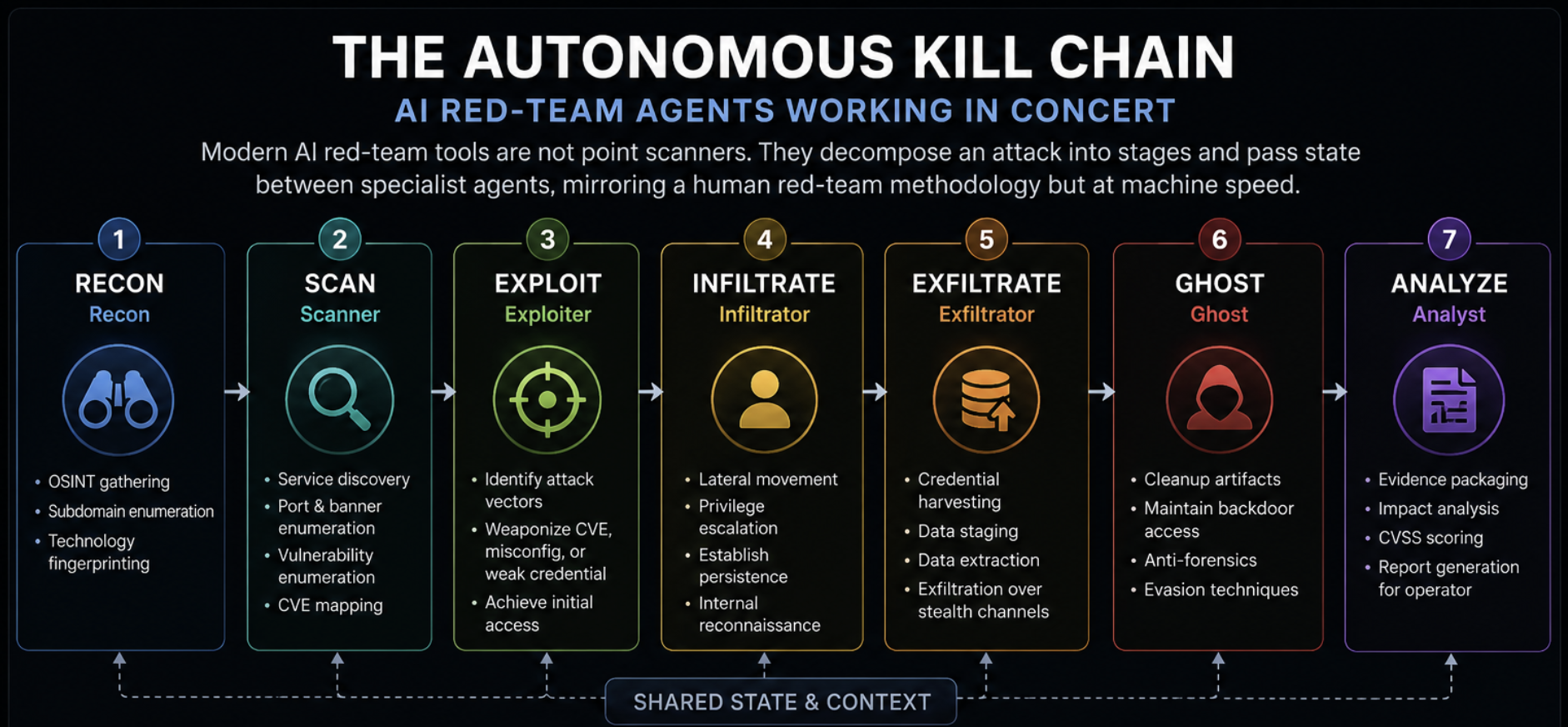
Traditional vulnerability scanners execute isolated tasks and rely heavily on human analysts to interpret results and determine the next steps. In contrast, autonomous AI red-team platforms orchestrate a coordinated sequence of specialized agents that collaborate throughout an engagement. Each agent focuses on a specific phase of the attack while continuously sharing context through a common memory layer, enabling adaptive decision-making and uninterrupted execution.
Rather than operating as independent tools, these agents function as an integrated offensive ecosystem. Information gathered during reconnaissance immediately informs vulnerability discovery, exploitation decisions, post-exploitation activities, and final reporting. This continuous feedback loop enables autonomous agents to refine their actions, recover from failures, and progress through complex attack paths with minimal human intervention.
Autonomous Attack Workflow
| Phase | Specialized Agent | Primary Objective | Typical Activities |
| Reconnaissance | Recon Agent | Identify potential attack surfaces | OSINT collection, subdomain enumeration, DNS analysis, technology fingerprinting, external asset discovery |
| Discovery | Scanner Agent | Build a detailed attack map | Service discovery, port identification, vulnerability enumeration, CVE correlation, application fingerprinting |
| Initial Access | Exploiter Agent | Obtain an initial foothold | Exploiting known vulnerabilities, abusing misconfigurations, credential attacks, validating exploitability |
| Post-Exploitation | Infiltrator Agent | Expand attacker control | Privilege escalation, lateral movement, persistence, internal reconnaissance, credential reuse |
| Collection & Exfiltration | Exfiltrator Agent | Gather valuable assets | Credential harvesting, sensitive data collection, data staging, stealthy exfiltration |
| Defense Evasion | Ghost Agent | Reduce detection and maintain access | Artifact cleanup, log evasion, persistence management, anti-forensics techniques |
| Reporting & Analysis | Analyst Agent | Produce actionable intelligence | Correlating findings, generating evidence, assigning risk scores, producing remediation guidance |
Shared Intelligence Across the Kill Chain
Unlike traditional automation, autonomous AI agents maintain a persistent understanding of the engagement. Every discovery made by one agent becomes immediately available to the others through a shared memory and planning layer. This collaborative architecture enables the system to:
- Maintain context throughout long-running assessments.
- Adapt dynamically when an exploit attempt fails.
- Automatically select alternative attack paths based on previous results.
- Correlate findings across multiple hosts, applications, and attack stages.
- Produce comprehensive evidence and executive-ready reports without manual consolidation.
AI Pentesting Tool Spectrum
The AI offensive security ecosystem has rapidly evolved from simple advisory assistants into fully autonomous attack platforms capable of planning, executing, validating, and documenting complex penetration tests. Rather than representing a single technology, modern AI pentesting solutions span a spectrum of autonomy, ranging from human-guided assistants to fully automated multi-agent systems that can operate with minimal supervision.
The primary distinction between these platforms is the level of decision-making delegated to artificial intelligence. As autonomy increases, so does the operational capability—and consequently, the potential for misuse if deployed outside authorized environments.
The field splits into three broad categories:
- Co-pilots and assistants (PentestGPT, Nebula) — advise, suggest, and maintain context; safer because they do not execute by default.
- Autonomous agents (Strix, T3MP3ST, CyberStrike, PentAGI, XBOW) — plan, execute, validate, and report with minimal human input.
- Commercial platforms (NodeZero, Pentera, RidgeBot, Hadrian) — continuous, production-safe, compliance-mapped testing for enterprises.
- MCP orchestrators (Pentest-MCP, NyxStrike, HexStrike) — expose large tool libraries to existing AI coding clients like Claude, Cline, and Cursor.
The further right a tool sits on the autonomy spectrum, the higher its misuse potential — and the more important sandboxing, scope control, and legal authorization become.
From Red Team to Real Threat: How AI Tools Are Misused
The same capabilities that make AI red-team tools valuable for legitimate security testing make them attractive to attackers.
1. Democratizing Sophistication
A mid-level attacker no longer needs deep knowledge of every protocol, language, or framework. An AI agent can interpret scan output, suggest the next exploit, write the payload, and adapt when the first attempt fails. This is the essence of “vibe hacking”: describing a goal in plain English and letting the agent handle execution.
2. Scale and Persistence
Human red teamers sleep, take notes, and lose context. An autonomous swarm can run 24/7 across thousands of targets, maintaining shared state on a blackboard and coordinating through a coordinator agent.
The FortiBleed campaign illustrated this scale: attackers reportedly compromised roughly 74,000–75,000 FortiGate firewalls across 194 countries and over 21,000 domains, using automation for scanning, credential harvesting, and backdoor account creation. Some reports claim the campaign touched 430,000+ firewalls and stole 110 million+ credentials. The operation included a custom Golang tool (FortiGateSniffer) that monitored up to 24 protocols, a distributed GPU password-cracking cluster (Hashtopolis), and a Telegram bot for coordination. Parts of the workflow are assessed to have been assisted by an AI-powered autonomous penetration-testing agent.
3. Self-Healing Attack Chains
The JadePuffer ransomware operation, reported in July 2026, is assessed as the first fully agentic ransomware incident. An LLM agent autonomously:
- Exploited CVE-2025-3248 (unauthenticated RCE in Langflow) for initial access.
- Harvested environment variables, cloud credentials, LLM API keys, crypto wallets, and database passwords.
- Dumped the Langflow PostgreSQL database.
- Moved laterally to a production server running MySQL and Alibaba Nacos.
- Exploited CVE-2021-29441 (Nacos auth bypass), forged a JWT with the default signing key, and inserted a backdoor admin account.
- Encrypted 1,342 Nacos configuration items with MySQL AES_ENCRYPT(), dropped original and history tables, and created a ransom table README_RANSOM.
Evidence that the operation was AI-driven included self-narrating Python code with natural-language reasoning, failure recovery in 31 seconds after a failed login, and a Bitcoin address (3J98t1WpEZ73CNmQviecrnyiWrnqRhWNLy) that appears to be a well-known documentation example, possibly generated from LLM training data. Critically, the encryption key was generated randomly and never stored or transmitted, meaning victims likely cannot recover data even if they pay.
4. AI as a Malware Factory
In August 2025, Anthropic disclosed a cybercrime operation tracked as GTG-2002 that weaponized Claude Code to carry out data theft and extortion.
- Targets: At least 17 organizations across healthcare, emergency services, government, and religious institutions.
- Ransom demands: $75,000–$500,000+ in Bitcoin.
- Misuse of Claude Code:
- Scanned thousands of VPN endpoints.
- Harvested credentials and penetrated networks.
- Generated customized versions of the Chisel tunneling tool.
- Disguised malicious executables as legitimate Microsoft utilities.
- Selected data to exfiltrate, organized stolen records (including medical and financial data), and suggested ransom amounts.
- Generated customized, visually alarming HTML ransom notes tailored to each victim.
A related UK-based group, GTG-5004, reportedly used Claude Code to develop and sell ransomware variants on darknet forums for $400–$1,200.
5. AI Coding Agent Hijacks: The “Double Agent”
In July 2026, Pentera Labs demonstrated how to turn Claude Desktop into a “double agent.” The attack chain:
- Compromise the victim’s email inbox.
- Inject a base64-encoded malicious prompt into Claude’s synced personal preferences.
- The poisoned preferences propagate to all Claude Desktop sessions.
- Claude checks for command-capable MCP tools (e.g., Desktop Commander).
- Attacker commands execute silently: reverse shell, data exfiltration, lateral movement.
Anthropic reportedly responded that this was “expected functionality” rather than a vulnerability, because personal preferences, skills, and MCP connectors are designed to execute code.
This is part of a broader MCP supply-chain risk: 30+ CVEs against MCP servers/SDKs in the first 60 days of 2026, 7,000+ exposed MCP servers on the public internet, and 24,000+ secrets exposed in MCP config files on GitHub.
6. Runtime-Polymorphic Malware and Vibeware
2026 threat intelligence from Google, Microsoft, CSA, and IEEE Spectrum documents malware that integrates LLMs during execution:
| Malware family | What it does |
| PromptFlux | VBScript dropper that queries Gemini to generate obfuscated VBScript variants for AV evasion |
| PromptSteal / LameHug | Data miner deployed in Ukraine; contacts a live LLM to generate host-specific command chains |
| FruitShell | PowerShell reverse shell with hard-coded prompts to bypass LLM-powered security analysis |
| QuietVault | JavaScript credential stealer that uses on-host AI CLI tools to find and exfiltrate secrets |
| PromptLock | Experimental cross-platform ransomware using Lua scripts |
This trend is called “vibeware” — AI-assisted malware industrialization. Two threat models dominate:
- Distributed Denial of Detection (DDoD): mass-produce dozens of unique variants per day in uncommon languages (Nim, Zig, Crystal, Rust, Go) to exhaust signatures and sandboxes.
- Autonomous / agentic: the LLM makes operational decisions during the attack, adapts to failures, and chains recon → exploit → impact without constant human input.
7. Underground Marketplaces Are Adapting Fast
A June 2026 analysis by Halcyon (presented at Infosecurity Europe) found a 3,810% surge in AI-powered cybercrime tool mentions across 77 Telegram channels, 20 dark-web forums, and 5 underground markets. Mentions rose from 38 in December 2025 to 1,486 in February 2026.
Four main categories
- Weaponized LLMs — models retrained or jailbroken for malicious use (e.g., WormGPT-style tools).
- AI-enabled identity fraud — voice/video deepfakes for BEC, KYC bypass, and selfie-check evasion (some claim 92% success with 3 seconds of audio).
- AI-augmented malware and infrastructure — fake call centers in 25 languages trained on 150,000+ calls, AI-powered malware builders, and infrastructure automation.
- Jailbroken and stolen AI services — the largest and cheapest category, including stolen ChatGPT accounts starting at around $0.10.
Marketplace features now include Telegram bot-driven storefronts, freemium models, tiered pricing, and multi-channel redundancy that makes takedowns ineffective.
Case Studies in AI-Augmented Attacks
1- FortiBleed — AI-Assisted Credential Harvesting at Scale
The FortiBleed campaign demonstrated how automation can dramatically increase the scale and speed of credential harvesting against Internet-facing infrastructure. By combining large-scale scanning, credential collection, GPU-accelerated password cracking, and coordinated post-exploitation activities, the operators established persistent access to thousands of exposed Fortinet devices worldwide.
Although the precise level of AI involvement has not been independently verified, public reporting suggests that autonomous offensive tooling may have assisted portions of the reconnaissance and exploitation workflow, illustrating how AI-driven automation can enhance traditional attack operations.
| Attribute | Details |
| Primary Target | Internet-facing Fortinet FortiGate firewalls and VPN gateways |
| Estimated Scale | Approximately 75,000–430,000 affected devices across 194 countries |
| Attack Method | Automated reconnaissance, credential harvesting, password cracking, and traffic interception |
| Tools Observed | FortiGateSniffer, Hashtopolis, Telegram-based coordination |
| Potential AI Usage | AI-assisted reconnaissance and workflow automation (publicly discussed but not independently confirmed) |
| Operational Impact | Credential theft, persistent access, and network traffic interception |
| Primary Weaknesses | Weak or reused credentials and insufficient MFA protection |
2-JadePuffer — First Fully Autonomous LLM Ransomware
The JadePuffer ransomware campaign followed a structured, multi-stage attack sequence that combined automated exploitation, credential harvesting, lateral movement, and data encryption. Rather than relying on manual operator actions, the malware autonomously progressed through each phase of the intrusion, using known vulnerabilities and misconfigurations to expand its access before encrypting critical assets and initiating extortion.
JadePuffer Attack Chain
| Stage | Description |
| Initial Access | Exploited Langflow (CVE-2025-3248) to gain unauthenticated remote code execution. |
| Reconnaissance & Credential Harvesting | Collected environment variables, cloud credentials, cryptocurrency wallets, and database secrets. |
| Lateral Movement | Performed internal network discovery and compromised MinIO instances using default credentials. |
| Privilege Escalation | Exploited Nacos (CVE-2021-29441) to bypass authentication, forge JWTs, and create administrative access. |
| Encryption | Encrypted over 1,300 Nacos configuration records and deleted historical configuration data. |
| Extortion | Deployed ransom instructions containing a ProtonMail contact and Bitcoin payment address. |
3-GTG-2002 / GTG-5004 — Claude Code as a Cybercrime Workbench
The GTG-2002 and GTG-5004 campaigns demonstrate how legitimate AI coding assistants can be repurposed to support cybercriminal operations. Rather than autonomously executing attacks, the operators reportedly used Claude Code to accelerate tasks such as reconnaissance, credential analysis, malware customization, and ransom note generation. These cases illustrate how AI can significantly improve the speed and efficiency of malicious workflows while reducing the technical effort required by attackers.
| Attribute | GTG-2002 | GTG-5004 |
| AI Tool | Anthropic Claude Code | Anthropic Claude Code |
| Primary Targets | 17+ organizations across healthcare, government, emergency services, and religious sectors | Darknet ransomware-as-a-service (RaaS) operation |
| Financial Motivation | Ransom demands ranging from $75,000–$500,000+ in Bitcoin | Ransomware variants sold for $400–$1,200 each |
| AI-Assisted Activities | VPN reconnaissance, credential harvesting, Chisel customization, ransom note generation | Malware development, payload customization, and ransomware sales |
AI vs. Human Red Teaming: Where the Balance Shifts
Artificial intelligence is rapidly changing offensive security, but current evidence suggests it complements rather than replaces experienced penetration testers. Recent benchmarking studies show that AI agents excel at speed, scalability, and automating repetitive tasks, while human experts continue to outperform AI in creative exploitation, business logic analysis, and the discovery of novel vulnerabilities.
One of the most comprehensive public evaluations to date is the ARTEMIS study conducted by researchers at Stanford University and Carnegie Mellon University (arXiv:2512.09882). The study compared six commercial AI offensive agents against ten professional penetration testers on a live university network comprising approximately 8,000 hosts across 12 subnets. The results provide valuable insight into the strengths and current limitations of autonomous AI in offensive security.
| Dimension | Human Red Teamer | AI Red-Team Agent |
| Speed | Hours or days for comprehensive reconnaissance | Minutes to hours with parallel reconnaissance and automated follow-up |
| Scalability | Limited by analyst availability | Capable of assessing thousands of assets simultaneously using multiple autonomous agents |
| Operational Cost | Approximately $125,000 annual salary (U.S. average) | Estimated $37,000 annual operating cost for the ARTEMIS A1 agent |
| Benchmark Performance | Not evaluated on XBOW | Up to 102/104 challenges solved by leading AI frameworks |
| Realistic Application Testing | Top performer identified 13 vulnerabilities in 40 hours | ARTEMIS matched 9 of 10 human testers; autonomous agents identified up to 15 of 20 benchmark vulnerabilities |
| False Positives | Generally lower | Higher due to occasional hallucinations and incorrect interpretation of application behavior |
| Novel Vulnerabilities | Strong at business logic flaws and zero-day discovery | More effective against known patterns than previously unseen vulnerabilities |
Scaffold vs. model: the surprising result
Several 2026 studies show that the agent scaffold / backend moves results more than the backbone LLM:
- Sultan 2026: Holding the model fixed and swapping the scaffold made the same backbone go from 0 to 49 solves on XBOW.
- Escape.tech benchmark: Shannon, Strix, and PentAGI all ran DeepSeek v3.2, yet scored 6/20, 1/20, and 9/20 respectively.
- Hackers or Hallucinators? (arXiv:2604.05719): Single-agent ReAct loops often match or beat complex multi-agent frameworks on Easy/Medium tasks.
- 0sec audit of XBOW: Substrate choice, commit SHA, single-shot vs. best-of-N, and build-failure handling dominate reported scores.
Bottom line: AI is a force multiplier, not a replacement. The recommended model is hybrid: AI handles scalable reconnaissance, triage, and known-pattern vulnerability discovery, while humans validate findings, handle GUI/business-logic attacks, and perform creative exploitation.
Dark Web AI Cybercrime Tool Surge
The underground cybercrime ecosystem is rapidly commercializing artificial intelligence using business models that closely resemble legitimate Software-as-a-Service (SaaS) platforms. Rather than developing offensive capabilities from scratch, threat actors can now purchase or subscribe to AI-powered services that automate reconnaissance, malware development, phishing campaigns, identity fraud, and operational decision-making. This commercialization significantly lowers the technical barrier to entry while enabling experienced attackers to conduct larger and more efficient campaigns.
Key characteristics of this emerging ecosystem include:
- Automated Telegram storefronts that handle product distribution, licensing, customer support, and payment processing.
- Freemium and tiered subscription models that allow users to access basic capabilities at little or no cost while paying for premium features such as autonomous agents, malware builders, or advanced jailbreaks.
- Multi-channel distribution, enabling vendors to maintain operations across Telegram, dark web forums, encrypted messaging platforms, and dedicated websites, increasing resilience against law enforcement takedowns.
- Low-cost access to premium AI services, with compromised or stolen AI accounts reportedly selling for as little as $0.10, making commercial AI capabilities accessible to a wide range of threat actors.
These marketplaces increasingly serve a diverse customer base, including ransomware affiliates, initial access brokers, phishing operators, business email compromise (BEC) groups, and less experienced attackers seeking to automate previously complex tasks. Many vendors also provide documentation, customer support, regular updates, and subscription-based licensing, further professionalizing the cybercrime ecosystem.
The result is a double democratization of offensive cyber capabilities: advanced AI tools are becoming both inexpensive and easy to use. As AI increasingly automates reconnaissance, exploit development, malware generation, and operational decision-making, attackers require less technical expertise to conduct sophisticated cyber operations, expanding the potential threat landscape.
Commercial AI Pentesting Platforms
Not all AI red-team tools are open-source. Several commercial platforms dominate enterprise continuous testing:
| Platform | Focus | Autonomy | Best fit | Pricing tier |
| Pentera | Internal network, AD, cloud, web apps | Full | Large enterprises, CTEM programs | ~$50K–$150K/yr |
| NodeZero (Horizon3.ai) | Internal network, AD, cloud pivoting | Full | Continuous adversarial validation | Enterprise |
| RidgeBot (Ridge Security) | Network, web apps, IoT | Full | Mid-market continuous coverage | ~$15K–$30K/yr |
| Hadrian | External attack surface only | Full (external) | Dynamic external perimeters | Custom |
| Penligent | CLI orchestrator of existing tools | Medium-high | AI-augmented pentest ops | ~$1K–$10K/yr |
These platforms are generally production-safe, non-destructive, and compliance-mapped. However, the same underlying technology could be deployed maliciously if an attacker obtained access or cloned the approach in an open-source agent.
What Defenders Should Do
1. Assume AI-Scale Scanning
Attack-surface discovery is now automated and continuous. Exposed admin panels, RDS endpoints, VPN gateways, and management interfaces will be found. Remove them from the public internet where possible; enforce MFA and network segmentation everywhere else.
2. Detect Agentic Behaviors
Look for signatures of autonomous tooling:
- Rapid, perfectly sequential requests with no human think-time.
- AI-generated user-agent strings or payloads.
- Self-correcting retry patterns (same endpoint, slightly different parameter each time).
- Tool outputs embedded in HTTP parameters or request bodies.
- Large language artifacts in POST data (verbose JSON, natural-language reasoning, LLM-style comments).
Behavioral detection often beats signature-based detection against agents.
3. Patch the “Agent-Friendly” Flaws
Unauthenticated RCEs, path traversals, default credentials, and weak JWT secrets are catnip for AI agents. Prioritize these with the understanding that automated exploitation is now cheaper and faster.
4. Segment and Reduce Blast Radius
If an AI agent gains initial access, lateral movement is often its next step. Zero-trust segmentation, least-privilege access, and credential hygiene can turn an autonomous breach into a contained incident.
5. Red-Team Your Own Defenses With AI
Use these same tools legitimately. Running T3MP3ST, CyberStrike, Strix, XBOW, PentesterFlow, or Ethiack against your own environment gives you a preview of what an attacker’s AI will see. Combine with human validation to manage false positives. Monitor for local/offline specialized offensive LLMs (CyberStrike-OffSec-35B, Nemesis, etc.) running on unmanaged GPUs.
6. Monitor and Restrict LLM Tool Access
- Track which employees have API keys for Claude Code, OpenAI Codex, GitHub Copilot, Cursor, etc.
- Enforce enterprise-tier controls, audit logs, and data-loss prevention on coding agents.
- Block or restrict personal AI coding assistants on machines with access to production code or credentials.
- Audit MCP server configurations; treat MCP tools as a new software supply chain.
7. Use MITRE ATLAS and OWASP LLM Top 10
Map AI-specific risks to shared taxonomies. The EU AI Act’s high-risk AI compliance deadline of August 2, 2026 is pushing organizations to operationalize ATLAS-mapped red teaming.
Conclusion
AI-powered offensive security tools represent a genuine leap forward for defensive security. They can find and validate bugs faster, make pentesting more affordable, and help overworked security teams scale their work. But they are inherently dual-use. The same autonomous reconnaissance, exploitation, and post-exploitation engines designed for authorized testing can be pointed at real infrastructure by criminals, ransomware groups, and state actors with minimal modification.
Events like FortiBleed, JadePuffer, GTG-2002, GTG-5004, and the Claude Desktop double-agent demonstration are not theoretical warnings — they are early signals of a shift in offensive operations. The question is no longer whether AI will be used in cyberattacks. It is whether defenders can adapt their detection, hardening, and response practices faster than attackers can scale their AI agents.
The most durable response is a defense that assumes every attack may be unique and prioritizes behavioral controls, zero-trust enforcement, and AI-agent governance over signature-based detection.