
Surveil, Project, Divide: China’s “Guerrilla” Strategy and the Cyber Battle for the Pacific
Cyber Threat Intelligence
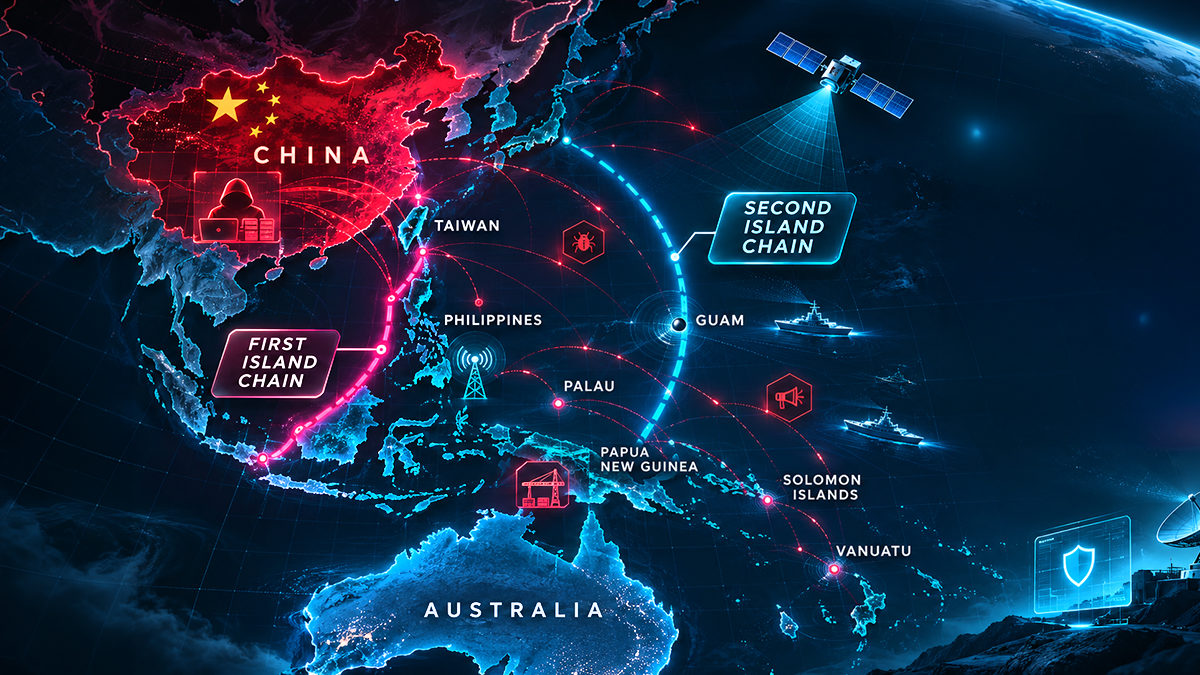
In November 2026, a joint report by the Institute for the Study of War (ISW) and the American Enterprise Institute (AEI) pulled back the curtain on a sweeping strategic doctrine shaping Beijing’s behavior across Oceania. Titled Surveil, Project, Divide: China’s “Guerrilla” Framework to Reshape the Pacific, the analysis details how the People’s Republic of China (PRC) is adapting classical Maoist guerrilla warfare principles into a modern, multi-domain maritime and political campaign across the Pacific Islands.
Rather than challenging U.S. naval supremacy head-on in open ocean—where the People's Liberation Army Navy (PLAN) still faces operational constraints beyond the First and Second Island Chains—Beijing is working to shape the Pacific battlefield ahead of any potential conflict, particularly a contingency over Taiwan. By fusing military posture with economic statecraft, covert influence, and digital infrastructure leverage, China is building an asymmetric foothold across the Pacific's critical sea lines of communication (SLOCs).
The Anatomy of a Maritime “Guerrilla” Campaign
Historically, Maoist guerrilla doctrine relied on avoiding decisive conventional engagements while blending military, civilian, and economic efforts to infiltrate an adversary's rear areas, establish "base areas," and gradually degrade an opponent's strength. According to the ISW-AEI report, the PLA has modernized this concept for the maritime domain.
The strategy operates across three primary vectors:
- Surveil: Leveraging dual-use maritime research vessels, space tracking stations, and telecommunications infrastructure to map ocean floors, monitor Allied naval movements, and gather signals intelligence across Oceania.
- Project: Expanding the PLAN's operational reach and logistical sustainment through commercial port investments, fishing fleets, and policing agreements—creating a network of friendly nodes between Hawaii and Asia without requiring formal, overt military bases.
- Divide: Exploiting receding Western diplomatic attention and local economic vulnerabilities to fracture regional unity, erode diplomatic recognition of Taiwan, and weaken the security partnerships that underpin U.S. access in the Pacific.[2]
Cyber Operations and the Digital Front: An Assessment by Resecurity
While the ISW-AEI framework highlights the physical, economic, and geopolitical dimensions of Beijing’s Pacific push, cyber threat intelligence reveals how the digital domain serves as the connective tissue for "surveilling" and "dividing" the region.
In cyber threat assessments examining PRC-aligned operations across the Indo-Pacific, Resecurity has documented how state-sponsored advanced persistent threats (APTs), hacktivist proxies, and criminal networks operate in tandem to advance Beijing's strategic objectives.
1. Pre-Staging and Infrastructure Exploitation
Resecurity’s threat intelligence notes that Chinese cyber actors routinely target regional telecommunications providers, government ministries, and critical infrastructure across the Pacific and Southeast Asia. By compromising local telecom networks and exploiting public-facing enterprise vulnerabilities, state-linked actors establish covert, long-term persistence. These compromised regional networks serve a dual purpose: they enable continuous espionage on diplomatic and defense communications, and they act as operational relay boxes—obscuring the origin of cyberattacks launched against higher-tier Western targets in Guam, Hawaii, and the continental United States.
2. Blurring State Espionage and Hacktivist Proxies
Consistent with the guerrilla doctrine's blurring of regular and irregular forces, Resecurity analysts have highlighted Beijing's reliance on an ecosystem of hacktivist collectives, state-aligned APTs (such as Mustang Panda), and "false flag" infrastructure. Ahead of or alongside overt geopolitical friction, these groups conduct distributed denial-of-service (DDoS) attacks, website defacements, and data leaks targeting regional governments. Resecurity assesses such campaigns as "pre-staging" activities designed to test defensive readiness, sow public distrust in local governance, and mask deeper, quieter cyber-espionage intrusions.
3. Information Operations and the Grey-Zone Convergence
In the "Divide" pillar of the guerrilla framework, cyber intrusions are directly synchronized with cognitive warfare. Resecurity has tracked how stolen data—and fabricated breach claims distributed on dark web forums—are weaponized alongside AI-generated disinformation and synthetic media to inflame domestic political divisions and undermine public confidence in pro-Western governments. Furthermore, broader intelligence assessments across the Pacific Islands (such as in Palau) show an increasing convergence between PRC-linked transnational organized crime—operating cyber-scam compounds—and Beijing's broader security and influence apparatus.
First Island Chain: The Frontline Siege
The First Island Chain, including Japan, Taiwan and the Philippines, lies close to potential areas of military confrontation. Cyber operations against these countries can expose diplomatic coordination, undermine essential services and increase pressure during a crisis. This differs from the emphasis on reinforcement routes and access farther across the Pacific, although espionage and disruption can affect both chains.
- Critical Infrastructure Targeting: Taiwan’s National Security Bureau describes Chinese campaigns against energy, telecommunications, government and other critical sectors. Its assessment identifies vulnerability exploitation, social engineering and supply-chain compromise, including efforts to maintain access to telecommunications systems and their contractors.
- Continuous Tactical Espionage: Unit 42 identified Stately Taurus, also known as Mustang Panda, malware packages assessed to target entities in the Philippines, Japan and other Asian countries around the March 2024 ASEAN-Australia Special Summit. The activity illustrates the intelligence value of diplomatic events and regional coordination.
- Disruption and Political Pressure: Taiwan’s intelligence assessment also describes DDoS attacks intended to interrupt services and increases in cyber activity around military patrols and political events. Such activity can strain civilian resilience alongside conventional military pressure.
One of the notable espionage campaigns targeting Taiwan and focused on the nuclear energy sector has been identified by Resecurity threat intelligence team. The actors compromised an Office 365 account associated with Taiwan’s Institute of Nuclear Energy Research (INER) - https://iner.gov.tw, to acquire sensitive communications. According to Taiwan's National Security Bureau (NSB), China's cyber operations against Taiwan averaged over 2.63 million intrusion attempts per day.

Similar targets based in Thailand, Vietnam, Brunei, and Malaysia have been probed by the same actors. The information about this campaign has been shared with authorities in Taiwan as well as domestic law enforcement partners. Based on Resecurity’s assessment, China-linked threat actors will continue to conduct cyber espionage and network intrusions into critical infrastructure across Asia, especially in countries with nuclear capabilities.
Second Island Chain & Pacific Islands: The Rear-Area Guerrilla Campaign
Across the Second Island Chain and the wider Pacific, the strategic focus includes the infrastructure and partnerships supporting U.S. reinforcement and sustained operations. Guam and nearby island networks connect military logistics with civilian power, water, transport and communications services.
- Severing the Logistics “Gas Station”: The U.S.-China Economic and Security Review Commission highlights Guam’s fuel storage, distribution and military facilities as essential to operations during a regional conflict. Separately, CISA, NSA and FBI confirmed Volt Typhoon compromises of U.S. critical infrastructure, including Guam, and assessed that the group was maintaining access for possible disruption during a crisis.
- Covert Infrastructure and Relay Networks: The joint advisory documents Volt Typhoon’s use of compromised small-office and home-office routers and multi-hop proxies to conceal its activity. For regional defenders, this means a connection appearing to originate from a familiar network may still require investigation.
- Weaponized Leaks for Diplomatic Leverage: The Commission’s 2025 report records that Palau attributed a cyberattack to China after approximately 20,000 government documents were stolen and posted on the dark web shortly before a U.S. aid-agreement celebration. The timing illustrates the potential diplomatic impact of a leak during a sensitive bilateral engagement.
Strategic Implications for the Pacific
The convergence of China’s maritime guerrilla strategy and its asymmetric cyber operations presents a complex challenge for Pacific Island nations and their security partners:
| Domain | Guerrilla Objective | Operational Mechanism |
|---|---|---|
| Maritime & Logistics | Neutralize U.S. sea control along critical SLOCs without direct fleet-on-fleet combat. | Dual-use ports, oceanographic survey ships, maritime militia, and regional policing pacts. |
| Cyber & Telecom | Establish persistent intelligence collection and operational staging grounds. | Compromise of local telecom backbones, zero-day exploitation, and proxy relay networks. |
| Political & Cognitive | Fracture regional alliances and erode diplomatic ties with Taiwan and the U.S. | Elite capture, economic leverage, hacktivist leaks, and coordinated disinformation campaigns. |
For Pacific Island states—many of which possess limited domestic cybersecurity capacity and rely heavily on foreign investment for telecommunications and port development—the guerrilla framework exploits the gap between peacetime commercial engagement and wartime military posture.
Based on Resecurity’s assessment, countering it requires treating digital infrastructure, maritime governance, and cybersecurity capacity-building not as isolated technical issues but as frontline components of regional sovereignty and deterrence.
References
[1] ISW. SURVEIL, PROJECT, DIVIDE: - ISW
[2] Institute for the Study of War. Surveil, Project, Divide: China’s “Guerrilla” Framework to Reshape the Pacific
[3] Messaggero Marittimo. Cina, il Pacifico si conquista anche dalla banchina
[4] Dark Reading. Philippines Pummeled by Cyberattacks & Misinformation Tied to China
[5] Resecurity. SharePoint Zero-Day Exploit (ToolShell) - Network Infrastructure
[6] U.S.-China Economic and Security Review Commission. Protecting Americans from China-Linked Scam Centers
[7] Observer Research Foundation. China's cyber aggression and the South China Sea dispute
[8] U.S.-China Economic and Security Review Commission. Small Islands, Big Stakes: China’s Playbook in the Pacific Islands
[9] CISA, NSA, FBI and international partners. PRC State-Sponsored Actors Compromise and Maintain Persistent Access to U.S. Critical Infrastructure
[10] Palo Alto Networks Unit 42. ASEAN Entities in the Spotlight: Chinese APT Group Targeting
[11] Taiwan National Security Bureau. Analysis on China’s Cyber Threats to Taiwan’s Critical Infrastructure in 2025
